191 posters, 5 topics, 20 sessions, 393 authors, 116 institutions
ePostersLive by SciGen Technologies S.A. All rights reserved.
Obstetric Anaesthesia Annual Scientific Meeting 2023
18 - 19 May, 2023 | EICC Edinburgh

5798992
Accidental Dural Punctures (ADPs): Is Regularity of practice more important than experience?
Poster Presenter
Authors
Part of Topic
Service Evaluation
Introduction
•Epidural analgesia remains the gold standard method of pain relief in the parturient.
•Accidental dural puncture (ADP) with epidural analgesia has reported rates between 0.19% and 3.6% [1].
•ADP can result in a debilitating post-dural puncture headache (PDPH) and has significant implications for the mother in the post partum period.
•The latest Royal College Of Anaesthetists (RCOA) Quality Improvement Compendium recommended an ADP rate of less than 1% [2].
•We retrospectively analysed all neuraxial procedures carried out over a year to identify
1.Our ADP rate
2.Any Factors that were contributing to our ADP rate
Method
•Data from CareFlow Electronic Patient Record (Maidstone, UK) was obtained retrospectively from 1st April 2021 to 30th March 2022 for all neuraxial procedures performed for labour analgesia and operative delivery.
•Parturients in whom a headache was identified by an anaesthetist as a PDPH postnatally were included
•Data obtained from this sub-set of ADP patients included:
1. Grade of anaesthetist
2. Type of neuraxial procedure (Epidural, Combined Spinal/Epidural and Spinal)
3. Positioning of patient
4. Number of insertion attempts
5. Whether ADP was recognised at time of insertion
6.Onset time of headache
7. Treatment with Epidural Blood Patch
•The audit was registered with the trust audit department
Results
•Over the period of study 1450 neuraxial procedures were performed
•38 women were identified clinically on follow up to have a PDPH
•Of those:
•19 occurred after Epidural insertion
•9 from Combined Spinal Epidural (CSE)
•10 from Spinal anaesthesia.
•Cases where spinal anaesthesia was the sole technique were discounted from further analysis.
•28 cases out of 1450 neuraxial procedures were identified as developing a PDPH giving our unit an ADP rate of 1.9%
Additional Findings
• 18/28 (64%) had undergone multiple neuraxial procedures.
•ADP was identified at the time of insertion in 14/19 (74%) of cases.
• In 86% (12/14) of cases a spinal catheter was placed.
•The mean time for onset of headache was 26.1 hours.
•13/28 (46%) received an EBP.
Discussion
•Our ADP rate was higher than the nationally recommend ADP rate of 1%.
•This audit included patients where a PDPH was clinically identified post-procedure but where an ADP wasn’t always identified at time of insertion- equally patients who had a recognised ADP but didn’t develop a headache were not included- this makes it difficult to fully estimate a ”unit ADP rate”
•The majority of these ADPs occurred OOH where labour analgesia accounts for 30% of all anaesthetic workload at night. [3]
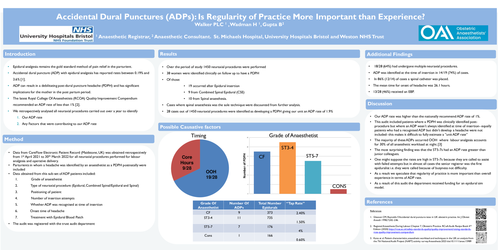
•The most surprising finding was that the ST5-7s had an ADP rate greater than junior colleagues.
•One might suppose the rates are high in ST5-7s because they are called to assist with failed attempts but in almost all cases the senior registrar was the first epiduralist i.e. they were called because of busyness not difficulty.
•As a result we speculate that regularity of practice is more important than overall experience in terms of ADP rate.
•As a result of this audit the department received funding for an epidural sim model.