191 posters, 5 topics, 20 sessions, 393 authors, 116 institutions
ePostersLive by SciGen Technologies S.A. All rights reserved.
Obstetric Anaesthesia Annual Scientific Meeting 2023
18 - 19 May, 2023 | EICC Edinburgh

5798298
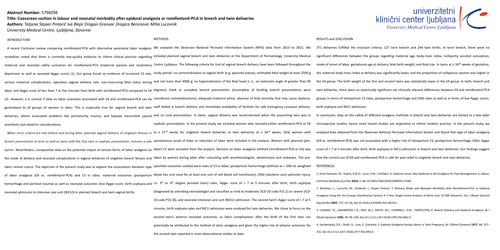
Cesarean section in labor and neonatal morbidity after epidural analgesia or remifentanil-PCA in breech and twin deliveries
Poster Presenter
Authors
Affiliations
Part of Topic
Service Evaluation
Abstract Number:
5798298
Title: Caesarean section in labour and neonatal morbidity after epidural analgesia or remifentanil PCA in breech and twin deliveries
Authors: Tatjana Stopar Pintarič Iva Blajic Dragan Graovac Dragica Becanovic Miha Lucovnik
University Medical Centre, Ljubljana, Slovenia
INTRODUCTION
A recent Cochrane review comparing remifentanil PCA with alternative parenteral labor analgesic
modalities noted that there is currently low quality evidence to inform clinical practice regarding
maternal and neonatal safety outcomes for remifentanil PCA (maternal apnoea and respiratory
depression as well as neonatal Apgar score 1 O ur group found no evidence of increased CS rate,
serious maternal complications, operative vaginal delivery rate, non reassuring fetal status during
labor, and Apgar score of less than 7 at five minutes from birth with remifentanil PCA compared to EA
2 However i t is unclear if data on labor outcomes associated with EA and remifentanil PCA can be
generalized to all groups of women in labor This is especially true for vaginal breech and twin
deliveries, where associated problems like prematurity, trauma, and hypoxia necessitate special
anesthetic and obstetric considerations.
When strict criteria are met before and during labor, planned vaginal delivery of singleton fetuses in
breech presentation at term as well as twins with the first twin in cephalic presentation, remains a safe
option Nevertheless, comparative data on the potential impact of various forms of labor analgesia on
the mode of delivery and neonatal complications in vaginal deliveries of singleton breech fetuses and
twins remain scarce T he objective of the present study was to explore the associations between type
of labor analgesia (EA vs remifentanil PCA) and CS in labor, maternal outcomes (postpartum
hemorrhage and perineal trauma) as well as neonatal outcomes (low Apgar score, birth asphyxia and
neonatal admission to intensive care unit ( in planned breech and twin vaginal births
METHODS
We analyzed the Slovenian National Perinatal Information System ( data from 2013 to 2021 We
included planned vaginal breech and twin deliveries at the Department of Perinatology, University Medical
Centre Ljubljana The following criteria for trial of vaginal breech delivery have been followed throughout the
study period n o contraindication to vaginal birth (e g placenta previa) estimated fetal weight at least 2500 g
and not more than 4000 g no hyperextension of the fetal head i e an extension angle of greater than 90
degrees) frank or complete breech presentation (incomplete of footling breech presentations were
considered contraindications) adequate maternal pelvis absence of fetal anomaly that may cause dystocia
staff skilled in breech delivery and immediate availability of facilities for safe emergency cesarean delivery
and no cord presentation In twins, vaginal delivery was recommended when the presenting twin was in
cephalic presentation In the present study, we included women who received either remifentanil PCA or EA
at 37 0 weeks for singleton breech deliveries or twin deliveries at 34 0 weeks Only women with
spontaneous onset of labor or induction of labor were included in the analysis Women with planned (pre
labor) CS were excluded from the analysis Decision on labor analgesia method (remifentanil PCA or EA) was
taken by women during labor after consulting with anesthesiologists, obstetricians and midwives The pre
specified outcomes studied were rates of CS in labor, postpartum hemorrhage (defined as 500 mL weighted
blood loss and need for at least one unit of red blood cell transfusion), OASI (obstetric anal sphincter injury,
i e 3 rd or 4 th degree perineal tears) rates, Apgar score of 7 at 5 minutes after birth, birth asphyxia
(diagnosed by attending neonatologist and classified as mild to moderate (ICD 10 code P 21 1 or severe (ICD
10 code P 21 0 and neonatal intensive care unit ( admission The second twin’s Apgar score of 7 at 5
minutes, birth asphyxia rates and NICU admission were analyzed for twin deliveries We chose to focus on the
second twin’s adverse neonatal outcomes, as labor complications after the birth of the first twin can
potentially be attributed to the method of labor analgesia and given the higher risk of adverse outcomes for
the second twin reported in most observational studies to date
RESULTS and DISCUSSION
371 deliveries fulfill ed the inclusion criteria 127 term breech and 244 twin births In term breech t here were no
significant differences between the groups regarding maternal age, body mass index, nulliparity, assisted conception,
mode of onset of labor, gestational age at delivery, fetal birth weight, and fetal size In twins at 34 0 weeks of gestation
t he maternal body mass index at delivery was significantly lower, and the proportion of nulliparous women was higher in
the EA group The birth weight of the first and second twins was statistically lower in the EA group In both breech and
twin deliveries t here were no statistically significant nor clinically relevant differences between EA and remifentanil PCA
groups in terms of intrapartum CS rates, postpartum hemorrhage and OASI rates as well as in terms of low Apgar scores,
birth asphyxia and NICU admission
In conclusion d ata on the safety of different analgesic methods in breech and twin deliveries are limited to a few older
retrospective studies hence more recent studies are imperative to inform modern practice In the present study, we
analyzed data obtained from the Slovenian National Perinatal Information System and found that type of labor analgesia
(EA vs remifentanil PCA) was not associated with a higher risk of intrapartum CS, postpartum hemorrhage, OASI, Apgar
score of 7 at 5 minutes after birth, birth asphyxia or NICU admission in breech and twin deliveries Our findings suggest
that the current use of EA and remifentanil PCA is safe for pain relief in singleton breech and twin deliveries
REFERENCES
1
Anim Somuah, M Smyth, R M D Cyna A M Cuthbert, A Epidural versus Non Epidural or No Analgesia for Pain Management in Labour
Cochrane Database Syst Rev 2018 5 doi 10 1002 14651858 CD 000331 PUB 4
2
Markova, L Lucovnik M Verdenik I Stopar Pintarič, T Delivery Mode and Neonatal Morbidity after Remifentanil PCA or Epidural
Analgesia Using the Ten Groups Classification System A 5 Year Single Centre Analysis of More than 10 000 Deliveries Eur J Obstet Gynecol
Reprod Biol 2022 277 53 56 doi 10 1016 /J EJOGRB 2022 08 011
3
CHADHA, Y C MAHMOOD, T A DICK, M J SMITH, N C CAMPBELL, D M TEMPLETON, A Breech Delivery and Epidural Analgesia Br J
Obstet Gynaecol 1992 99 96 100 doi 10 1111 /J 1471 0528 1992 TB 14462 X
4
Jaschevatzky O E Shalit, A Levy, Y Günstein S Epidural Analgesia during Labour in Twin Pregnancy Br J Obstet Gynaecol 1977 84 327
331 doi 10 1111 /J 1471 0528 1977 TB 12592 X