191 posters, 5 topics, 20 sessions, 393 authors, 116 institutions
ePostersLive by SciGen Technologies S.A. All rights reserved.
Obstetric Anaesthesia Annual Scientific Meeting 2023
18 - 19 May, 2023 | EICC Edinburgh

5796894
OAA Survey 1040: Anaesthetic management of artificial rupture of membranes in theatre
Poster Presenter
Authors
Affiliations
Part of Topic
Surveys
Anaesthetic management of artificial rupture of membranes in theatre
Introduction
Artificial rupture of membranes (ARM) is a common practice on labour ward to induce or augment labour. In some instances, these are performed in a controlled setting in theatre when the procedure is deemed high risk of complications, such as cord prolapse. This is an emergency which frequently necessitates immediate birth to prevent prolonged fetal hypoxaemia. There is no literature on the incidence and anaesthetic management of ARM in theatre and thus, no best practice guidance. In this survey, we aim to look at individual practices for the anaesthetic management of ARMs in theatre in the UK, with an attempt to standardise care and inform future directions of research.
Method
We sent out an OAA approved survey (Survey number 1040) to all member anaesthetists. The questionnaire aimed to establish the frequency with which ARMs are performed in the operating theatre and what anaesthetic involvement is provided. We collected data on preferred or established techniques and drugs used for this clinical situation.
Results
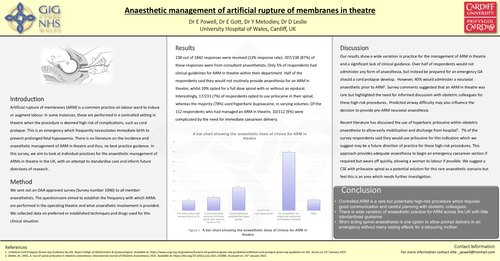
238 out of 1842 responses were received (13% response rate). 207/238 (87%) of these responses were from consultant anaesthetists. Only 5% of respondents had clinical guidelines for ARM in theatre within their department. Half of the respondents said they would not routinely provide anaesthesia for an ARM in theatre, whilst 20% opted for a full dose spinal with or without an epidural. Interestingly, 17/231 (7%) of respondents opted to use prilocaine in their spinal, whereas the majority (78%) used hyperbaric bupivacaine, in varying volumes. Of the 112 respondents who had managed an ARM in theatre, 10/112 (9%) were complicated by the need for immediate caesarean delivery.
Discussion
Our results show a wide variation in practice for the management of ARM in theatre and a significant lack of clinical guidance. Over half of respondents would not administer any form of anaesthesia, but instead be prepared for an emergency GA should a cord prolapse develop. However, 40% would administer a neuraxial anaesthetic prior to ARM1. Survey comments suggested that an ARM in theatre was rare but highlighted the need for informed discussion with obstetric colleagues for these high-risk procedures. Predicted airway difficulty may also influence the decision to provide pre-ARM neuraxial anaesthesia.
Recent literature has discussed the use of hyperbaric prilocaine within obstetric anaesthesia to allow early mobilisation and discharge from hospital2. 7% of the survey respondents said they would use prilocaine for this indication which we suggest may be a future direction of practice for these high-risk procedures. This approach provides adequate anaesthesia to begin an emergency caesarean section if required but wears off quickly, allowing a woman to labour if possible. We suggest a CSE with prilocaine spinal as a potential solution for this rare anaesthetic scenario but feel this is an area which needs further investigation.
Conclusion