191 posters, 5 topics, 20 sessions, 393 authors, 116 institutions
ePostersLive by SciGen Technologies S.A. All rights reserved.
Obstetric Anaesthesia Annual Scientific Meeting 2023
18 - 19 May, 2023 | EICC Edinburgh

5794213
Postnatal venous thromboembolism prophylaxis - a survey
Poster Presenter
Authors
Affiliations
Part of Topic
Surveys
Introduction
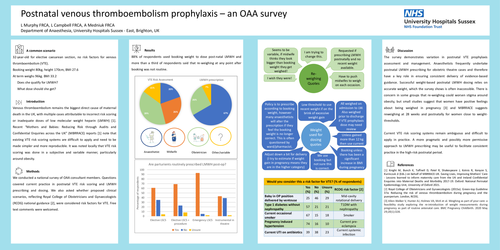
Venous thromboembolism remains the biggest direct cause of maternal death in the UK, with multiple cases attributable to incorrect risk scoring or inadequate doses of low molecular weight heparin (LMWH) [1]. Recent “Mothers and Babies: Reducing Risk through Audits and Confidential Enquiries across the UK” (MBRRACE) reports [1] note that existing VTE risk scoring systems are difficult to apply and need to be made simpler and more reproducible. It was noted locally that VTE risk scoring was done in a subjective and variable manner, particularly around obesity.
Methods
We conducted a national survey of OAA consultant members. Questions covered current practice in postnatal VTE risk scoring and LMWH prescribing and dosing. We also asked whether proposed clinical scenarios, reflecting Royal College of Obstetricians and Gynaecologists (RCOG) national guidance [2], were considered risk factors for VTE. Free text comments were welcomed.
Discussion
The survey demonstrates variation in postnatal VTE prophylaxis assessment and management. Anaesthetists frequently undertake postnatal LMWH prescribing for obstetric theatre cases and therefore have a key role in ensuring consistent delivery of evidence-based guidance. Successful weight-based postnatal LMWH dosing relies on accurate weight, which the survey shows is often inaccessible. There is concern in some groups that re-weighing could worsen stigma around obesity, but small studies suggest that women have positive feelings about being weighed in pregnancy [3] and MBRRACE suggests reweighing at 28 weeks and postnatally for women close to weight-thresholds. Current VTE risk scoring systems remain ambiguous and difficult to apply in practice. A more pragmatic and possibly more permissive approach to LMWH prescribing may be useful to facilitate consistent practice in the high-risk postnatal period.