191 posters, 5 topics, 20 sessions, 393 authors, 116 institutions
ePostersLive by SciGen Technologies S.A. All rights reserved.
Obstetric Anaesthesia Annual Scientific Meeting 2023
18 - 19 May, 2023 | EICC Edinburgh

5792526
Starvation before caesarean delivery -- do we meet the standards?
Poster Presenter
Authors
Part of Topic
Service Evaluation
Starvation before caesarean delivery -
do we meet the standards?
RADWAN, AHMAD ; JOHN, ANCY ; BAJPAY, YASH ; MALACHY, COLUMB ; BHATIA, KAILASH
ST MARY'S HOSPITAL, MANCHESTER ;
WYTHENSHAWE HOSPITAL, MANCHESTER ;
1. Introduction
Most enhanced recovery (ERAS) guidelines for caesarean delivery (CD) recommend fasting of 2vhours for clear fluids and 6-hours for solids prior to a neuraxial or a general anaesthetic for CD.[1]
2. Methodology
We prospectively reviewed starvation times for 75 patients undergoing elective [category(cat)-4] or scheduled (cat-3) CD from June to November 2022 to assess the number of patients who met the recommended trust standards for starvation.
Side effects experienced by these patients prior to the CD were also recorded.
Starvation times for those having CD in the morning (am) were compared to those having the CD in the afternoon (pm).
Results are presented as median [interquartiles], count (%) and median difference (95% confidence interval).
Mann-Whitney U-statistics were used for statistical analysis with P<0.05 (two sided) as significant.
3. Results
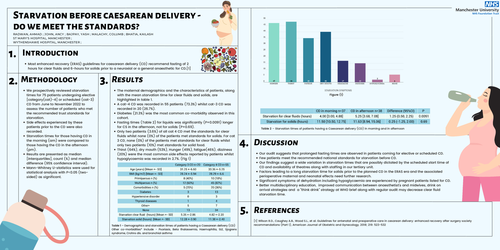
The maternal demographics and the characteristics of patients, along with the mean starvation time for clear fluids and solids, are highlighted in table 1.
A cat-4 CD was recorded in 55 patients (73.3%) whilst cat-3 CD was recorded in 20 (26.7%).
Diabetes (21.3%) was the most common co-morbidity observed in this cohort.
Fasting times (Table 2) for liquids was significantly (P=0.0091) longer for CS in the afternoon, not for solids (P=0.69).
Only two patients (3.6%) of all cat 4 CD met the standards for clear fluids whilst none (0%) of the patients met standards for solids. For cat 3 CD, none (0%) of the patients met standards for clear fluids whilst only two patients (10%) met standards for solid food.
Thirst (64%), dry mouth (53%), Hunger (49%), fatigue(46%), dizziness (20%) were the most common side effects reported by patients whilst hypoglycaemia was recorded in 2.7%. (Fig 1)
4. References
[1] Wilson R.D., Caughey A.B., Wood S.L., et al. Guidelines for antenatal and preoperative care in cesarean delivery: enhanced recovery after surgery society recommendations (Part 1), American Journal of Obstetric and Gynecology. 2018; 219: 523-532