191 posters, 5 topics, 20 sessions, 393 authors, 116 institutions
ePostersLive by SciGen Technologies S.A. All rights reserved.
Obstetric Anaesthesia Annual Scientific Meeting 2023
18 - 19 May, 2023 | EICC Edinburgh

5790969
Anaesthetic pre-assessment of obese patients in obstetrics: challenges in COVID recovery
Poster Presenter
Part of Topic
Service Evaluation
Anaesthetic pre-assessment of obese patients in obstetrics: challenges in COVID recovery
P Vila, R Kumar
Princess Royal University Hospital
King’s College Hospital NHS FoundationTrust
Introduction
One in five pregnant women in the UK is obese. Obesity is associated with increased risk of both maternal and foetal adverse outcomes. RCOG guidelines(1) recommend that all women with a booking BMI over 40 kg/m2 should be reviewed antenatally by a senior obstetric anaesthetist to guide risk assessment,medical optimisation and shared decision-making. The 2021 MMBRACE report (2) recommends that all women should be reweighed in the third trimester for accurate VTE risk scoring and prophylactic LMWH dosing. In our institution, reconfiguration of hospital areas as part of the COVID-19 response led to loss of designated clinic space for our obstetric anaesthetic clinic. As a result our practice since has been to initially offer a telephone consultation followed by a face-to-face review if needed. Finding space for the latter has often been a significant logistical challenge.Our project sought to assess whether our practice continued to meet national standards in the wake of these changes.
Methods
Following audit approval, we retrospectively reviewed all women with a BMI over 40 kg/m2 undergoing caesarean section (CS) over a six month period (1/4/22 to 31/9/22).
Results
-
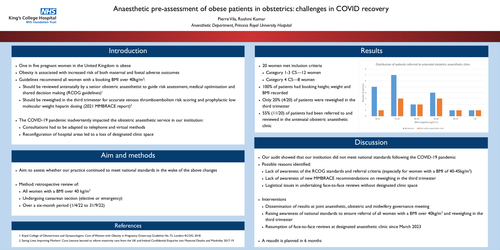
20 women met inclusion criteria
-
Category 1-3 CS - 12 women
-
Category 4 CS - 8 women
-
100% of patients had booking height, weight and BMI recorded
-
20% (4/20) of patients were reweighed in the 3rd trimester
-
Only 55% (11/20) of patients had been referred to and reviewed in the antenatal obstetric anaesthetic clinic
-
Of the 11 patients referred, 6 were referred later than 30 weeks
-
Of the 9 patients not referred, 8 had a BMI between 40 and 45 kg/m2
-
By contrast, 87% (6/7) of patients with BMI over 45 kg/m2 were referred and seen
Discussion
Our audit showed that we are not meeting national standards.Possible reasons identified were lack of awareness of the RCOG standards and referral criteria (especially for women with a BMI of 40 to 45 kg/m2) and logistical issues in undertaking face-to-face reviews without designated clinic space. Presentation of our results at the joint anaesthetic,obstetric and midwifery governance meeting has helped identify space in the antenatal clinic for face-to-face reviews, to start from March 2023 and to raise awareness of the national standards to ensure referral of all women with a BMI over 40 kg/m2. A reaudit is planned in 6 months.