191 posters, 5 topics, 20 sessions, 393 authors, 116 institutions
ePostersLive by SciGen Technologies S.A. All rights reserved.
Obstetric Anaesthesia Annual Scientific Meeting 2023
18 - 19 May, 2023 | EICC Edinburgh

5790926
An evaluation of the reasons for unsuccessful top-up of labour epidural analgesia for caesarean section
Poster Presenter
Authors
Affiliations
Part of Topic
Service Evaluation
An evaluation of the reasons for unsuccessful top-up of labour epidural analgesia for caesarean section
James Parry, Tooba Nawaz, Nuala Lucas, Abigail Richardson
London North West University Hospital NHS Trust
Introduction
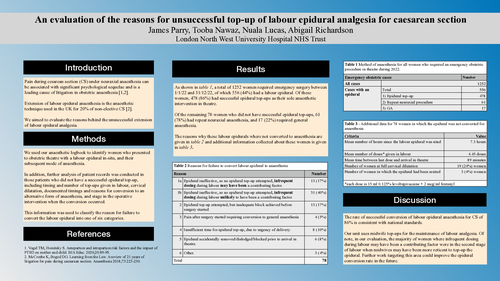
Pain during cesarean section (CS) under neuraxial anaesthesia can be associated with significant psychological sequelae and is a leading cause of litigation in obstetric anaesthesia [1,2]. Extension of labour epidural anaesthesia is the anaesthetic technique used in the UK for 20% of non-elective CS [2]. We aimed to evaluate the reasons behind the unsuccessful extension of labour epidural analgesia.
Methods
We used our anaesthetic logbook to identify women who presented to obstetric theatre with a labour epidural in-situ, and their subsequent mode of anaesthesia.
In addition, further analysis of patient records was conducted in those patients who did not have a successful epidural top-up, including timing and number of top-ups given in labour, cervical dilatation, documented timings and reasons for conversion to an alternative form of anaesthesia, and stage in the operative intervention when the conversion occurred.
This information was used to classify the reason for failure to convert the labour epidural into one of six categories.
Results
As shown in table 1, a total of 1252 women required emergency surgery between 1/1/22 and 31/12/22, of which 556 (44%) had a labour epidural. Of these women, 478 (86%) had successful epidural top-ups as their sole anaesthetic intervention in theatre.
Of the remaining 78 women who did not have successful epidural top-ups, 61 (78%) had repeat neuraxial anaesthesia, and 17 (22%) required general anaesthesia.
The reasons why these labour epidurals where not converted to anaesthesia are given in table 2 and additional information collected about these women is given in table 3.
Discussion
The rate of successful conversion of labour epidural anaesthesia for CS of 86% is consistent with national standards.
Our unit uses midwife top-ups for the maintenance of labour analgesia. Of note, in our evaluation, the majority of women where infrequent dosing during labour may have been a contributing factor were in the second stage of labour when midwives may have been more reticent to top-up the epidural. Further work targeting this area could improve the epidural conversion rate in the future.