191 posters, 5 topics, 20 sessions, 393 authors, 116 institutions
ePostersLive by SciGen Technologies S.A. All rights reserved.
Obstetric Anaesthesia Annual Scientific Meeting 2023
18 - 19 May, 2023 | EICC Edinburgh

5790717
Preliminary findings from a post caesarean delivery pain core outcome set development study: is it time to shift our focus?
Part of Topic
Original Research
Preliminary findings from a post caesarean delivery pain core outcome set development study: time to shift our focus?
•Cesarean delivery is the most performed inpatient operation worldwide
•Adequate management of post caesarean delivery pain (PCDP) remains a challenge
•PCDP is associated with increased maternal persistent pain, postpartum depression, opioid use disorder, delays to recovery and impacts the ability to care for a newborn1
•The aim of this study is to produce a core outcome set for PCDP
•Study design: Scoping review and qualitative interviews
•Registration: PROSPERO, COMET; following PRISMA guidelines
•Source: 7 database search from May 2016 to 2021
•Inclusion criteria: Effectiveness RCTs for PCDP
•Outcomes: Identify outcome measures used to evaluate PCDP in published RCT and group according to previously published postpartum pain domains2
•Interviews: Focus group interviews with diverse participants from University College London Hospital operative delivery patient and public involvement group were conducted
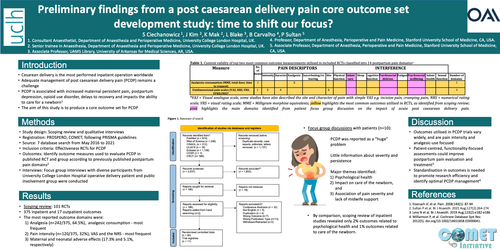
•Scoping review: 101 RCTs
•375 inpatient and 17 outpatient outcomes
•The most reported outcome domains were:
1)Analgesia (n=242/375, 64.5%), analgesic consumption - most frequent
2)Pain intensity (n=120/375, 32%), VAS and the NRS - most frequent
3)Maternal and neonatal adverse effects (17.3% and 5.1%, respectively)
•Focus group discussions with patients (n=10):
•
•PCDP was reported as a “huge” problem
•Little information about severity and persistence
•Major themes identified:
1)Psychological health
2)Impact on care of the newborn, and
3)Association of pain severity and lack of midwife support
●
•By comparison, scoping review of inpatient studies revealed only 2% outcomes related to psychological health and 1% outcomes related to care of the newborn.
•Outcomes utilised in PCDP trials vary widely, and are pain intensity and analgesic-use focused
•Patient-centred, functionality-focused assessments could improve postpartum pain evaluation and treatment3
•Standardisation in outcomes is needed to promote research efficiency and identify optimal PCDP management4