191 posters, 5 topics, 20 sessions, 393 authors, 116 institutions
ePostersLive by SciGen Technologies S.A. All rights reserved.
Obstetric Anaesthesia Annual Scientific Meeting 2023
18 - 19 May, 2023 | EICC Edinburgh

5788715
Evaluation of electronic record monitoring following implementation of neuraxial morphine for caesarean section in an Australian suburban hospital
Poster Presenter
Authors
Affiliations
Part of Topic
Service Evaluation
Evaluation of electronic record monitoring following implementation of neuraxial morphine for caesarean section in an Australian suburban hospital.
Introduction
•Latest guidelines for monitoring after neuraxial opiates for caesarean analgesia recommend reduced frequency and intensity [1,2].
•There are no Australian consensus guidelines for monitoring after neuraxial opiates.
•Standards are based on local guidelines and an electronic set created for scheduling nurse observation tasks: hourly for 12 hours then two hourly for 12 hours: blood pressure (BP), heart rate (HR), respiratory rate (RR), oxygen saturations (sats), pain scores, postoperative nausea and vomiting (PONV), Bromage and functional activity score (FAS).
Methods
•Postoperative observations of 64 patients undergoing caesarian section
•5 week data-collection period following implementation of ITM
•Retrospectively audited data from the electronic medical record (EMR)
•Three patients were excluded – two general anaesthesia, one declined monitoring.
•The EMR for 61 patients was checked for on-time monitoring +/-10 minutes.
•Analysis with Microsoft Excel®
Results
•Audit included 54% emergency and 46% elective caesareans.
•Twelve of 61 patients did not receive neuraxial morphine; 10 had epidural morphine 2.5-3mg; 39 had intrathecal morphine 100microg.
•Higher risk for clinically significant respiratory depression (CSRD) noted in 9/49, all BMI>40; however, no desaturation events occurred.
•Scheduled tasks were ordered on EMR for 32/49 patients.
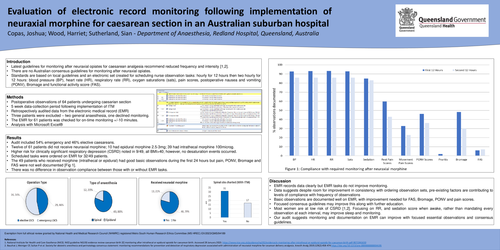
•The 49 patients who received morphine (intrathecal or epidural) had good basic observations during the first 24 hours but pain, PONV, Bromage and FAS were not well documented [Fig 1].
•There was no difference in observation compliance between those with or without EMR tasks.
Discussion
•EMR records data clearly but EMR tasks do not improve monitoring.
•Data suggests despite room for improvement in consistency with ordering observation sets, pre-existing factors are contributing to levels of compliance with frequency of observations
•Basic observations are documented well on EMR, with improvement needed for FAS, Bromage, PONV and pain scores.
•Focused consensus guidelines may improve this along with further education.
•Most women are at low risk of CSRD [1,2]. Focusing on RR, and sedation score when awake, rather than mandating every observation at each interval, may improve sleep and monitoring.
•Our audit suggests monitoring and documentation on EMR can improve with focused essential observations and consensus guidelines.