191 posters, 5 topics, 20 sessions, 393 authors, 116 institutions
ePostersLive by SciGen Technologies S.A. All rights reserved.
Obstetric Anaesthesia Annual Scientific Meeting 2023
18 - 19 May, 2023 | EICC Edinburgh

5785812
Epidural top-up rates of obesity class three patients at Grange University Hospital
Poster Presenter
Authors
Affiliations
Part of Topic
Service Evaluation
EPIDURAL TOP-UP RATES OF OBESITY CLASS 3 PATIENTS AT GRANGE UNIVERSITY HOSPITAL
Introduction
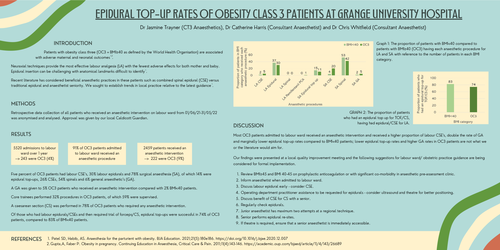
Patients with obesity class three (OC3 = BMI≥40 as defined by the World Health Organisation) are associated with adverse maternal and neonatal outcomes1,2. Neuraxial techniques provide the most effective labour analgesia (LA) with the fewest adverse effects for both mother and baby. Epidural insertion can be challenging with anatomical landmarks difficult to identify1. Recent literature has considered beneficial anaesthetic practices in these patients such as combined spinal epidural (CSE) versus traditional epidural and anaesthetist seniority. We sought to establish trends in local practice relative to the latest guidance1.
Methods
Retrospective data collection of all patients who received an anaesthetic intervention on labour ward from 01/06/21-31/05/22 was anonymised and analysed. Approval was given by our local Caldicott Guardian.
Results
There were 5520 admissions to labour ward over 1 year - 243 were OC3 (4%). 91% of OC3 patients admitted to labour ward received an anaesthetic procedure. 2459 patients received an anaesthetic intervention - 222 were OC3 (9%). Five percent of OC3 patients had labour CSE’s, 30% labour epidurals and 78% surgical anaesthesia (SA), of which 14% were epidural top-ups, 26% CSEs, 54% spinals and 6% general anaesthetic’s (GA). A GA was given to 5% OC3 patients who received an anaesthetic intervention compared with 2% BMI<40 patients. Core trainees performed 32% procedures in OC3 patients, of which 59% were supervised. A caesarean section (CS) was performed in 78% of OC3 patients who required any anaesthetic intervention. Of those who had labour epidurals/CSEs and then required trial of forceps/CS, epidural top-ups were successful in 74% of OC3 patients, compared to 83% of BMI<40 patients.
Discussion
Most OC3 patients admitted to labour ward received an anaesthetic intervention and received a higher proportion of labour CSE’s, double the rate of GA and marginally lower epidural top-up rates compared to BMI<40 patients; lower epidural top-up rates and higher GA rates in OC3 patients are not what we or the literature would aim for. Our findings were presented at a local quality improvement meeting and the following suggestions for labour ward/ obstetric practice guidance are being considered for formal implementation.
- Review BMI≥45 and BMI 40-45 on prophylactic anticoagulation or with significant co-morbidity in anaesthetic pre-assessment clinic.
- Inform anaesthetist when admitted to labour ward.
- Discuss labour epidural early - consider CSE.
- Operating department practitioner assistance to be requested for epidurals - consider ultrasound and theatre for better positioning.
- Discuss benefit of CSE for CS with a senior.
- Regularly check epidurals.
- Junior anaesthetist has maximum two attempts at a regional technique.
- Senior performs epidural re-sites.
- If theatre is required, ensure that a senior anaesthetist is immediately accessible.
References
- Patel SD, Habib, AS. Anaesthesia for the parturient with obesity. BJA Education. 2021;21(5):180e186. https://doi.org/10.1016/j.bjae.2020.12.007
- Gupta,A, Faber P. Obesity in pregnancy. Continuing Education in Anaesthesia, Critical Care & Pain. 2011;11(4):143-146. https://academic.oup.com/bjaed/article/11/4/143/26689