90 posters, 5 videos, 1 audios, 6 topics, 3 sessions, 245 authors, 1 institutions
ePostersLive by SciGen Technologies S.A. All rights reserved.
Net Zero Clinical Care 2023
10 October 2023 | BMA House, London
30600
Enteral feeding equipment sustainability initiative
Poster Presenter
Part of Topic
Other
A pilot initiative exploring the impact of implementing sustainable enteral feeding practices
L.-M. Baldwin1, S. A. L. Williams1, R. McLean2, I. Steinbach2, R. Capener3, F. McCarten3
1 Home Enteral Feeding Team, Gloucester Hospitals NHS Foundation Trust, Gloucester, 2 The Centre for Sustainable Healthcare, Oxford, 3 NUTRICIA, Trowbridge, United Kingdom
Background
The NHS are responsible for 4% of the carbon dioxide emissions produced by the UK. NHS England have set a target to deliver healthcare that is carbon neutral by the year 2040. To commence this journey, Gloucestershire Hospitals NHS Foundation Trust developed a ‘Green plan’ to outline the Trusts mission
throughout 2021 to 2025 to start their contribution to net zero healthcare. The Gloucestershire Home Enteral Feeding Team are aware of the amount of plastic waste generated by enteral feeding in the community and are keen to develop and implement more sustainable enteral feeding practices and share
these ideas and experiences with other NHS Trusts across the UK. Inspiration for more sustainable practices was also gained from an increasing number of patients expressing their concerns around the amount of plastic waste generated by enteral feeding.
Aims and objectives
A project initiative was chosen following creation of a driver diagram and the aim of the project was to reduce the amount of plastic waste associated with enteral feeding by sustainable means.
The objectives focused on 3 parameters:
People: Raising awareness of the environmental impact of healthcare among staff.
Planet: Reducing the carbon emissions produced by enteral feeding.
Profit: Ensuring new practices are economically favourable.
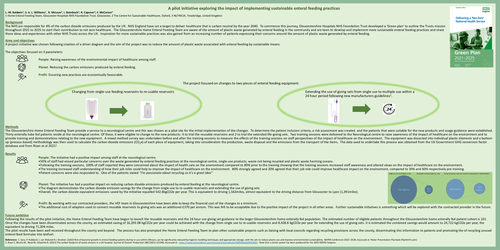
The project focused on changes to two pieces of enteral feeding equipment:
Changing from single-use feeding reservoirs to re-usable reservoirs Extending the use of giving sets from single use to multiple use within a
24 hour period following new manufacturers guidelines1.
Methods
The Gloucestershire Home Enteral Feeding Team provide a service to a neurological centre and this was chosen as a pilot site for the initial implementation of the changes. To determine the patient inclusion criteria, a risk assessment was created and the patients that were suitable for the new products and usage guidance were established.
Thirty enterally tube fed patients reside at the neurological centre. Of these, 6 were eligible to change to the new products: 4 to trial the reusable reservoirs and 2 to trial the extended life-giving sets. Two training sessions were delivered to the Neurological centre to raise awareness of the impact of healthcare on the environment and to
provide training and demonstrations relating to the new equipment. A mixed method survey was undertaken before and after the training sessions to measure the effects of the training sessions on staff perspectives of the impact of healthcare on the environment. The equipment was dissected into individual plastic elements and a bottom
up (process-based) methodology was then used to calculate the carbon dioxide emissions (CO2e) of each piece of equipment, taking into consideration the production, waste disposal and the emissions from the transport of the items. The data used to undertake this process was obtained from the UK Government GHG conversion factor
database and from Rizan et al 20212.
Results
People: The initiative had a positive impact among staff at the neurological centre.
•50% of staff had voiced particular concerns over the waste generated by enteral feeding practices at the neurological centre, single-use products, waste not being recycled and plastic waste harming oceans.
•Following the training sessions, 100% of staff reported they were concerned about the impact of health care on the environment compared to 80% prior to the training showing that the training sessions increased staff awareness and altered views on the impact of healthcare on the environment.
•The training increased staff understanding of how their job roles could help to improve the impact of healthcare on the environment. 80% strongly agreed and 20% agreed that their job role could improve healthcare impact on the environment, compared to 30% and 60% respectively pre-training.
•Patient concerns were also responded to. One of the patients stated “I'm passionate about recycling so it’s a great idea”
Planet: The initiative has had a positive impact on reducing carbon dioxide emissions produced by enteral feeding at the neurological centre.
•The diagram demonstrates the carbon dioxide emission savings for the change from single use to re-usable reservoirs and extending the use of giving sets
•Overall, the carbon dioxide equivalent emissions saved by the initiative equalled 542.8kgCO2e per year. This is equivalent to driving 1,563miles, almost equivalent to the driving distance from Gloucester to Lyon (1,391miles).
Profit: By working with our contracted providers, the HEF team in Gloucestershire have been able to keep the financial cost of the changes to a minimum.
•The additional cost of adapters used to connect reusable reservoirs to giving sets was an additional £370 per annum. This was felt to be acceptable due to the positive impact of the project in all other areas. Further sustainable initiatives is something which will be explored with the contracted provider in the future.
Future ambition
Following the results of the pilot initiative, the Home Enteral Feeding Team have begun to launch the reusable reservoirs and the 24 hour use giving set guidance to the larger Gloucestershire home enterally fed population. The estimated number of eligible patients throughout the Gloucestershire home enterally fed patient cohort is 101.
Once the changes have been disseminated across the county, an estimated saving of 16,293.08 kgCO2e per year could be achieved with the change from single use to re-usable reservoirs and 8,428.8 kgCO2e per year for extending the use of giving sets. it is estimated the combined savings would amount to 24,722 kgCO2e per year, the
equivalent to driving 71,204 miles.
The pilot results have been well received throughout the county and beyond. The process has also prompted the Home Enteral Feeding Team to plan other sustainable projects such as liaising with local councils regarding recycling provisions across the county, disseminating this information to patients and promoting the of recycling unused
enteral feed formulas into biofuel.
References: 1. Gary. P. Hubbard, J. van Wykand R.J. Stratton. (2022) Risk of bacterial growth in enteral feeding systems during re-use within 24hours, can be significantly reduced by hygienic handling techniques and appropriate storage, with the aim to reduce plastic use and improve environmental sustainability. BAPEN Conference 2022: OC36. Accessed at: Poster Presentation Flip book (fliphtml5.com)
2. Rizan C, Bhutta M,. Reed M, Lillywhite R. (2021) The carbon footprint of waste streams in a UK hospital. Journal of Cleaner Production 286 (2021) 125446. Accessed at: https://www.sciencedirect.com/science/article/abs/pii/S0959652620354925. Note that a similar poster has been produced for the 2023 ESPEN Congress.