90 posters, 5 videos, 1 audios, 6 topics, 3 sessions, 245 authors, 1 institutions
ePostersLive by SciGen Technologies S.A. All rights reserved.
Net Zero Clinical Care 2023
10 October 2023 | BMA House, London

30519
Trends over time in the use, cost and carbon footprint of facet joint injections and medial branch blocks to manage lumbar pain in England: retrospective study.
Poster Presenter
Part of Topic
Other
Trends over time in the use, costs and carbon footprint of facet joint injections and medial branch blocks to manage lumbar pain in England: retrospective analysis of an administrative dataset.
E. Ojelade,1,2 J. Koris,1,3 M. Van-Hove,1 W.K. Gray,1 T.W.R. Briggs1,2 and M. Hutton1
1) Getting It Right First Time Programme, NHS England, UK, 2) Royal National Orthopaedic Hospital, Stanmore, UK, 3) John Radcliffe Hospital, Oxford, UK
Low back pain is a common problem worldwide affecting people of all ages, ethnicities, demographic background and sex and is a common cause of disability in people of working age. The worldwide prevalence of back pain in 2019 was 568 million cases,(1) and in Great Britain in financial year 2021-22, there were 202,000 self-reported cases of work-related musculoskeletal disorders affecting the back.(2) A number of these cases resolve without the need for any medical intervention, but for those with ongoing symptoms, multiple treatment methods are utilised to manage the pain. Guidance for the management of non-specific low back pain has been available in the National Back Pain and Radicular Pain Pathway (3) since 2014 and this has been endorsed by NICE who have also published guidance regarding the management of low back pain.(4) This included the advice to stop using Facet Joint Injections (FJI) as a method of treatment due to a lack of evidence of clinical benefit and to instead offer diagnostic Medial Branch Block (MBB) injections and if these were successful, to offer a radiofrequency denervation. The 2019 GIRFT report into spinal services highlighted marked variation in England in the management of non-specific low back pain with some patients having multiple FJI and MBB injections in one year.(5) Repeat injections also have an associated financial and environmental cost which needs to be considered to reflect the NHS 2040 net zero target.(6)
AIM
The aim of this study was to investigate the changing practice in England of the use of FJI/MBB for non-specific low back pain over a six-year period and the associated carbon production and financial impact.
METHOD
A retrospective analysis of administrative data from the UK Hospital Episodes Statistics database was performed covering all first spinal injections for non-specific low back pain performed between 1st April 2015 and 31st March 2021 and any repeat injections performed within one year of the first. Patients aged under 17 and where the body site for injection was listed as cervical, thoracic or sacral were excluded. The exposure of interest was two injections within 180 days or three within one year and the following outcomes were considered: subsequent facet joint denervation within one year of the injection, the carbon footprint associated with the FJI/MBB injections, and the financial cost associated with the injections. Due to lockdowns in England during 2020/21 owing to the COVID-19 pandemic, 2019/20 was used as the final year when comparisons between financial years were made.
RESULTS
134,249 patients were included in the dataset.
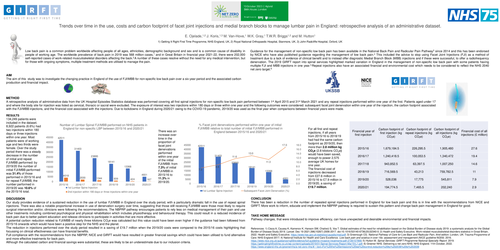
8,922 patients (6.6%) had two injections within 180 days or three injections within one year. Most patients were of working age and two thirds were female. Over the study period there was a steady decrease in the number of initial and repeat FJI/MBB performed: by 2019/20 the number of initial FJI/MBB performed was 31.4% of those performed in 2015/16 and for repeat FJI/MBB, the number performed in 2019/20 was 10.6% of the 2015/16 total.
There was an increase over time in the proportion of facet joint denervations performed within one year of the initial FJI/MBB: from 7.3% of initial FJI/MBB in 2015/16 to 11.3% in 2019/20.
For all first and repeat injections, if all years from 2015/16 to 2018/19 had had the same carbon footprint as 2019/20, then more than 2.8 million kg CO2e (2.8 kilotons CO2e) would have been saved, enough to power 2,575 average UK homes for one year.
The financial cost of injections decreased from £27.6 million in 2015/16 to £7.9 million in 2019/20, a saving of £19.7 million.
DISCUSSION
Our study provides evidence of a sustained reduction in the use of lumbar FJI/MBB in England over the study period, with a particularly dramatic fall in the use of repeat spinal injections. There was also a notable proportional increase in use of denervation surgery over time, suggesting that those still receiving FJI/MBB were those most likely to require surgical intervention and/or, clinicians were following the recommendations. The NBPRP pathway encourages patients to rely less on medical management of their pain and use other treatments including combined psychological and physical rehabilitation which includes physiotherapy and behavioural therapy. This could result in a reduced incidence of back pain due to better patient education and release clinicians to participate in activities that are more effective.
A potential carbon reduction related to FJI/MBB of nearly three kilotons CO2e was calculated but this value could have been even higher if the guidance had been followed from 2015/16 onwards which would have been a positive step for the NHS and the planet.
The reduction in injections performed over the study period resulted in a saving of £19.7 million when the 2019/20 costs were compared to the 2015/16 costs highlighting that focussing on clinical effectiveness can have financial benefits.
Full compliance with the recommendations from the NBPRP, NICE and GIRFT would have resulted in greater financial savings which could have been utilised to fund alternative and more effective treatments for back pain.
Although the calculated carbon and financial savings were substantial, these are likely to be an underestimate due to our inclusion criteria.
CONCLUSION
There has been a reduction in the number of repeated spinal injections performed in England for low back pain and this is in line with the recommendations from NICE and GIRFT. More work to inform, educate and implement the NBPRP pathway is required to sustain this pattern and change back pain management in England for good.
TAKE HOME MESSAGE
Pathway changes, that were introduced to improve efficiency, can have unexpected and desirable environmental and financial impacts.
References:
1) Cieza A, Causey K, Kamenov K, Hanson SW, Chatterji S, Vos T. Global estimates of the need for rehabilitation based on the Global Burden of Disease study 2019: a systematic analysis for the Global Burden of Disease Study 2019. Lancet. Dec 19 2021;396(10267):2006-2017. doi:10.1016/S0140-6736(20)32340-0
2) Health and Safety Executive. Work-related musculoskeletal disorders statistics in Great Britain, 2022. Health and Safety Executive. https://www.hse.gov.uk/statistics/causdis/msd.pdf
3) Greenough CG. National Pathway of Care for Low Back and Radicular Pain, third edition. London, UK: Trauma Programme of Care: NHS England 2017;
4) National Institute for Health and Care Excellence. Low back pain and sciatica in over 16s: assessment and management (NICE guideline NG59). 2016. https://www.nice.org.uk/guidance/ng59/evidence/full-guideline-invasive-treatments-pdf-2726157998
5) Hutton M. Spinal Services: GIRFT Programme National Specialty Report. 2019. https://gettingitrightfirsttime.co.uk/wp-content/uploads/2019/01/Spinal-Services-Report-Mar19-L1.pdf
6) Greener NHS. Delivering a net zero NHS. NHS England. 11th October, 2022. https://www.england.nhs.uk/greenernhs/a-net-zero-nhs/#:~:text=For%20the%20emissions%20we%20control,reduction%20by%202036%20to%202039