90 posters, 5 videos, 1 audios, 6 topics, 3 sessions, 245 authors, 1 institutions
ePostersLive by SciGen Technologies S.A. All rights reserved.
Net Zero Clinical Care 2023
10 October 2023 | BMA House, London

30473
Remote Medical Conferencing - Future or Fad?
Poster Presenter
Authors
Part of Topic
Other
Video
Remote Medical Conferencing – Future or Fad?
Introduction
Recent studies have explored the carbon footprint of in-person conferences (1).
• Since the pandemic, some conferences have moved to a virtual or hybrid format (2).
• A review of the literature revealed that existing calculations for assessing conference emissions often focus on one area, such as delegate travel (3,4).
• There isan absence of a comprehensive tool which can allow event organisers to estimate the reduction in carbon footprint caused by switching to a virtual format.
Aims
1. To explore ‘hidden’ carbon costs of in-person medical conferences, for example, venue emissions and hotel stays of in-person events, but also the ‘hidden’ costs of virtual events such electricity and internet use.
2. To develop a simple tool to facilitate a direct comparison of carbon footprints when variables are changed.
3. To compare carbon footprints of a hypothetical in-person and hypothetical virtual conference.
Methods
• Ethical review was not required for this project as all data used was published and freely available for interpretation.
• Published data was used to estimate the main sources of emissions for conferences, in terms of kilograms of carbon dioxide equivalent (kgCO2e).
• The formulae for these sources were inputted to a Microsoft Excel spreadsheet to allow automated calculation and comparison of variables (3, 5, 6).
• For the purposes of this project, the carbon footprints of a hypothetical in-person conference and the same conference in a virtual format were calculated and their emissions were compared (3).
Conclusion
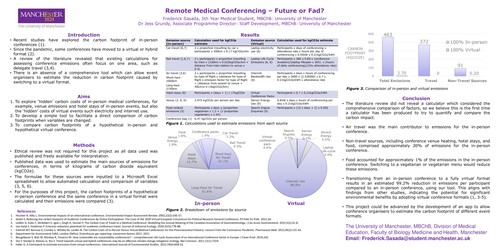
• The literature review did not reveal a calculator which considered the comprehensive comparison of factors, so we believe this is the first time a calculator has been produced to try to quantify and compare the carbon impact.
• Air travel was the main contributor to emissions for the in-person conference.
• Non-travel sources, including conference venue heating, hotel stays, and food, comprised approximately 20% of emissions for the in-person conference.
• Food accounted for approximately 1% of the emissions in the in-person conference. Switching to a vegetarian or vegetarian menu would reduce these emissions.
• Transitioning from an in-person conference to a fully virtual format results in an estimated 99.2% reduction in emissions per participant compared to an in-person conference, using our tool. This aligns with findings from other studies, indicating the potential for significant environmental benefits by adopting virtual conference formats (1, 3-5).
• This project could be advanced by the development of an app to allow conference organisers to estimate the carbon footprint of different event formats