90 posters, 5 videos, 1 audios, 6 topics, 3 sessions, 245 authors, 1 institutions
ePostersLive by SciGen Technologies S.A. All rights reserved.
Net Zero Clinical Care 2023
10 October 2023 | BMA House, London
30502
The potential for UK doctors to roll out Net Zero to global NGO's
Poster Presenter
Authors
Part of Topic
Other
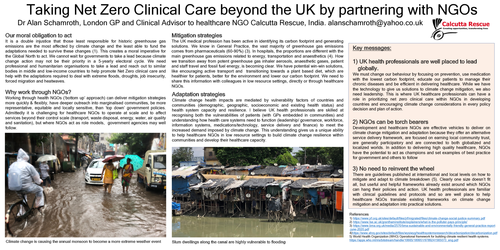
Taking Net Zero Clinical Care beyond the UK by partnering with NGOs
Dr Alan Schamroth, London GP and Clinical Advisor to healthcare NGO Calcutta Rescue, India. alanschamroth@yahoo.co.uk
Our moral obligation to act
It is a double injustice that those least responsible for historic greenhouse gas emissions are the most affected by climate change and the least able to fund the adaptations needed to survive these changes (1). This creates a moral imperative for the Global North to act. We cannot wait for governments to take a lead because climate change action may not be their priority in a 5-yearly electoral cycle. We need professional and humanitarian organisations to take a lead and reach out to similar bodies in middle and low-income countries to help promote Net Zero clinical care and help with the adaptations required to deal with extreme floods, droughts, job insecurity, forced migration and heatwaves.
Why work through NGOs?
Working through health NGOs (‘bottom up’ approach) can deliver mitigation strategies more quickly & flexibly, have deeper outreach into marginalised communities, be more representative, equitable and locally sensitive, than ‘top down’ government policies. Admittedly it is challenging for healthcare NGOs to operate at scale and to affect services beyond their control scale (transport, waste disposal, energy, water, air quality and sanitation), but where NGOs act as role models, government agencies may well follow.
Mitigation strategies
The UK medical profession has been active in identifying its carbon footprint and generating solutions. We know in General Practice, the vast majority of greenhouse gas emissions comes from pharmaceuticals (60-90%) (3). In hospitals, the proportions are different with the main greenhouse gas emissions related to energy, transportation and anaesthetics (4). How we transition away from potent greenhouse gas inhaler aerosols, anaesthetic gases, patient and staff travel and fossil fuel energy, is becoming clear. We have potential win-win solutions, like encouraging active transport and transitioning towards a plant based diet, which are healthier for patients, better for the environment and lower our carbon footprint. We need to share this information with colleagues in low resource settings, directly or through healthcare NGOs.
Adaptation strategies
Climate change health impacts are mediated by vulnerability factors of countries and communities (demographic, geographic, socioeconomic and existing health status) and health system capacity and resilience. I believe UK health professionals are skilled at recognising both the vulnerabilities of patients (with GPs embedded in communities) and understanding how health care systems need to function (leadership/ governance, workforce, information systems, medications/technology, service delivery and finance) to meet the increased demand imposed by climate change. This understanding gives us a unique ability to help healthcare NGOs in low resource settings to build climate change resilience within communities and develop their healthcare capacity.
Key messages:
1) UK health professionals are well placed to lead globally.
We must change our behaviour by focusing on prevention, use medication with the lowest carbon footprint, educate our patients to manage their chronic diseases and be efficient in delivering healthcare. While we have the technology to give us solutions to climate change mitigation, we also need leadership. This is where UK healthcare professionals can have a role in prioritizing net zero clinical care within NGOs in developing countries and encouraging climate change considerations in every policy decision and plan of action.
2) NGOs can be torch bearers
Development and healthcare NGOs are effective vehicles to deliver on climate change mitigation and adaptation because they offer an alternative service delivery framework, are focused on earning local community trust, are generally participatory and are connected to both globalized and localized worlds. In addition to delivering high quality healthcare, NGOs have the potential to act as champions and set examples of best practice for government and others to follow
3) No need to reinvent the wheel
There are guidelines published at international and local levels on how to mitigate and adapt to climate breakdown (5). Clearly one size doesn’t fit all, but useful and helpful frameworks already exist around which NGOs can hang their policies and action. UK health professionals are familiar with clinical guidelines and protocols and so are well place to help healthcare NGOs translate existing frameworks on climate change mitigation and adaptation into practical solutions.
References
2) https://www.lse.ac.uk/granthaminstitute/explainers/what-is-the-polluter-pays-principle/
5) World Health Organization (WHO) Operational framework for building climate resilient health systems. https://apps.who.int/iris/bitstream/handle/10665/189951/9789241565073_eng.pdf