90 posters, 5 videos, 1 audios, 6 topics, 3 sessions, 245 authors, 1 institutions
ePostersLive by SciGen Technologies S.A. All rights reserved.
Net Zero Clinical Care 2023
10 October 2023 | BMA House, London
30560
Sustainable Waste Management in Anaesthesia: Service Evaluation and Staff Survey
Poster Presenter
Part of Topic
Other
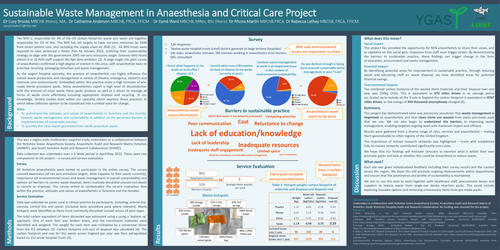
Sustainable Waste Management in Anaesthesia and Critical Care Project
Dr Lucy Brooks MBChB (Hons), MA. Dr Catherine Anderson MBChB, FRCA, FFICM. Dr Esmé Ward MBChB, MRes, BSc (Hons). Dr Rhona Martin MBChB FRCA. Dr Rebecca Lathey MBChB, FRCA, FFICM.
Background:
The NHS is responsible for 4% of the UK carbon footprint; waste and water are together responsible for 5% of this. The NHS has set targets to have net-zero emissions by 2040 from direct patient care, and including the supply chain by 2045 (1). All NHS trusts were required to have produced a Green Plan by January 2022, outlining their sustainability strategy to align with the government 2045 net-zero emissions target. Greener NHS found almost 9 in 10 NHS staff support the Net Zero ambition (2). A large single site pilot survey of anaesthetists confirmed a high degree of interest in this area, with anaesthetists keen to prioritise recycling, packaging reduction and waste management.
As the largest hospital specialty, the practice of anaesthetists can highly influence the overall waste production and management in variety of theatre, emergency, obstetric and intensive care environments. Embedded within this practice exists a high turnover of pre-made sterile procedure packs. Many anaesthetists report a high level of dissatisfaction with the amount of clean waste these packs produce as well as a desire to manage all forms of waste more effectively including appropriate disposal and recycling. To our knowledge, limited studies exist within our specialty which examine these practices or which allow collective opinion to be crystallised into a unified voice for change.
Aims:
This was a region-wide multicentre snapshot study undertaken as a collaboration between the Yorkshire Green Anaesthesia Society, Anaesthetic Audit and Research Matrix Yorkshire (AARMY), and South Yorkshire Audit and Research Collaboration (SHARC).
Data collection was undertaken over a 6 week period in April-May 2022. There were two components to the project – a survey and service evaluation.
Survey
All Yorkshire anaesthetists were invited to participate in the online survey. The survey covered awareness (of net zero emissions targets, what happens to their waste currently), importance (of environmental issues and waste management in overall sustainability) and opinion (of barriers to correct waste disposal, items routinely discarded unused and desire to recycle or improve). The survey aimed to contextualise the service evaluation data within the practice, attitudes and values of anaesthetists in Yorkshire and the Humber.
Service Evaluation
Data was collected on packs used in clinical practice by participants, including; arterial line, cannula, central line and spinal. (included basic procedure pack where relevant). Waste hotspots were identified as items most commonly discarded unused across all pack types.
The total carbon equivalent of items discarded was estimated using a using a ‘bottom up’ approach. One of each item was broken down, and the constituent materials were identified and weighed. The weight for each item was multiplied by a conversion factor from the ICE database (3). Carbon footprint and cost of disposal was calculated (4). The carbon footprint and cost for this waste across England per year was then extrapolated based on 152 acute hospital Trusts (5).
Results:
Survey
94% said environmental issues are important to them.
Anaesthtists want more information.
Anaesthetitsts want more to be done.
Barriers to sustainable practice: Lack of education/knowledge; inadequate resources; cost; lack of leadership; poor communication; reluctance to chanfe; inadequate staff engagement; limited space; belief that waste is not properly processed; competing priorities; need for investment in sustainable waste management; lack of motivation.
Service evaluation
Every pack included unused wasted items.
Wasted items have a carbon footprint.
Discussion:
What does this mean?
Social impact
This project has provided the opportunity for NHS anaesthetists to share their views, and to capitalise on this social gain, responses from staff must trigger action. By demonstrating the barriers to sustainable practice, these findings can trigger change in the form of education, procurement and waste management.
Financial Impact
By identifying potential areas for improvement in sustainable practice, through reducing waste and educating staff on waste disposal, we have identified areas for potential financial savings.
Environmental impacts
The combined carbon footprint of the wasted items materials and their disposal over one year was 250kg CO2e. This is equivalent to 676 miles driven in an average petrol car. Scaled up to include all the Trusts in England the carbon footprint is equivalent to 8767 miles driven, or the energy of 430 thousand smartphones charged (6).
Summary
This project has demonstrated what was previously anecdotal: that waste management is important to anaesthetists and that clean items are wasted from every pre-made pack that we use. We can also begin to understand the barriers to improving waste management, enabling targeted ongoing work with maximum impact and efficacy.
Results were gathered from a diverse range of sites, services and anaesthetists – making them generalisable to other regions of the United Kingdom.
The importance of trainee research networks was highlighted – trusts with established links to trainee networks contributed significantly more data.
We hope that our findings will motivate clinicians to examine what is within their own premade packs and look at whether this could be streamlined to reduce waste.
What next?
Each site was given individualised feedback including their survey results and the context across the region. We hope this will promote ongoing improvements within departments and ensure that the prominence and profile of sustainability is maintained.
We aim to use this data to work together with healthcare staff, procurement teams and suppliers to reduce waste from single-use device insertion packs. This could include exploring reusable options and removing unnecessary items from pre-made packs.
Acknowledgements
Undertaken in collaboration with Yorkshire Green Anaesthesia Society, Anaesthetic Audit and Research Matrix of Yorkshire, South Yorkshire Hospitals Audit and Research Collaboration. No funding was received for this project.
References
2.Greener NHS. ‘Healthier Planet, Healthier People’ staff engagement campaign. [Accessed 03/09/2023] Available from: https://www.england.nhs.uk/greenernhs/get-involved/staff-engagement-campaign/
3.Circular Ecology. 2019. Embodied Carbon – The ICE database. [Accessed 06/03/2023] Available from: https://circularecology.com/embodied-carbon-footprint-database.html
4. Rizan C, Bhutta M F, Reed M, Lillywhite R. The carbon footprint of waste streams in a UK hospital. Journal of Cleaner Production. 2021; 286
5. NHS Confederation (2017). Key Statistics on the NHS. [Accessed 6/3/23] Available from: https://www.nhsconfed.org/publications/key-statistics-nhs
6.Environmental Protection Agency. (2022). Greenhouse Gas Equivalencies Calculator. [Accessed 06/03/2023] Available from: https://www.epa.gov/energy/greenhouse-gas-equivalencies-calculator