90 posters, 5 videos, 1 audios, 6 topics, 3 sessions, 245 authors, 1 institutions
ePostersLive by SciGen Technologies S.A. All rights reserved.
Net Zero Clinical Care 2023
10 October 2023 | BMA House, London
30533
Preparing the medical workforce of the future; an all-Ireland Initiative on Planetary Health in Medical Education
Poster Presenter
Authors
Part of Topic
Embedding Net Zero through Clinical Leadership, Systems and Workforce
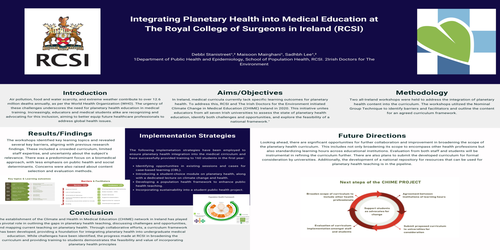
Integrating Planetary Health into Medical Education at The Royal College of Surgeons in Ireland (RCSI)
Introduction
Air pollution, food and water scarcity, and extreme weather contribute to over 12.6 million deaths annually, as per the World Health Organization (WHO). The urgency of these challenges underscores the need for planetary health education in medical training. Increasingly, educators and medical students alike are recognizing and advocating for this inclusion, aiming to better equip future healthcare professionals to address global health issues.
Aim and Objectives
In Ireland, medical curricula currently lack specific learning outcomes for planetary health. To address this, RCSI and The Irish Doctors for the Environment initiated Climate Change in Medical Education (CHIME) Ireland in 2020. This initiative unites educators from all seven Irish universities to assess the state of planetary health education, identify both challenges and opportunities, and explore the feasibility of a national framework."
Methodology
Two all-Ireland workshops were held to address the integration of planetary health content into the curriculum. The workshops utilized the Nominal Group Technique to identify barriers and facilitators and outline the content for an agreed curriculum framework.
Results/Findings
The workshops identified key leaning topics and revealed several key barriers, aligning with previous research findings. These included a crowded curriculum, limited staff expertise, and uncertainty about the subject's relevance. There was a predominant focus on a biomedical approach, with less emphasis on public health and social determinants. Concerns were also raised about content selection and evaluation methods.
Future Directions
Looking ahead, there are significant opportunities for further collaboration and improvement in broadening the scope of the planetary health curriculum. This includes not only broadening its scope to encompass other health professions but also standardizing learning hours across educational institutions. Evaluation from both staff and students will be instrumental in refining the curriculum further. There are also plans to submit the developed curriculum for formal consideration by universities. Additionally, the development of a national repository for resources that can be used for planetary health teaching is in the pipeline.
Conclusion
The establishment of the Climate and Health in Medical Education (CHIME) network in Ireland has played 1 pivotal role in outlining the gaps in planetary health teaching, discussing challenges and opportunities, nd mapping current teaching on planetary health. Through collaborative efforts, a curriculum framework has been developed, providing a foundation for integrating planetary health into undergraduate medical education. While challenges have been identified, the progress made at RCSI in broadening the curriculum and providing training to students demonstrates the feasibility and value of incorporating planetary health principles