90 posters, 5 videos, 1 audios, 6 topics, 3 sessions, 245 authors, 1 institutions
ePostersLive by SciGen Technologies S.A. All rights reserved.
Net Zero Clinical Care 2023
10 October 2023 | BMA House, London
30475
Embedding Climate Knowledge and Understanding in the New Healthcare Workforce through Climate Fresk
Poster Presenter
Part of Topic
Embedding Net Zero through Clinical Leadership, Systems and Workforce
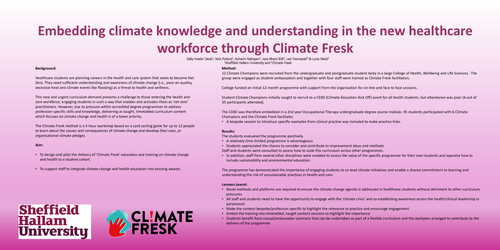
Embedding climate knowledge and understanding in the new healthcare workforce through Climate Fresk
Sally Fowler Davis1, Nick Pollard1,Ashwini Mahajan1, Iqra Ghani BiBi1, Lea Francastel2 & Lucie Nield1
1Sheffield Hallam University and 2Climate Fresk
Background:
Healthcare students are planning careers in the health and care system that seeks to become Net Zero. They need sufficient understanding and awareness of climate change (i.e., poor air quality, excessive heat and climate events like flooding) as a threat to health and wellness.
This new and urgent curriculum demand presents a challenge to those entering the health and care workforce; engaging students in such a way that enables and activates them as ‘net zero’ practitioners. However, due to pressure within accredited degree programmes to address profession specific skills and knowledge, delivering as taught, timetabled curriculum content which focuses on climate change and health is of a lower priority.
The Climate Fresk method is a 3-hour workshop based on a card sorting game for up to 12 people to learn about the causes and consequences of climate change and develop their own, or organisational climate pledges.
Aim:
12 Climate Champions were recruited from the undergraduate and postgraduate student body in a large College of Health, Wellbeing and Life Sciences. The group were engaged as student ambassadors and together with four staff were trained as Climate Fresk facilitators.
College funded an initial 12-month programme with support from the organisation for on-line and face to face sessions.
Student Climate Champions initially sought to recruit to a CEKO (Climate Education Kick Off) event for all health students, but attendance was poor (6 out of 35 participants attended).
The CEKO was therefore embedded in a 2nd year Occupational Therapy undergraduate degree course module. 45 students participated with 6 Climate Champions and the Climate Fresk facilitator.
Results:
The students evaluated the programme positively.
Staff and students were consulted to assess how to scale this curriculum across other programmes.
The programme has demonstrated the importance of engaging students to co-lead climate initiatives and enable a shared commitment to learning and understanding the risk of unsustainable practices in health and care.
Lessons Learnt: