90 posters, 5 videos, 1 audios, 6 topics, 3 sessions, 245 authors, 1 institutions
ePostersLive by SciGen Technologies S.A. All rights reserved.
Net Zero Clinical Care 2023
10 October 2023 | BMA House, London

30492
Understanding healthcare professionals’ perceptions of climate change policy in the UK, and how these can be used to further NHS net zero ambitions.
Poster Presenter
Authors
Part of Topic
Embedding Net Zero through Clinical Leadership, Systems and Workforce
Introduction:
With climate change’s unprecedented threat to human health, the NHS is striving towards net zero carbon emissions [1] . Policies and initiatives are introduced at multiple levels of governance, from NHS England, through NHS trusts, departments, and right down to the individual actions.
The role of the BMA, the GMC and specialty colleges, alongside organisations such as the Centre for Sustainable Healthcare and the UK Health Alliance on Climate Change influence the formulation and uptake of such strategies.
An interconnected system with overlapping jurisdiction will require an approach mindful of its complexity [2].
This research looks at the awareness and attitudes of healthcare professionals in England, and how they view their role within a ‘greener’ healthcare system. It explores the interaction between large-scale policy shifts, individual engagement and external agents/organisations
Objectives:
a) Establish a baseline level of awareness of current climate change policy and sustainability initiatives at different levels of organisation.
b) Identify where professionals find out information on climate change policy in healthcare.
c) Develop an understanding of perceived effectiveness of different policies.
d) Examine professional’s attitudes towards climate change influencing their practice.
Methods:
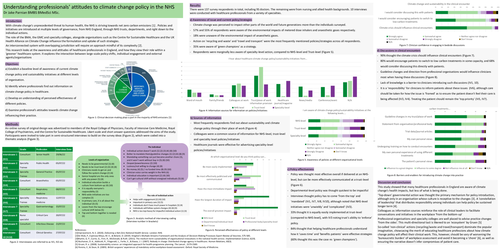
An online survey of original design was advertised to members of the Royal College of Physicians, Faculty of Intensive Care Medicine, Royal College of Psychiatrists, and the Centre for Sustainable Healthcare. Likert scale and short answer questions addressed the aims of the study. Participants were invited to take part in semi-structured interviews to build on the survey ideas (Figure 2), which were coded into a thematic analysis (Figure 3).
Levels of organisation
The Individual
The role of individual action
References:
[1]Improvement, N. E. (2020). Delivering a Net-Zero National Health Service. London: NHS
[2]De Wals, P., Espinoza-Moya, M.-E., & Beland, D. (2019). Kingdon's Multiple Streams Framework and the Analysis of Decision-Making Processes Expert Review of Vaccines, 575-585.
[3]Martin, G. P., Currie, G., Finn, R., McDonald, & Ruth. (2011). The medium-term sustainability of organisational innovations in the national health service. Implementation Science, 6(19).
[4] Buchanan, D. A., Addicott, R., Fitzgerald, L., Ferlie, E., & Baeza, J. I. (2007). Nobody in charge: Distributed change agency in healthcare. Human Relations, 60(3).
[5] Gruen, R. e. (2008). Sustainability science: an integrated approach for health-programme planning. The Lancet , 1579-1589.
[6] Pereira, E., & Dean, B. (2009). British surgeons' experiences of mandatory online workplace-based assessment. Oxford: Royal Society of Medicine.
Results:
There were 137 survey respondents in total, including 95 doctors. The remaining were from nursing and allied health backgrounds. 10 interviews were conducted with healthcare professionals from a variety of specialties.
a) Awareness of issue and current policy/strategies
b) Sources of information
c) Policy effectiveness
d) Discussions in clinical encounters
Discussion and conclusion:
This study showed that many healthcare professionals in England are aware of climate change’s health impacts, but less of what is being done.
‘Top-down’ governmental action was thought the primary mechanism for policy introduction, although only in an organisation whose culture is receptive to the changes [3]. A ‘constellation of leadership’ that distributes responsibility among individuals can help policy be sustained longer term [4].
Colleagues as information sources reinforce the role of clinical leaders to facilitate conversations and initiatives in the workplace ‘from the bottom-up’
Professional organisations and specialty colleges are well placed to advise practice changes ‘from the sides’. This multi-directional tact is likened to an ‘ecosystem’ by Gruen [5]
So-called ‘non-clinical’ actions (recycling/waste and travel/transport) dominate the popular imagination, showcasing the merit of educating healthcare professions about how climate change policy will affect their clinical work. This, however, should be vary of worsening the ‘bureaucratic burden’ of workplace assessment and avoid it becoming a ‘chore’ [6], as well as ensuring the narrative doesn’t infer compromises of patient care.