90 posters, 5 videos, 1 audios, 6 topics, 3 sessions, 245 authors, 1 institutions
ePostersLive by SciGen Technologies S.A. All rights reserved.
Net Zero Clinical Care 2023
10 October 2023 | BMA House, London
30497
Climate and Health Scorecard Initiative
Poster Presenter
Authors
Part of Topic
Embedding Net Zero through Clinical Leadership, Systems and Workforce
About
This initiative was set up in response to the climate and ecological emergency - the most significant health threat of our time. Societal actions in the next decade will determine the extent to which we can minimise harm to physical and mental health. Every fraction of a degree of heating matters. Every action taken to reduce emissions matters. There is so much that health organisations can do to help tackle this crisis. This initiative focuses on supporting high-impact change within the health community.
Goal
Support health organisations in moving towards a just, healthy and sustainable world at the rate and speed required to ensure a liveable planet for all.
Strategy
UK health organisations are surveyed to establish what are doing about climate change and environmental degradation. The questionnaire functions as a framework which breaks down climate action into manageable steps to aid health organisations with their climate work. Publishing results annually monitors progress and allows health professionals to see what their membership organisations have and have not done. This ensures transparency and accountability, and drives action by harnessing the competitive spirit of organisations! Cross-organisational learning is facilitated by sharing examples of good practice.
Methodology
1. CONSTRUCTING THE QUESTIONNAIRE
A working group developed a framework of climate actions that were considered ambitious yet achievable for health organisations. A range of experts in the field of climate, nature, health, education, finance and campaigning were involved to maximise content validity. Four core domains were identified. Questions were written to cover the highest impact areas. Weighting was determined according to the estimated impact of each question on mitigating the climate and ecological emergency.
2. ORGANISATIONS ARE INVITED TO PARTICIPATE Inclusion criteria: UK-based health professional bodies (medical, nursing, allied health, pharmacy and psychology); unions; journals; and regulators.
3. QUESTIONNAIRES ARE REVIEWED AND SCORED Health organisations complete the questionnaires. The questionnaire is self-reported and includes suggestions of evidence which helps verify the answers. The questionnaire is then marked by the scorecard team. During the marking process, organisations may be contacted to seek clarification on some answers. The questionnaire is then reviewed by a second scorecard team member who is blind to the name of the organisation to reduce potential bias. The scores are then compared and any discrepancies are discussed by the scorecard team. Finalised scores are shared with the organisation.
4. SCORECARDS ARE PUBLISHED Results are presented as a total score and subdomain scores with a traffic light rating system depending on the percentage of points obtained.
Domains
This domain focuses on the work health organisations are doing to minimise their carbon footprints and waste production. Not only do these actions reduce greenhouse gas emissions, but it demonstrates positive leadership and indicates to members and the public that climate change is an important health issue on which everyone should act. ‘Getting one's house in order’ is a crucial step.
This domain focuses on organisations divesting their financial assets from investments in fossil fuels as well as banking with green banks and using green insurers. When health organisations move their funds, it makes a social and political statement which stigmatises fossil fuels and contributes to uncertainties around the long-term viability of this harmful industry. This is a critical action for breaking society's dependence on fossil fuels.
Health organisations have a responsibility to advocate for population health. This means advocating for an end to fossil fuel exploration and for bold climate policy. Health organisations should challenge global and intergenerational inequity as well as the colonial capitalist structure that underpins the climate crisis. This involves using the health voice to lobby policymakers to positively influence legislation.
Education holds a critical role in building a climate-resilient health sector. Climate-informed health professionals can engage in public health promotion and prevention as well as integrating sustainable practice into their workplaces. This domain reviews actions taken by organisations to prepare their members for clinical practice in a climate-changing world, for example by including planetary health on their exam curriculum.
Results
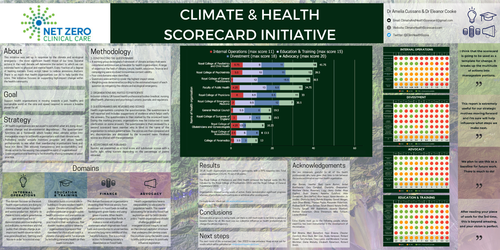
28 UK health organisations were asked to participate, with a 39% response rate. Total scores ranged from 13 to 41.75 out of 64 points. The Royal College of Paediatrics and Child Health achieved the highest score (41.75) followed by the Royal College of Psychiatrists (39.5) and the Royal College of General Practitioners (38.5). Organisations showed varying levels of action. Some demonstrated significant progress whereas others chose not to participate or withdrew after scoring poorly. For more details, check out climatehealthscorecard.com
Conclusions
Considerable progress is being made, yet there is still much work to be done to secure a liveable future for all. We must use our collective influence as health professionals to change the climate trajectory.
Next steps
The next round of the scorecard (Jan - Dec 2022) is now underway. Keep an eye out for results which will be published on climatehealthscorecard.com.
Acknowledgements
We are immensely grateful to all of the health professionals who have given their time to link between the scorecard initiative and their health organisation: Alan Barnes, Heather Baid, Laura Burton, Isobel Braithwaite, Cara Campbell, Charlotte Cheeseman, Matthew Clarke, Rosemary Lugg, Jenny Girdler, Anya Gopfert, Sivan Greene, Natasha Guildford, Hilde Gundersen, Sara Harford, Alice Harpur, Karen Herndon, Jo Hindley, Charlotte Hurry, Kamilla Kingsley, Gareth Morgan, Jack Oliver-Blaney, Thomas Payne, Alexander Robertson, Andrew Savill, Aimee Serisier, Sarah Sheard, Natalie Smith, Timothy Spruell, Will Stableforth, Victoria Stanford, Andrew Stevenson, Olivia Stevenson, Mike Tomson, Louise Weissel. Extra thanks must go to the following people, whose expertise has been instrumental in the development of the initiative: Rob Abrams, Matt Beresford, Yaso Browne, Chester Cornford, Alice Clack, Ben Eder, Nuala Hampson, Richard Hixson, Terry Kemple, Tracy Lyons, Joel Moreland, Frances Mortimer, Elaine Mulcahy, Elizabeth Robertson, Richard Smith.