90 posters, 5 videos, 1 audios, 6 topics, 3 sessions, 245 authors, 1 institutions
ePostersLive by SciGen Technologies S.A. All rights reserved.
Net Zero Clinical Care 2023
10 October 2023 | BMA House, London
30571
Integrating environmental sustainability into quality improvement education and practice - The SusQI Education project pilot and beyond
Poster Presenter
Part of Topic
Embedding Net Zero through Clinical Leadership, Systems and Workforce
Sustainability in Quality Improvement and the future
Frances Mortimer, Catherine Richards, Siobhan Parslow-Williams, Rachel McLean, Alice Clack and Ayoma Ratnappuli
Affiliation: Centre for Sustainable Healthcare
What is Sustainability in Quality Improvement (SusQI)?
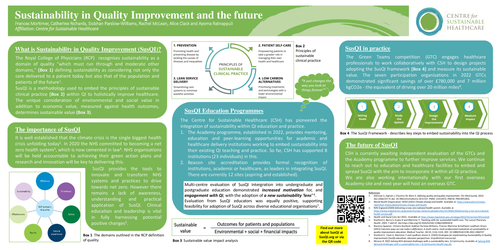
The Royal College of Physicians (RCP) recognises sustainability as a domain of quality “which must run through and moderate other domains,” (Box 1) defining sustainability as considering not only the care delivered to a patient today but also that of the population and patients of the future1.
SusQI is a methodology used to embed the principles of sustainable clinical practice (Box 2) within QI to holistically improve healthcare. The unique consideration of environmental and social value in addition to economic value, measured against health outcomes, determines sustainable value (Box 3).
The importance of SusQI
It is well established that the climate crisis is the single biggest health crisis unfolding today2. In 2020 the NHS committed to becoming a net zero health system3, which is now cemented in law4. NHS organisations will be held accountable to achieving their green action plans and research and innovation will be key to delivering this.
SusQI provides the tools to innovate and transform NHS systems and practices to drive towards net zero. However there remains a lack of awareness, understanding and practical application of SusQI. Clinical education and leadership is vital in fully harnessing potential positive changes5.
SusQI Education Programmes
The Centre for Sustainable Healthcare (CSH) has pioneered the integration of sustainability within QI education and practice.
Multi-centre evaluation of SusQI intergration into undergraduate and postgraduate education demonstrated increased motivation for, and engagement with QI, with the adoption of a new sustainability ‘lens’ 6.
Evaluation from SusQI educators was equally positive, supporting feasibility for adoption of SusQI across diverse educational organisations7.
SusQI in practice
The Green Teams competition (GTC) engages healthcare professionals to work collaboratively with CSH to design projects adopting the SusQI framework (Box 4) and measure its sustainable value. The seven participation organisations in 2022 GTCs demonstrated significant savings of over £780,000 and 7 million kgCO2e - the equivalent of driving over 20 million miles8.
The future of SusQI
CSH is currently awaiting independent evaluation of the GTCs and the Academy programme to further improve services. We continue to reach out to education and healthcare facilities to embed and spread SusQI with the aim to incorporate it within all QI practice.
We are also working internationally with our first overseas Academy site and next year will host an overseas GTC.