586 posters, 8 topics, 23 sessions, 1,077 authors, 622 institutions
ePostersLive by SciGen Technologies S.A. All rights reserved.
ISQua's 40th International Conference 2024
24th - 27th September 2024 | Istanbul, Türkiye

P375
Using the Situational Teaching Model to Improve the Accuracy of Two-Year Training Program Nurses for Heel Blood Collection from Newborns.
Poster Presenter
Authors
Affiliations
Part of Topic
Patient Safety & Quality Improvement
Using the Situational Teaching Model to Improve the Accuracy of Two-Year Training Program Nurses for Heel Blood Collection from Newborns
Introduction
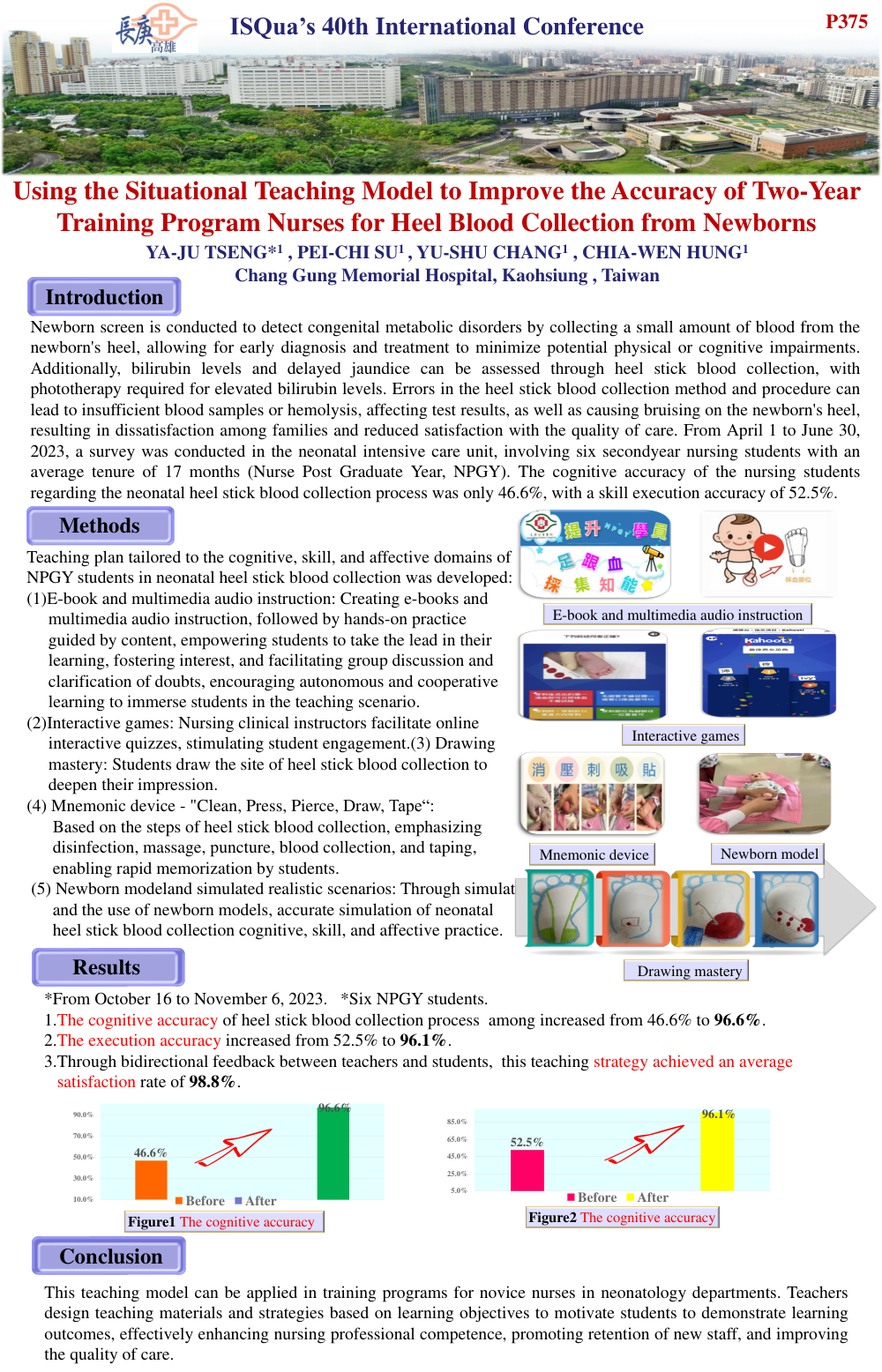
Newborn screen is conducted to detect congenital metabolic disorders by collecting a small amount of blood from the newborn's heel, allowing for early diagnosis and treatment to minimize potential physical or cognitive impairments. Additionally, bilirubin levels and delayed jaundice can be assessed through heel stick blood collection, with phototherapy required for elevated bilirubin levels. Errors in the heel stick blood collection method and procedure can lead to insufficient blood samples or hemolysis, affecting test results, as well as causing bruising on the newborn's heel, resulting in dissatisfaction among families and reduced satisfaction with the quality of care. From April 1 to June 30, 2023, a survey was conducted in the neonatal intensive care unit, involving six secondyear nursing students with an average tenure of 17 months (Nurse Post Graduate Year, NPGY). The cognitive accuracy of the nursing students regarding the neonatal heel stick blood collection process was only 46.6%, with a skill execution accuracy of 52.5%.
Methods
Teaching plan tailored to the cognitive, skill, and affective domains of
NPGY students in neonatal heel stick blood collection was developed:
(1)E-book and multimedia audio instruction: Creating e-books and
multimedia audio instruction, followed by hands-on practice
guided by content, empowering students to take the lead in their
learning, fostering interest, and facilitating group discussion and
clarification of doubts, encouraging autonomous and cooperative
learning to immerse students in the teaching scenario.
(2)Interactive games: Nursing clinical instructors facilitate online
interactive quizzes, stimulating student engagement.(3) Drawing
mastery: Students draw the site of heel stick blood collection to
deepen their impression.
(4) Mnemonic device - "Clean, Press, Pierce, Draw, Tape“:
Based on the steps of heel stick blood collection, emphasizing
disinfection, massage, puncture, blood collection, and taping,
enabling rapid memorization by students.
(5) Newborn modeland simulated realistic scenarios: Through simulated scenarios
and the use of newborn models, accurate simulation of neonatal
heel stick blood collection cognitive, skill, and affective practice.
Results
*From October 16 to November 6, 2023. *Six NPGY students.
1.The cognitive accuracy of heel stick blood collection process among increased from 46.6% to 96.6%.
2.The execution accuracy increased from 52.5% to 96.1%.
3.Through bidirectional feedback between teachers and students, this teaching strategy achieved an average
satisfaction rate of 98.8%.
Conclusion
This teaching model can be applied in training programs for novice nurses in neonatology departments. Teachers design teaching materials and strategies based on learning objectives to motivate students to demonstrate learning outcomes, effectively enhancing nursing professional competence, promoting retention of new staff, and improving the quality of care.