586 posters, 8 topics, 23 sessions, 1,077 authors, 622 institutions
ePostersLive by SciGen Technologies S.A. All rights reserved.
ISQua's 40th International Conference 2024
24th - 27th September 2024 | Istanbul, Türkiye

ISQUA2024-ABS-1209
Multiple strategies to improve sarcopenia for nursing home residents
Poster Presenter
Authors
Chia-Ming Chi, Yu-Ru Li, Ya-Ting Wu, Shu-Ting Chuang, Ju-Huei Chien
Affiliations
Department of nursing,Taichung Tzu Chi Hospital, Buddhist Tzu Chi Medical Foundation, Ph.D. Program in Healthcare Science, China Medical University, Taichung City, Taiwan, .Department of Family Medicine,Taichung Tzu Chi Hospital, Buddhist Tzu Chi Medical Foundation, .Office of Superintendent,Taichung Tzu Chi Hospital, Buddhist Tzu Chi Medical Foundation, .Department of Research, Taichung Tzu Chi Hospital, Buddhist Tzu Chi Medical Foundation
Part of Topic
Patient Safety & Quality Improvement
Multiple strategies to improve sarcopenia for nursing home residents
Chia-Ming Chi, Yu-Ru Li, Ya-Ting Wu , Shu-Ting Chuang,Ju-Huei Chien
Background:
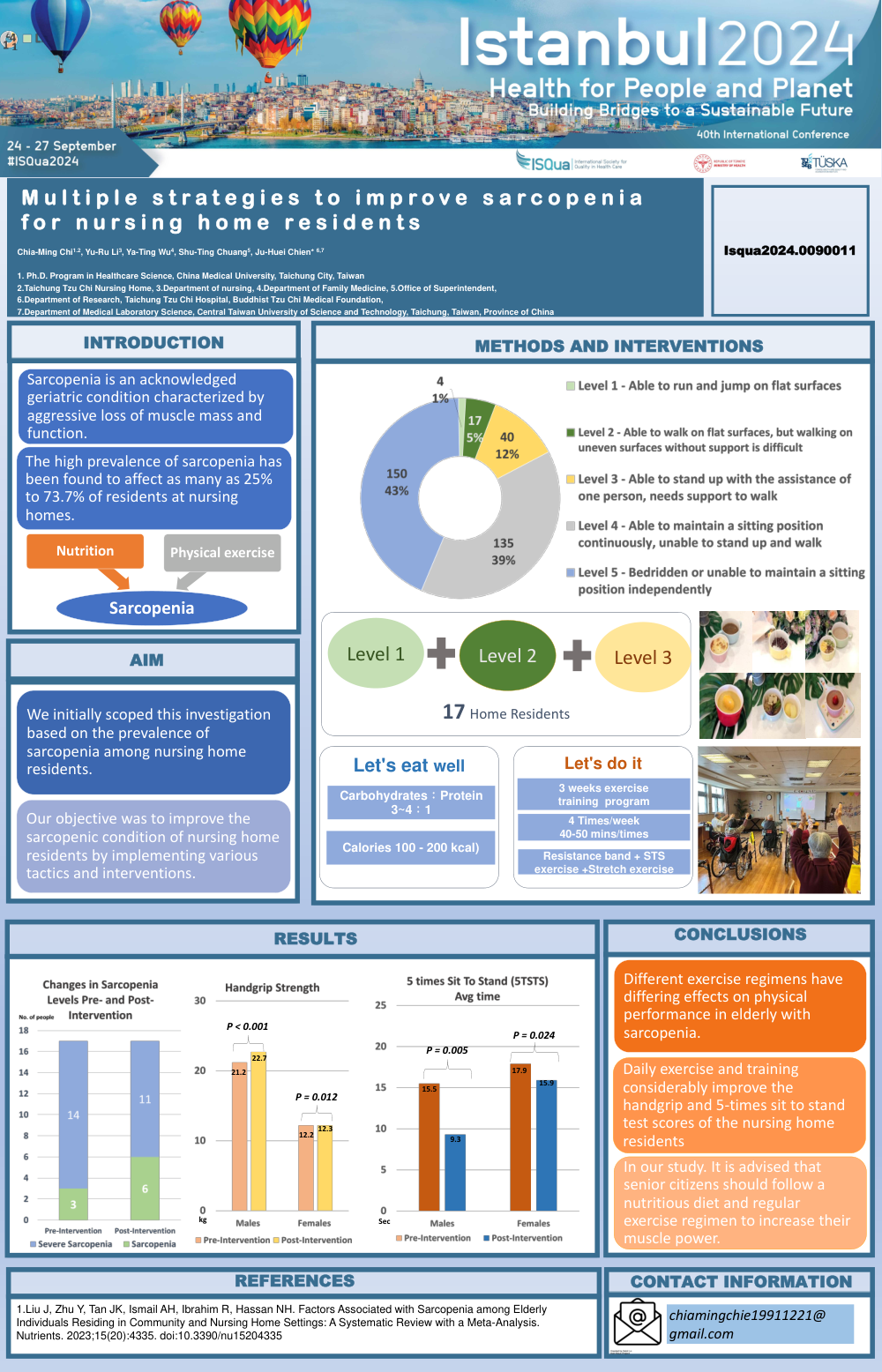
Sarcopenia is an acknowledged geriatric condition characterized by aggressive loss of muscle mass and function. The high prevalence of sarcopenia has been found to affect as many as 25% to 73.7% of residents at nursing homes.1 Sarcopenia not only impairs physical function but also lowers the quality of life of the elderly. A number of factors have been associated with sarcopenia, such as aging, chronic illness, malnutrition, and a lack of physical exercise. We initially scoped this investigation based on the prevalence of sarcopenia among nursing home residents. Our objective was to improve the sarcopenic condition of nursing home residents by implementing various tactics and interventions.
Methods:
The gross motor function categorization system (GMFCS) was used to assess the physical and muscular state of 346 individuals in total. We also evaluated the inhabitants of nursing homes in terms of their capacity for training and learning. Participants with physical limitations, those unable to participate, or those with compromised cognitive ability were not allowed. A total of sixty-one walkable GMFCS lever 1–3 participants were screened. To assess sarcopenic state, handgrip strength, 5-times chair stand test, and bioelectrical impedance analysis were performed on seven male residents (41%) and ten female residents (59%) (Figure 1). In this sarcopenia improvement project, we implemented two main strategies: "Let's eat well-modification in diet and Chinese herbal food" and "Let's do it-3 weeks exercise training award program."
Results:
Participants in the "let's do it-exercise program" were encouraged to work out for an hour, four days a week. We observed the best-performing muscle strength changes in a 4-month period follow-up. In the handgrip assessment, it increased from 21.2 ± 2.3 to 22.7 ± 3.7 (p < 0.001) in males, and for females, it increased from 12.2 ± 3.9 to 12.3 ± 4.7 (p = 0.012). The male movement time decreased from 15.5 ± 4.6 sec. to 9.3 ± 2.1 sec. (p = 0.005) and the female movement time decreased from 17.9 ± 1.8 sec. to 15.9 ± 2.5 sec. (p = 0.024) for the five chair stand tests. Nonetheless, there is no discernible variation in bioelectrical impedance analysis (BIA) between the pre- and post-intervention values.
Conclusions:
Sarcopenia is a complex and multifactorial disease. To date, only a few pharmaceutical medications have demonstrated promising outcomes in treating or minimizing symptoms. A recent system review indicated different exercise regimens have differing effects on physical performance in sarcopenia patients.2 Daily exercise and training considerably improve the handgrip and 5-times chair stand test scores of the nursing home residents in our study. It is advised that senior citizens should follow a nutritious diet and regular exercise regimen to increase their muscle power.