Loading...

586 posters, 8 topics, 23 sessions, 1,077 authors, 622 institutions

ePostersLive by SciGen Technologies S.A. All rights reserved.

ISQua's 40th International Conference 2024

24th - 27th September 2024 | Istanbul, Türkiye

ISQua's 40th International Conference 2024 banner

ISQUA2024-ABS-1207

Using Quality Control Circle to Optimise Hospital Pharmacy Inventory Management Processes-A Case Study of a Medical Center in Taiwan
Part of Topic

Patient Safety & Quality Improvement

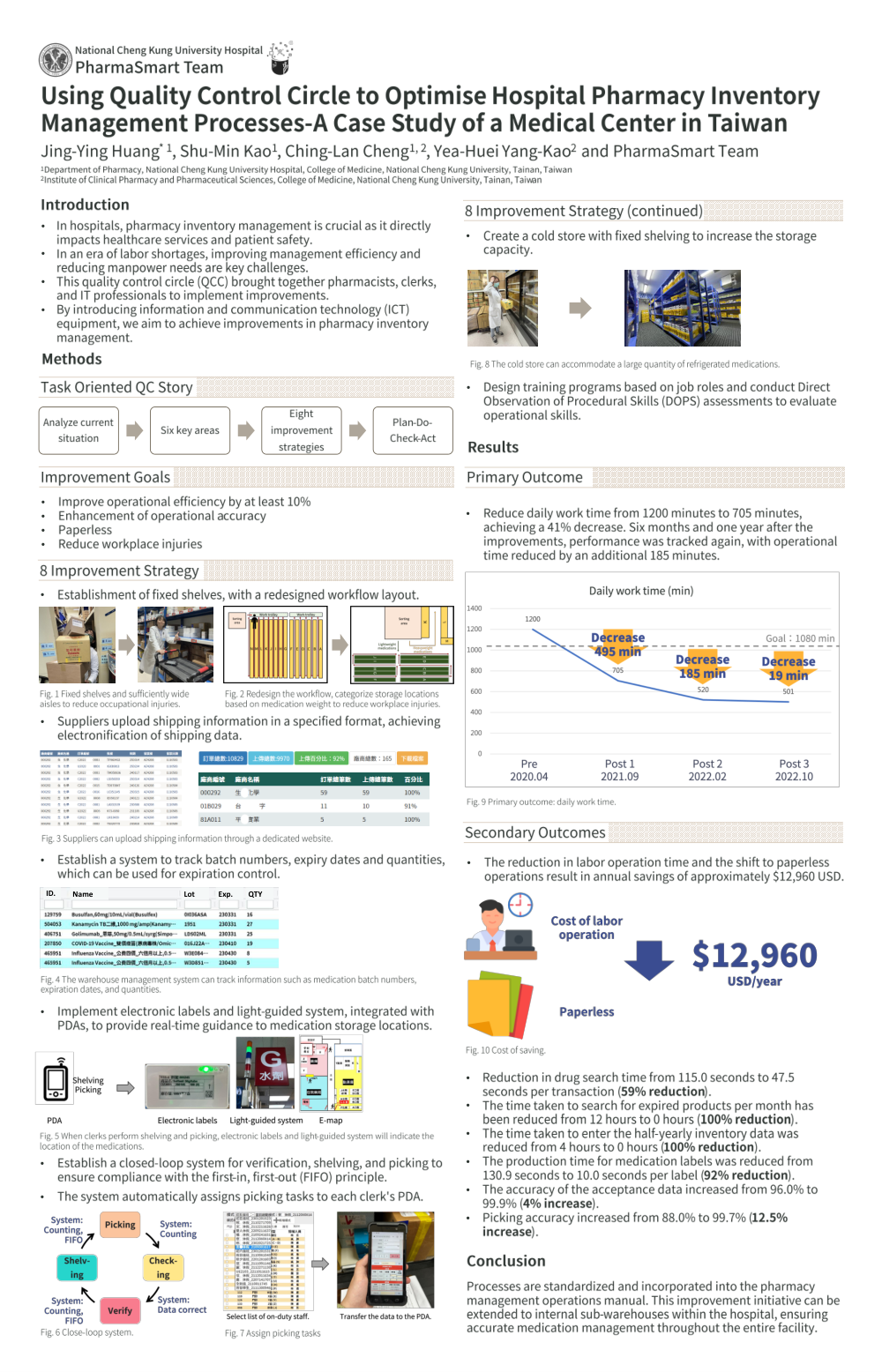
Using Quality Control Circle to Optimise Hospital Pharmacy Inventory Management Processes-A Case Study of a Medical Center in Taiwan

Introduction

•In hospitals, pharmacy inventory management is crucial as it directly impacts healthcare services and patient safety.
•In an era of labor shortages, improving management efficiency and reducing manpower needs are key challenges.
•This quality control circle (QCC) brought together pharmacists, clerks, and IT professionals to implement improvements.
•By introducing information and communication technology (ICT) equipment, we aim to achieve improvements in pharmacy inventory management.
 

Methods

Task Oriented QC Story

Improvement Goals

•Improve operational efficiency by at least 10%
•Enhancement of operational accuracy
•Paperless
•Reduce workplace injuries
 

8 Improvement Strategy

•Establishment of fixed shelves, with a redesigned workflow layout.
•Suppliers upload shipping information in a specified format, achieving electronification of shipping data.
•Establish a system to track batch numbers, expiry dates and quantities, which can be used for expiration control.
•Implement electronic labels and light-guided system, integrated with PDAs, to provide real-time guidance to medication storage locations.
•Establish a closed-loop system for verification, shelving, and picking to ensure compliance with the first-in, first-out (FIFO) principle.
•The system automatically assigns picking tasks to each clerk's PDA.
•Create a cold store with fixed shelving to increase the storage capacity.
•Design training programs based on job roles and conduct Direct Observation of Procedural Skills (DOPS) assessments to evaluate operational skills.
 

Results

Primary Outcome

•Reduce daily work time from 1200 minutes to 705 minutes, achieving a 41% decrease. Six months and one year after the improvements, performance was tracked again, with operational time reduced by an additional 185 minutes.
 

Secondary Outcomes

•The reduction in labor operation time and the shift to paperless operations result in annual savings of approximately $12,960 USD.
•Reduction in drug search time from 115.0 seconds to 47.5 seconds per transaction (59% reduction).
•The time taken to search for expired products per month has been reduced from 12 hours to 0 hours (100% reduction).
•The time taken to enter the half-yearly inventory data was reduced from 4 hours to 0 hours (100% reduction).
•The production time for medication labels was reduced from 130.9 seconds to 10.0 seconds per label (92% reduction).
•The accuracy of the acceptance data increased from 96.0% to 99.9% (4% increase).
•Picking accuracy increased from 88.0% to 99.7% (12.5% increase).
 

Conclusion

Processes are standardized and incorporated into the pharmacy management operations manual. This improvement initiative can be extended to internal sub-warehouses within the hospital, ensuring accurate medication management throughout the entire facility.

ISQua's 40th International Conference 2024 » banner
Copyright © 2015-2026, ePostersLive® SciGen is a registered trademark of SciGen Technologies S.A. Patent pending.

This website and third-party tools we use rely on cookies for the best user experience. By selecting "I agree", you agree to cookie usage as described in our Privacy Policy.