586 posters, 8 topics, 23 sessions, 1,077 authors, 622 institutions
ePostersLive by SciGen Technologies S.A. All rights reserved.
ISQua's 40th International Conference 2024
24th - 27th September 2024 | Istanbul, Türkiye

P170
Improving the Timeliness of Patient Experience Survey Analysis Through Information Technology
Poster Presenter
Part of Topic
Improving the Timeliness of Patient Experience Survey Analysis Through Information Technology
Jiang-Wen Chen 1,Hsu-Tseng Kao2,Cai-Wei Wang 1, Ya-Ping Lin 1,Jia-Jing Zhang 1,Ting-Kuo Yao 1
1 Hualien Tzu Chi Hospital, Buddhist Tzu Chi Medical Foundation, 2 Buddhist Tzu Chi Medical Foundation Eastern District
Information Room, Hualien, Taiwan
Objective
Patient-centeredness, as one of the six key healthcare quality goals proposed by the American Institute of Medicine, is integral to initiatives aimed at improving hospital quality. Regular surveys of patient experience are essential for this purpose. Traditionally reliant on time-consuming paper-based methods, these surveys involved extensive administrative tasks such as printing, face-to-face interviews, handwritten responses, and data entry, leading to delayed analyses. This paper details 1) the integration of Short Message Service (SMS) systems with Google Forms for efficient data collection and 2) the utilization of Power BI for automated data analysis, thereby enhancing the timely analysis of patient experience survey results. This method also facilitates swift responses to suggestions for improvement, underscoring the hospital’s commitment to quality care.
Methods
In May 2022, an SMS system was developed in collaboration with the Information Office. Customized text messages and Google Form links were tailored for different patient categories: outpatients, emergency room patients, and inpatients. Selection criteria included (1) outpatients who had completed the billing and provided a cell phone number, excluding first-time patients; (2) emergency room patients who had completed the billing and provided a cell phone number; (3) inpatients who had been discharged and billed, with a minimum 72-hour stay, and provided a cell phone number, excluding patients coded AAD, DDT , and deceased. The operational process entailed daily SMS dispatches to a randomly selected patient group, with adjustments in selection proportions based on response rates, especially targeting departments and wards with traditionally lower response rates or data collection challenges.
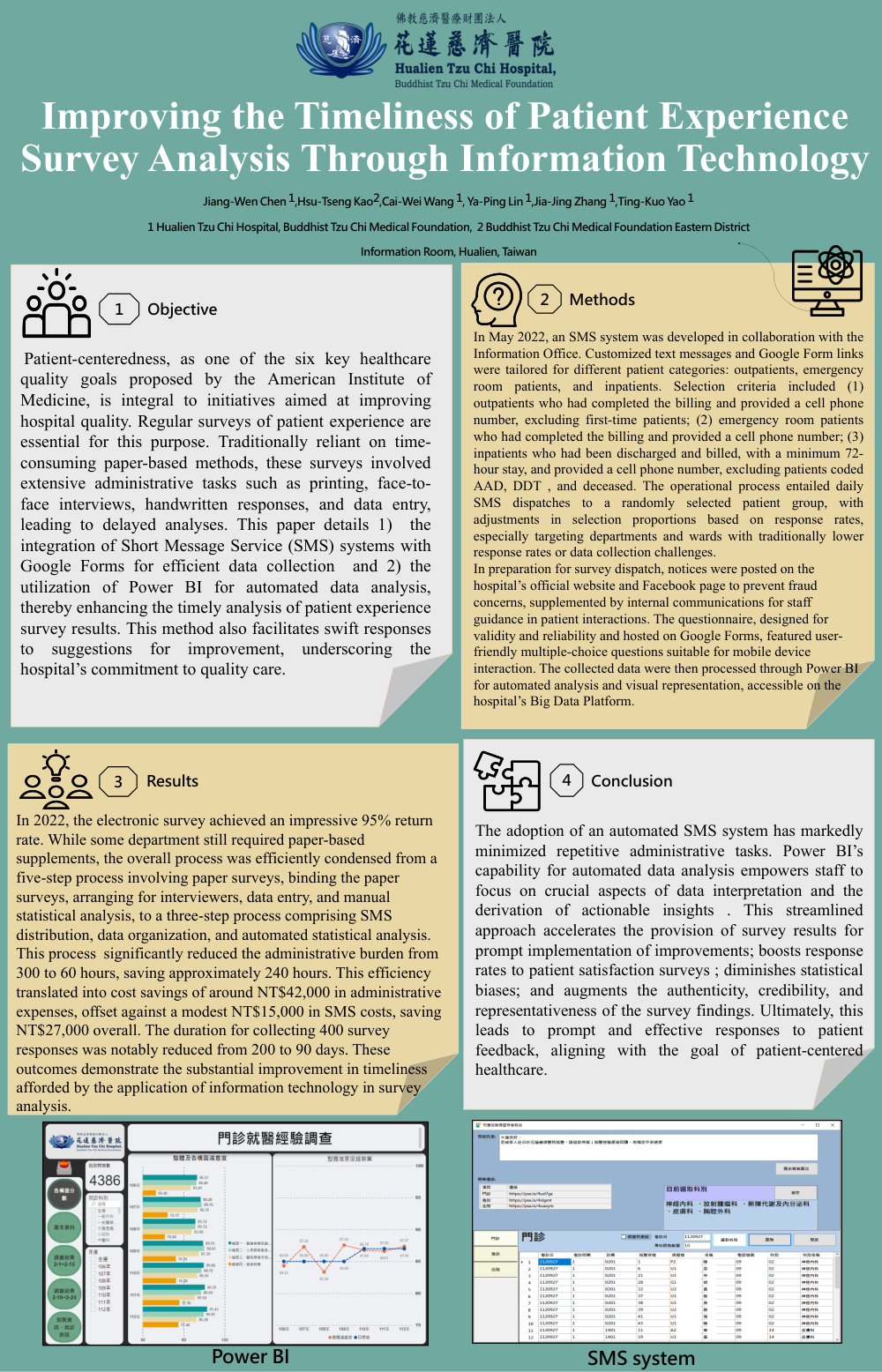
In preparation for survey dispatch, notices were posted on the hospital’s official website and Facebook page to prevent fraud concerns, supplemented by internal communications for staff guidance in patient interactions. The questionnaire, designed for validity and reliability and hosted on Google Forms, featured user-friendly multiple-choice questions suitable for mobile device interaction. The collected data were then processed through Power BI for automated analysis and visual representation, accessible on the hospital’s Big Data Platform.
Results
In 2022, the electronic survey achieved an impressive 95% return rate. While some department still required paper-based supplements, the overall process was efficiently condensed from a five-step process involving paper surveys, binding the paper surveys, arranging for interviewers, data entry, and manual statistical analysis, to a three-step process comprising SMS distribution, data organization, and automated statistical analysis. This process significantly reduced the administrative burden from 300 to 60 hours, saving approximately 240 hours. This efficiency translated into cost savings of around NT$42,000 in administrative expenses, offset against a modest NT$15,000 in SMS costs, saving NT$27,000 overall. The duration for collecting 400 survey responses was notably reduced from 200 to 90 days. These outcomes demonstrate the substantial improvement in timeliness afforded by the application of information technology in survey analysis.
Conclusion
The adoption of an automated SMS system has markedly minimized repetitive administrative tasks. Power BI’s capability for automated data analysis empowers staff to focus on crucial aspects of data interpretation and the derivation of actionable insights . This streamlined approach accelerates the provision of survey results for prompt implementation of improvements; boosts response rates to patient satisfaction surveys ; diminishes statistical biases; and augments the authenticity, credibility, and representativeness of the survey findings. Ultimately, this leads to prompt and effective responses to patient feedback, aligning with the goal of patient-centered healthcare.