586 posters, 8 topics, 23 sessions, 1,077 authors, 622 institutions
ePostersLive by SciGen Technologies S.A. All rights reserved.
ISQua's 40th International Conference 2024
24th - 27th September 2024 | Istanbul, Türkiye

P123
Enabling scale-up implementation of Patients Safety Checklist in Surgery: Investigating implementation factors -activities, and possible -outcomes.
Poster Presenter
Authors
Hilde Valen Waehle, Kristin Harris, Anette Storesund, Stig Harthug, Randi J. Tangvik, Åshild Teigland Tepstad, Ann Kristin Sandsbakk Austarheim, Arvid Steinar Haugen
Affiliations
Haukeland University Hospital, 1Department of Anaesthesia and Intensive Care, Haukeland University Hospital, Bergen, Norway,2Department of Research and Development, Haukeland University Hospital, Bergen, Norway, 1Department of Anaesthesia and Intensive Care, Haukeland University Hospital, Bergen, 4Department of Health and Caring Sciences, Western Norway University of Applied Sciences, Bergen, Norway,, 1Department of Anaesthesia and Intensive Care, Haukeland University Hospital, Bergen, Norway,2Department of Research and Development, Haukeland University Hospital, Bergen, Norway, 1Department of Anaesthesia and Intensive Care, Haukeland University Hospital, Bergen, Norway,, 1Department of Anaesthesia and Intensive Care, Haukeland University Hospital, Bergen, Norway, 5Centre for Nutrition, Faculty of Clinical Medicine, University of Bergen, Bergen, Norway,, 1Department of Anaesthesia and Intensive Care, Haukeland University Hospital, Bergen, Norway, 6Department of Clinical Nutrition, Haukeland University Hospital, Bergen, Norway,, 1Department of Anaesthesia and Intensive Care, Haukeland University Hospital, Bergen, Norway, 7Department of Nursing and Health Promotion Acute and Critical Illness, Oslo Metropolitan University, Oslo, Norway
Part of Topic
Patient Safety & Quality Improvement
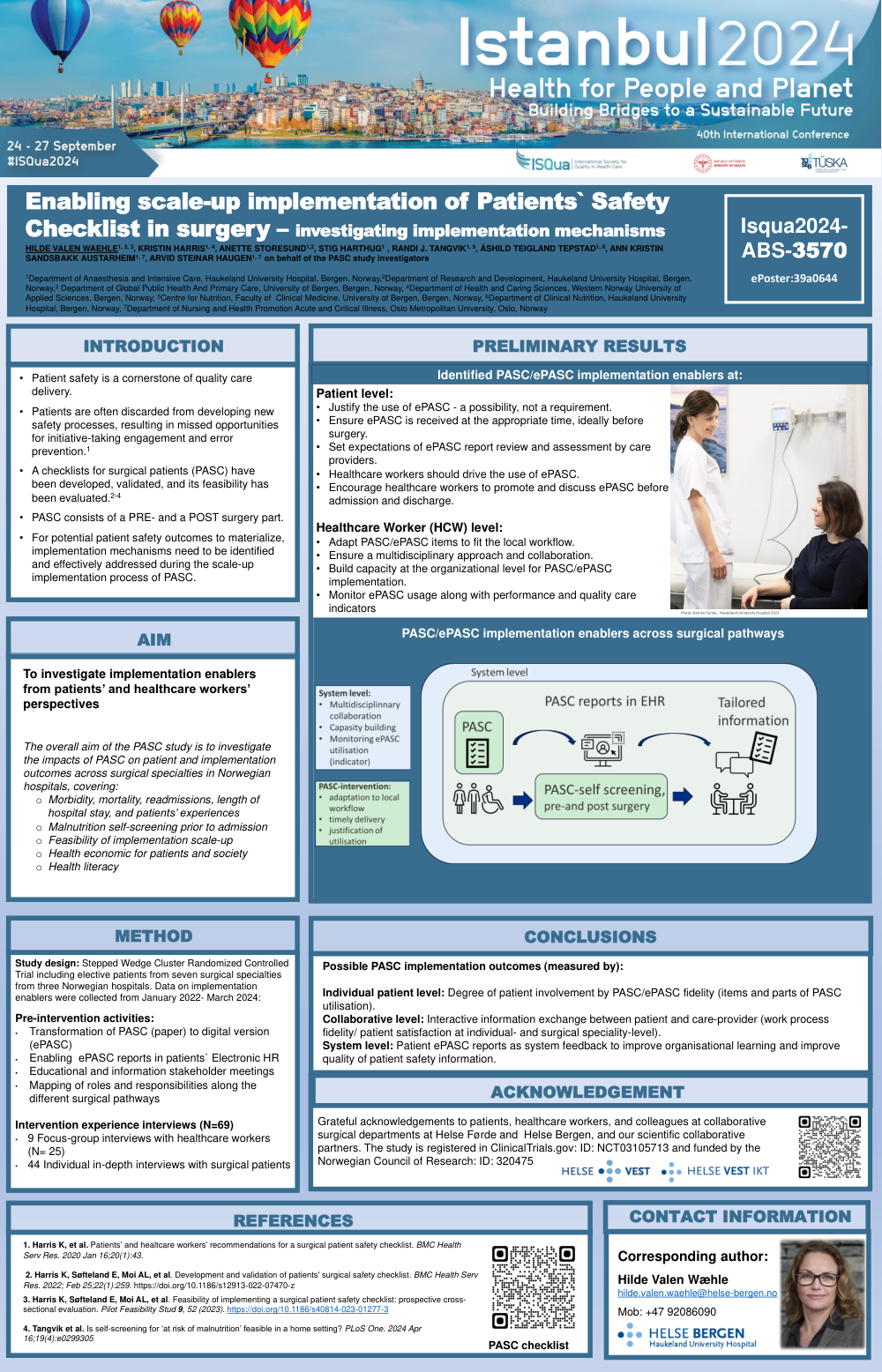
Enabling scale-up implementation of Patients` Safety Checklist in surgery – investigating implementation mechanisms
HILDE VALEN WAEHLE1, 2, 3, KRISTIN HARRIS1, 4, ANETTE STORESUND1,2,4, STIG HARTHUG1 , RANDI J. TANGVIK1, 5, ÅSHILD TEIGLAND TEPSTAD1, 6, ANN KRISTIN SANDSBAKK AUSTARHEIM1, 7, ARVID STEINAR HAUGEN1, 7 on behalf of the PASC study investigators
1Department of Anaesthesia and Intensive Care, Haukeland University Hospital, Bergen, Norway,2Department of Research and Development, Haukeland University Hospital, Bergen, Norway,3 Department of Global Public Health And Primary Care, University of Bergen, Bergen, Norway, 4Department of Health and Caring Sciences, Western Norway University of Applied Sciences, Bergen, Norway, 5Centre for Nutrition, Faculty of Clinical Medicine, University of Bergen, Bergen, Norway, 6Department of Clinical Nutrition, Haukeland University Hospital, Bergen, Norway, 7Department of Nursing and Health Promotion Acute and Critical Illness, Oslo Metropolitan University, Oslo, Norway
INTRODUCTION
To investigate implementation enablers from patients’ and healthcare workers’ perspectives
METHOD
Study design: Stepped Wedge Cluster Randomized Controlled Trial including elective patients from seven surgical specialties from three Norwegian hospitals. Data on implementation enablers were collected from January 2022- March 2024:
Pre-intervention activities:
Intervention experience interviews (N=69)
Patient level:
Healthcare Worker (HCW) level:
Possible PASC implementation outcomes (measured by):
Individual patient level: Degree of patient involvement by PASC/ePASC fidelity (items and parts of PASC utilisation).
Collaborative level: Interactive information exchange between patient and care-provider (work process fidelity/ patient satisfaction at individual- and surgical speciality-level).
System level: Patient ePASC reports as system feedback to improve organisational learning and improve quality of patient safety information.