586 posters, 8 topics, 23 sessions, 1,077 authors, 622 institutions
ePostersLive by SciGen Technologies S.A. All rights reserved.
ISQua's 40th International Conference 2024
24th - 27th September 2024 | Istanbul, Türkiye

P360
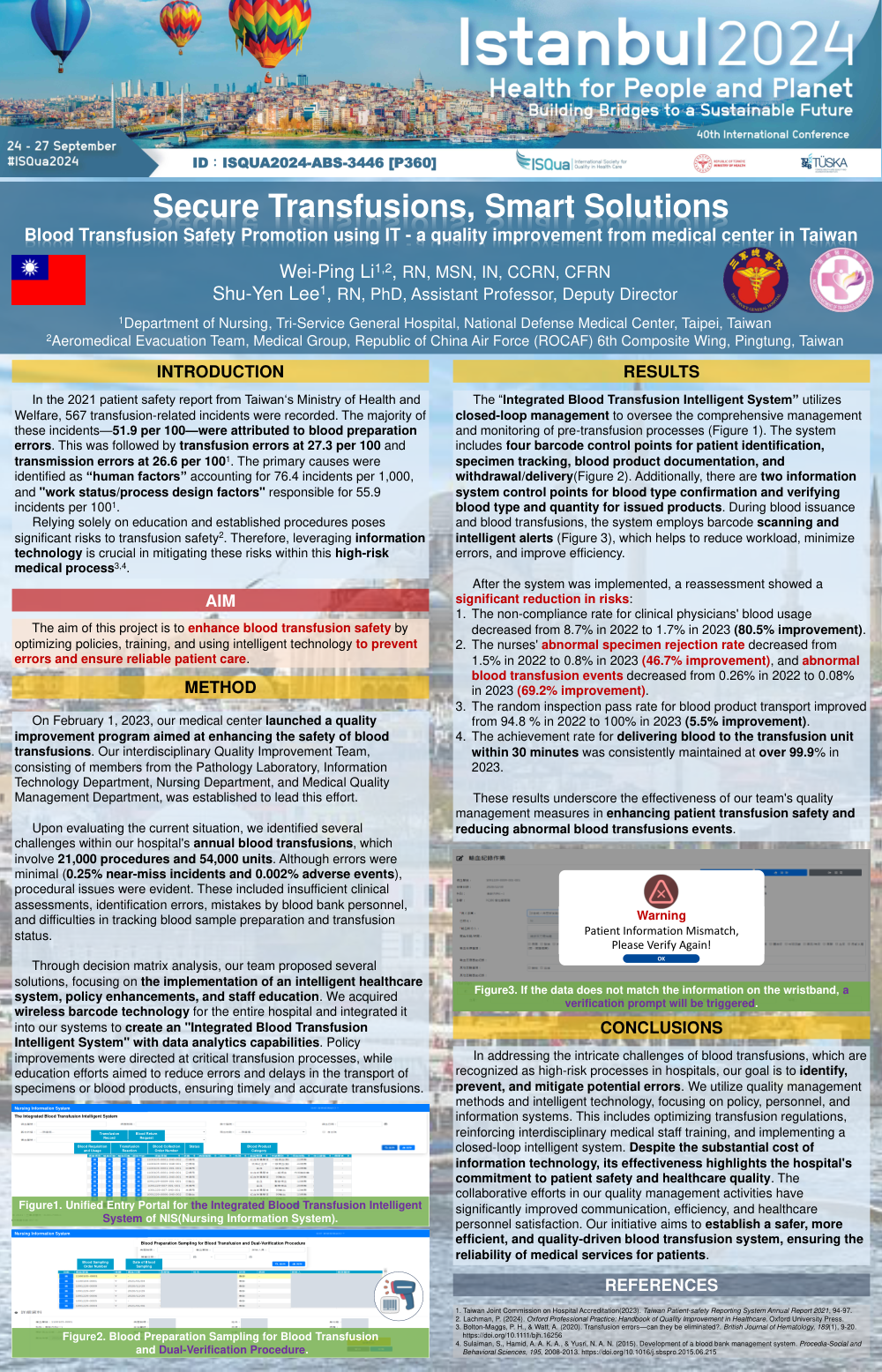
Secure Transfusions, Smart Solutions: Blood Transfusion Safety Promotion using IT - a quality improvement from medical center in Taiwan
Poster Presenter
Authors
Affiliations
Tri-Service General Hospital, National Defense Medical Center, Department of Nursing, Tri-Service General Hospital, National Defense Medical Center, Taipei, Taiwan, Department of Nursing, Tri-Service General Hospital, National Defense Medical Center, Taipei, Taiwan & Aeromedical Evacuation Team, Medical Group, Republic of China Air Force (ROCAF) 6th Composite Wing, Pingtung, Taiwan
Part of Topic
Patient Safety & Quality Improvement
Secure Transfusions, Smart Solutions
Blood Transfusion Safety Promotion using IT - a quality improvement from medical center in Taiwan
Wei-Ping Li1,2, RN, MSN, IN, CCRN, CFRN
Shu-Yen Lee1, RN, PhD, Assistant Professor, Deputy Director
1Department of Nursing, Tri-Service General Hospital, National Defense Medical Center, Taipei, Taiwan
2Aeromedical Evacuation Team, Medical Group, Republic of China Air Force (ROCAF) 6th Composite Wing, Pingtung, Taiwan
INTRODUCTION
In the 2021 patient safety report from Taiwan‘s Ministry of Health and Welfare, 567 transfusion-related incidents were recorded. The majority of these incidents—51.9 per 100—were attributed to blood preparation errors. This was followed by transfusion errors at 27.3 per 100 and transmission errors at 26.6 per 1001. The primary causes were identified as “human factors” accounting for 76.4 incidents per 1,000, and "work status/process design factors" responsible for 55.9 incidents per 1001.
Relying solely on education and established procedures poses significant risks to transfusion safety2. Therefore, leveraging information technology is crucial in mitigating these risks within this high-risk medical process3,4.
AIM
The aim of this project is to enhance blood transfusion safety by optimizing policies, training, and using intelligent technology to prevent errors and ensure reliable patient care.
METHOD
On February 1, 2023, our medical center launched a quality improvement program aimed at enhancing the safety of blood transfusions. Our interdisciplinary Quality Improvement Team, consisting of members from the Pathology Laboratory, Information Technology Department, Nursing Department, and Medical Quality Management Department, was established to lead this effort.
Upon evaluating the current situation, we identified several challenges within our hospital's annual blood transfusions, which involve 21,000 procedures and 54,000 units. Although errors were minimal (0.25% near-miss incidents and 0.002% adverse events), procedural issues were evident. These included insufficient clinical assessments, identification errors, mistakes by blood bank personnel, and difficulties in tracking blood sample preparation and transfusion status.
Through decision matrix analysis, our team proposed several solutions, focusing on the implementation of an intelligent healthcare system, policy enhancements, and staff education. We acquired wireless barcode technology for the entire hospital and integrated it into our systems to create an "Integrated Blood Transfusion Intelligent System" with data analytics capabilities. Policy improvements were directed at critical transfusion processes, while education efforts aimed to reduce errors and delays in the transport of specimens or blood products, ensuring timely and accurate transfusions.
RESULTS
The “Integrated Blood Transfusion Intelligent System” utilizes closed-loop management to oversee the comprehensive management and monitoring of pre-transfusion processes (Figure 1). The system includes four barcode control points for patient identification, specimen tracking, blood product documentation, and withdrawal/delivery(Figure 2). Additionally, there are two information system control points for blood type confirmation and verifying blood type and quantity for issued products. During blood issuance and blood transfusions, the system employs barcode scanning and intelligent alerts (Figure 3), which helps to reduce workload, minimize errors, and improve efficiency.
After the system was implemented, a reassessment showed a significant reduction in risks:
1.The non-compliance rate for clinical physicians' blood usage decreased from 8.7% in 2022 to 1.7% in 2023 (80.5% improvement).
2.The nurses' abnormal specimen rejection rate decreased from 1.5% in 2022 to 0.8% in 2023 (46.7% improvement), and abnormal blood transfusion events decreased from 0.26% in 2022 to 0.08% in 2023 (69.2% improvement).
3.The random inspection pass rate for blood product transport improved from 94.8 % in 2022 to 100% in 2023 (5.5% improvement).
4.The achievement rate for delivering blood to the transfusion unit within 30 minutes was consistently maintained at over 99.9% in 2023.
These results underscore the effectiveness of our team's quality management measures in enhancing patient transfusion safety and reducing abnormal blood transfusions events.
CONCLUSIONS
In addressing the intricate challenges of blood transfusions, which are recognized as high-risk processes in hospitals, our goal is to identify, prevent, and mitigate potential errors. We utilize quality management methods and intelligent technology, focusing on policy, personnel, and information systems. This includes optimizing transfusion regulations, reinforcing interdisciplinary medical staff training, and implementing a closed-loop intelligent system. Despite the substantial cost of information technology, its effectiveness highlights the hospital's commitment to patient safety and healthcare quality. The collaborative efforts in our quality management activities have significantly improved communication, efficiency, and healthcare personnel satisfaction. Our initiative aims to establish a safer, more efficient, and quality-driven blood transfusion system, ensuring the reliability of medical services for patients.