586 posters, 8 topics, 23 sessions, 1,077 authors, 622 institutions
ePostersLive by SciGen Technologies S.A. All rights reserved.
ISQua's 40th International Conference 2024
24th - 27th September 2024 | Istanbul, Türkiye

P306
Enhancing Patient Safety and Nursing Efficiency through the Implementation of a Medication Barcode Label Printing System
Poster Presenter
Authors
Shu-Fang Wu, Mei-Chun Chen, Zheng-Ren Huang, Jen-Yeu Chi, Hsueh-Ming Kuo, Wei-Jen Huang
Affiliations
National Cheng Kung University Hospital, null1Department of Nursing, National Cheng Kung University Hospital, Tainan, Taiwan, 2Department of Nursing, College of Medicine, National Cheng Kung University, Tainan, Taiwan, 1Department of Nursing, National Cheng Kung University Hospital, Tainan, Taiwan, 3Department of Information Technology, National Cheng Kung University Hospital, Tainan, Taiwan
Part of Topic
Patient Safety & Quality Improvement
Title:Enhancing Patient Safety and Nursing Efficiency through the Implementation of a MBLP System
Authors:Shu-Fang Wu* 1, 2 , Mei-Chun Chen 1 , Zheng-Ren Huang 3 , Jen-Yeu Chi 1 , Hsueh-Ming Kuo 1 , Wei-Jen Huang 1
1 Department of Nursing, National Cheng Kung University Hospital,
2 Department of Nursing, College of Medicine, National Cheng Kung University,
3 Department of Information Technology, National Cheng Kung University Hospital, Tainan, Taiwan
Introduction:
Human errors account for 80% of nurses' medication administration errors.
Human factors such as distractions, interruptions, poor communication, fatigue, and time pressure contribute to these errors.
BCMA technology can reduce manual transcription errors and lower human error rates by 50%.
Studies show that barcode scanning reduces medication errors by over 50% and patient identification errors by 70%.
Medication and patient identification errors can be significantly reduced through human factors engineering and system improvements in the medication process.
Method and Result:
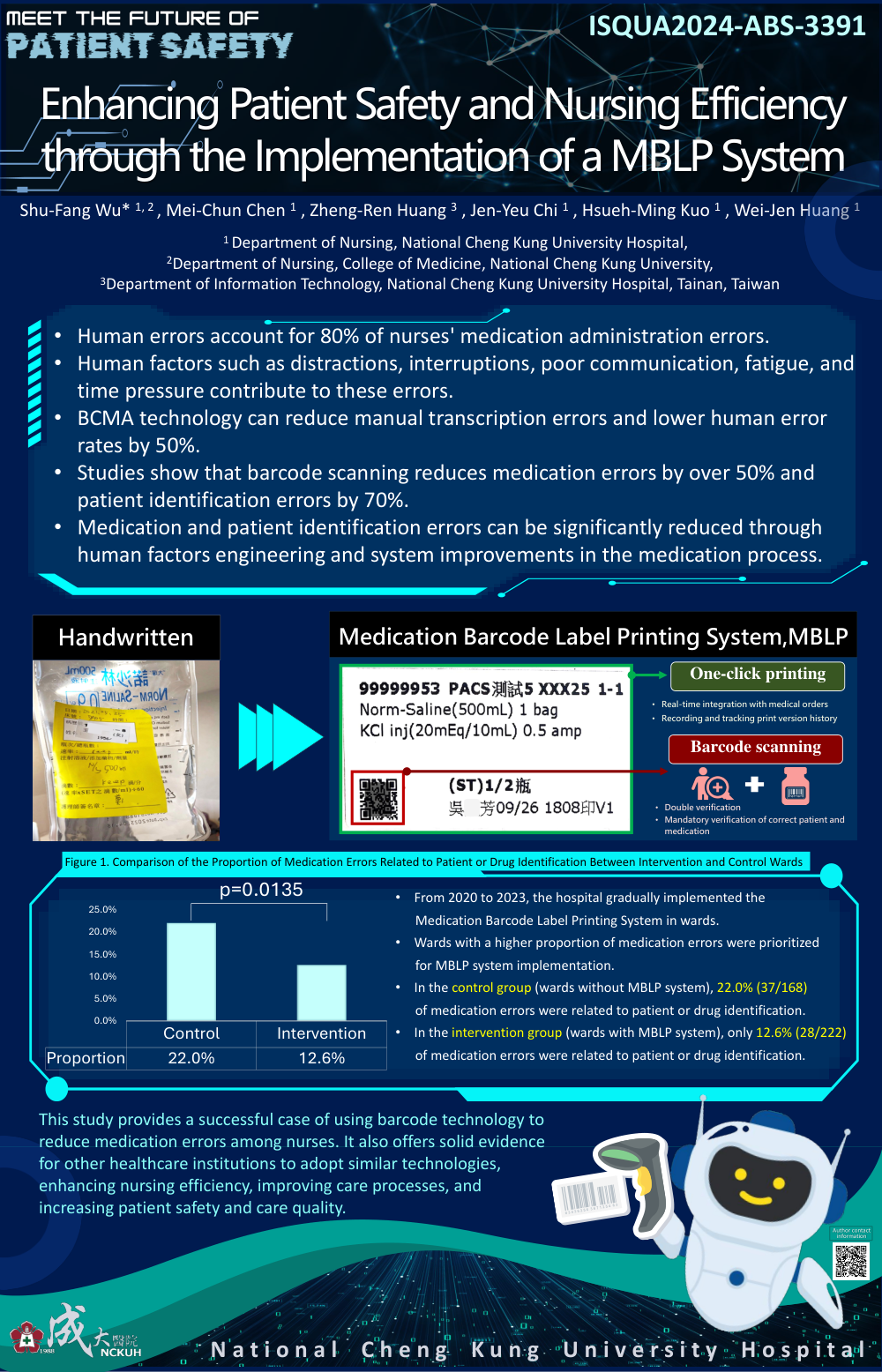
From 2020 to 2023, the hospital gradually implemented the Medication Barcode Label Printing System in wards.
Wards with a higher proportion of medication errors related to patient or drug identification were prioritized for system implementation.
In the control group (wards without the system), 22.0% (37/168) of medication errors were related to patient or drug identification.
In the intervention group (wards with the system), only 12.6% (28/222) of medication errors were related to patient or drug identification.
The intervention group showed a significantly lower rate of patient or drug identification errors compared to the control group (p = 0.0135, Chi-square test). (Figure 1)
Conclusions
This study provides a successful case of using barcode technology to reduce medication errors among nurses. It also offers solid evidence for other healthcare institutions to adopt similar technologies, enhancing nursing efficiency, improving care processes, and increasing patient safety and care quality.