586 posters, 8 topics, 23 sessions, 1,077 authors, 622 institutions
ePostersLive by SciGen Technologies S.A. All rights reserved.
ISQua's 40th International Conference 2024
24th - 27th September 2024 | Istanbul, Türkiye

P081
Intraoperative Radiotherapy & Oncoplastic Breast Surgery - Safe, Feasible, and Better
Poster Presenter
Authors
Dominic van Loggerenberg, Carol-Ann Benn, Barend van den Bergh, Hadar Nevo, Tanya Volschenk
Affiliations
BREAST CARE CENTER OF EXCELLENCE MILPARK, Netcare Breast Care Centre of Excellence, Milpark Hospital, 10 Guild Road, South Africa, MB.BCh (Wits) FCS (SA) Department of Immunology, Faculty of Health Sciences, University of Pretoria, MBchB(UP). FC PLAST SURG(SA), MMED(PLAST &RECONSTRUCTIVE SURG)WITS, HoD Netcare Breast Care Centre of Excellence, Milpark Hospital, 10 Guild Road, South Africa, Netcare Breast Care Centre of Excellence, Milpark Hospital, 9 Guild Road, South Africa
Part of Topic
Patient Safety & Quality Improvement
Intraoperative Radiotherapy & Oncoplastic Breast Surgery - Safe, Feasible, And Better
-
Prof Carol-Ann Benn, MB.BCh (Wits) FCS (SA) Department of Immunology, Faculty of Health Sciences, University of Pretoria
-
Dr Hadar Nevo, Netcare Breast Care Centre of Excellence, Milpark Hospital, 9 Guild Road, South Africa
-
Dr Barend H. van den Bergh, MBchB(UP). FC PLAST SURG(SA), MMED(PLAST &RECONSTRUCTIVE SURG)WITS, HoD Netcare Breast Care Centre of Excellence, Milpark Hospital, 10 Guild Road, South Africa
-
Dominic Van Loggerenberg, Netcare Breast Care Centre of Excellence, Milpark Hospital, 10 Guild Road, South Africa
-
Tanya Volschenk, Netcare Breast Care Centre of Excellence, Milpark Hospital, 10 Guild Road, South Africa
Key-words:
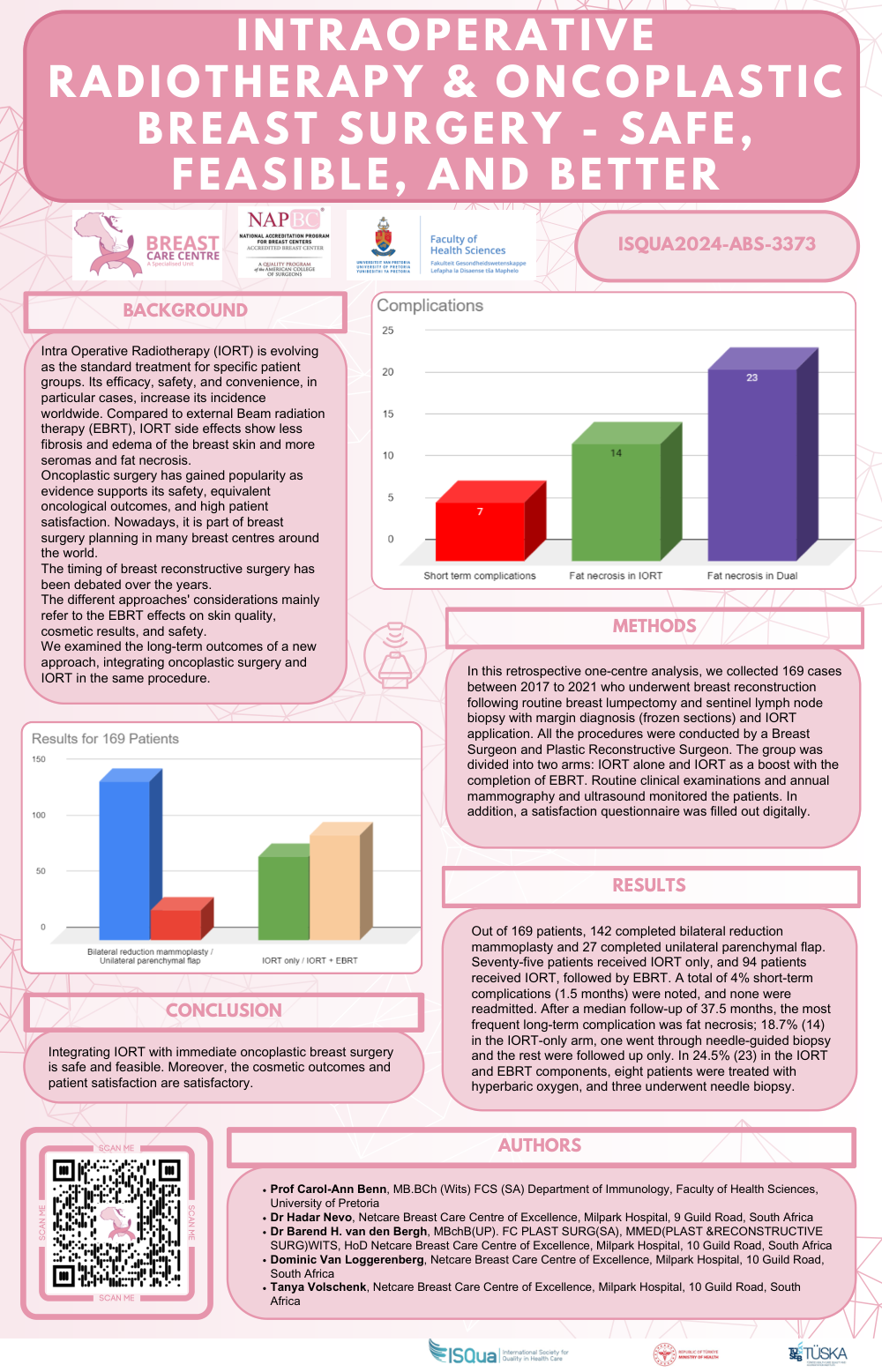
Background: Intra Operative Radiotherapy (IORT) is evolving as the standard treatment for specific patient groups. Its efficacy, safety, and convenience, in particular cases, increase its incidence worldwide. Compared to external Beam radiation therapy (EBRT), IORT side effects show less fibrosis and edema of the breast skin and more seromas and fat necrosis.
Oncoplastic surgery has gained popularity as evidence supports its safety, equivalent oncological outcomes, and high patient satisfaction. Nowadays, it is part of breast surgery planning in many breast centres around the world.
The timing of breast reconstructive surgery has been debated over the years.
The different approaches' considerations mainly refer to the EBRT effects on skin quality, cosmetic results, and safety.
We examined the long-term outcomes of a new approach, integrating oncoplastic surgery and IORT in the same procedure.
Methods: In this retrospective one-centre analysis, we collected 169 cases between 2017 to 2021 who underwent breast reconstruction following routine breast lumpectomy and sentinel lymph node biopsy with margin diagnosis (frozen sections) and IORT application. All the procedures were conducted by a Breast Surgeon and Plastic Reconstructive Surgeon. The group was divided into two arms: IORT alone and IORT as a boost with the completion of EBRT. Routine clinical examinations and annual mammography and ultrasound monitored the patients. In addition, a satisfaction questionnaire was filled out digitally.
Results: Out of 169 patients, 142 completed bilateral reduction mammoplasty and 27 completed unilateral parenchymal flap. Seventy-five patients received IORT only, and 94 patients received IORT, followed by EBRT. A total of 4% short-term complications (1.5 months) were noted, and none were readmitted. After a median follow-up of 37.5 months, the most frequent long-term complication was fat necrosis; 18.7% (14) in the IORT-only arm, one went through needle-guided biopsy and the rest were followed up only. In 24.5% (23) in the IORT and EBRT components, eight patients were treated with hyperbaric oxygen, and three underwent needle biopsy.
Conclusion: Integrating IORT with immediate oncoplastic breast surgery is safe and feasible. Moreover, the cosmetic outcomes and patient satisfaction are satisfactory.