586 posters, 8 topics, 23 sessions, 1,077 authors, 622 institutions
ePostersLive by SciGen Technologies S.A. All rights reserved.
ISQua's 40th International Conference 2024
24th - 27th September 2024 | Istanbul, Türkiye

P505
Harmonizing local referral systems: lessons and insights from the development of referral guidelines in selected UHC-integration sites in the National Capital Region
Part of Topic
Integrated Care Communities
Introduction
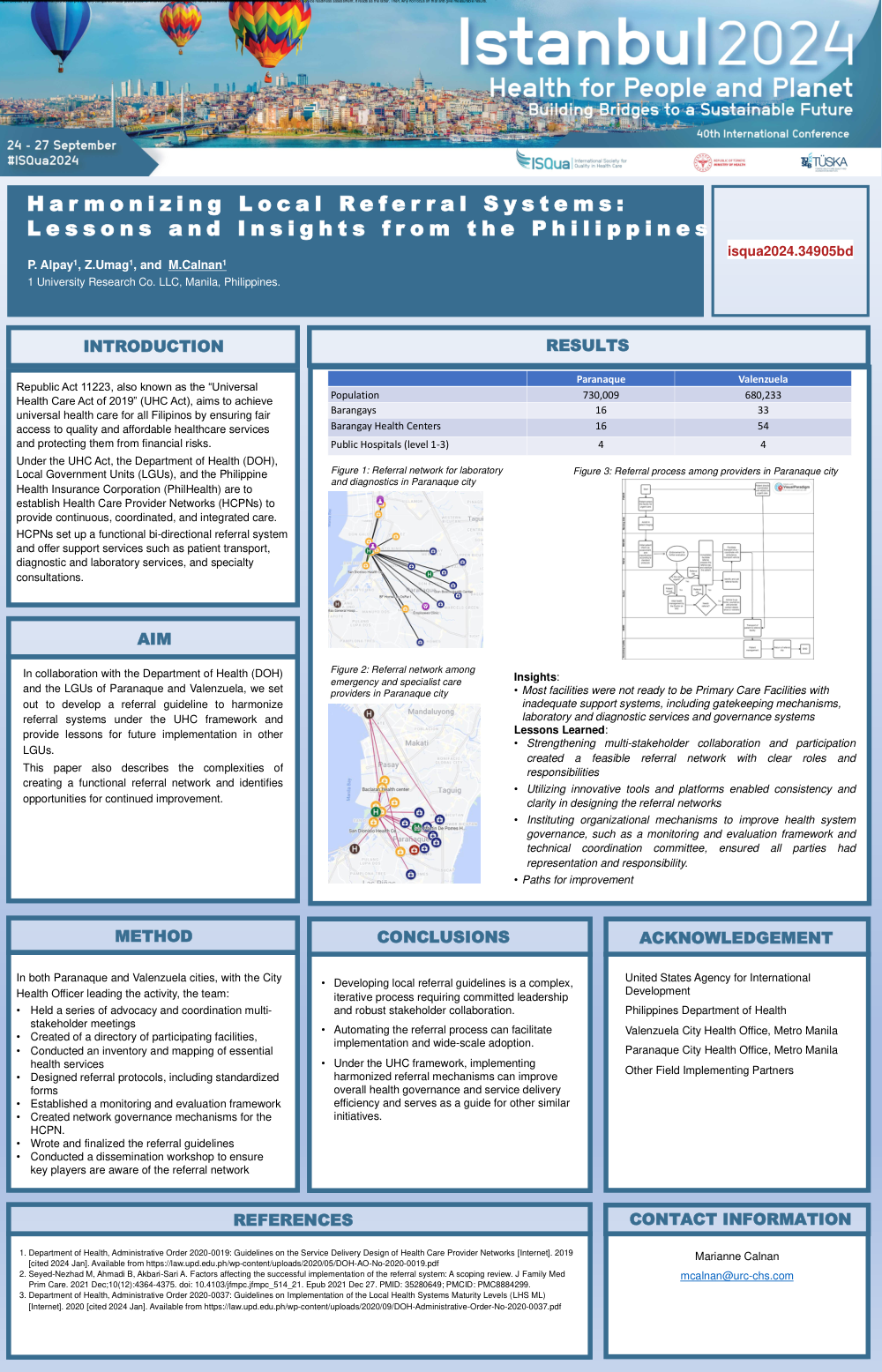
Following the legislation of the Universal Health Care (UHC) Act of 2019 in the Philippines, local government units (LGU) were mandated to integrate into province or city-wide health systems (P/CWHS) through a Health Care Provider Network (HCPN), with emphasis on the need for a functional and integrated referral system. In collaboration with the Department of Health (DOH) and the LGUs of Paranaque and Valenzuela, we explored the complexities of developing a referral guideline to harmonize referral systems under the UHC framework and provided insights for future implementation.
Methods
The development of the referral guidelines involved a series of multi-stakeholder convenings following an iterative process that included advocacy and coordination, facility and service capability assessment, data validation and referral design workshops, and consultative meetings. This was concluded with a dissemination and simulation workshop.
Results/Lessons Learned
The activities resulted in the creation of a directory of participating facilities, an inventory and mapping of essential health services, a visualization of patient referral pathways, and designing referral protocols, including standardized forms. Further consultations with stakeholders developed a monitoring and evaluation framework and network governance mechanisms for the HCPN.
The analysis of the existing service delivery system showed that LGUs were constrained with incomplete diagnostic services in primary care facilities (PCFs), resulting in congestion in level one hospitals, inadequate capacity of PCFs to facilitate gatekeeping, and absence of level 2 government hospitals for specialty care that can buffer for the tertiary and apex hospitals. Furthermore, the lack of an interconnected and interoperable health information system has hampered the seamless integration and implementation of existing referral mechanisms.
Strengthened multi-stakeholder collaboration emerges as critical for success, emphasizing the importance of identifying local champions, forming technical working groups, and maintaining open communications among stakeholders.
The use of online platforms like Google Forms, Google Docs, and Google Maps was instrumental in streamlining data collection, enhancing the visualization of referral relationships, and facilitating efficient work collaborations.
Instituting network governance mechanisms provided for a clear delineation of roles, a definitive accountability framework, and a platform for convergence and participation.
Conclusion
Developing local referral guidelines is a complex process that requires committed leadership, an iterative process, and meaningful collaboration among stakeholders. To further enhance this, close monitoring of implementation and continuous improvement are recommended. Automating the referral process and its recording and reporting can facilitate implementation and wide-scale adoption.