586 posters, 8 topics, 23 sessions, 1,077 authors, 622 institutions
ePostersLive by SciGen Technologies S.A. All rights reserved.
ISQua's 40th International Conference 2024
24th - 27th September 2024 | Istanbul, Türkiye

ISQUA2024-ABS-2619
Implementation experiences of providing care coordination for children with medical complexity in rural Australia
Poster Presenter
Part of Topic
Integrated Care Communities
Implementation experiences of Providingcare coordination for children with medical complexity in rural Australia
Hutchinson K1, Lingam R2,3, Smithers-Sheedy H2, Zurynski Y1,4
1Australia Institute of Health Innovation, Macquarie University, 2Paediatric Population Health, University of New South Wales, 3The Sydney Children’s Hospitals Network, 4Partnership Centre of Health System Sustainability, Macquarie University
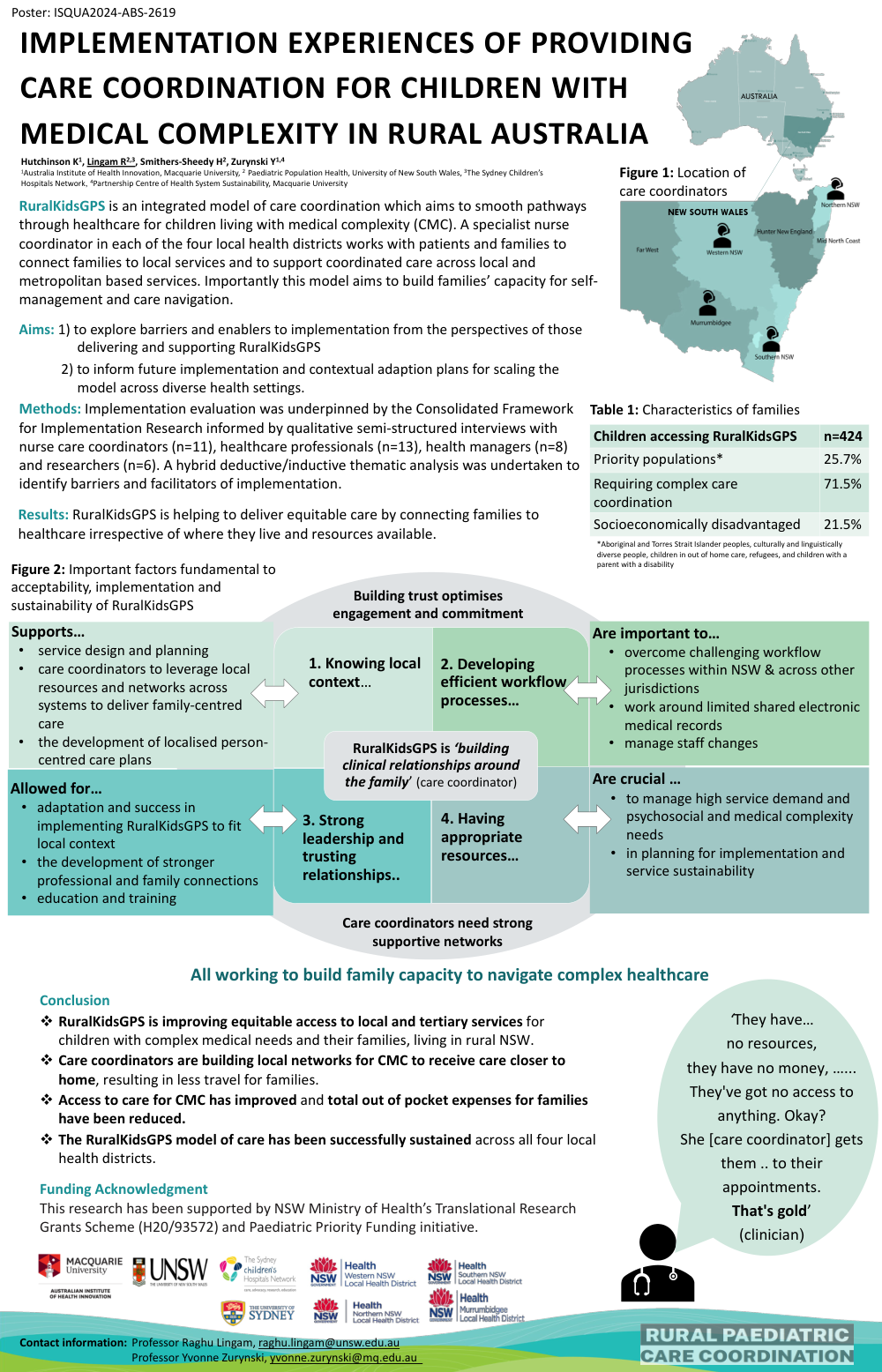
RuralKidsGPS is an integrated model of care coordination which aims to smooth pathways through healthcare for children living with medical complexity (CMC). A specialist nurse coordinator in each of the four local health districts works with patients and families to connect families to local services and to support coordinated care across local and metropolitan based services. Importantly this model aims to build families’ capacity for self-management and care navigation.
Aims: 1) to explore barriers and enablers to implementation from the perspectives of those delivering and supporting RuralKidsGPS
2) to inform future implementation and contextual adaption plans for scaling the model across diverse health settings.
Methods: Implementation evaluation was underpinned by the Consolidated Framework for Implementation Research informed by qualitative semi-structured interviews with nurse care coordinators (n=11), healthcare professionals (n=13), health managers (n=8) and researchers (n=6). A hybrid deductive/inductive thematic analysis was undertaken to identify barriers and facilitators of implementation.
Results: RuralKidsGPS is helping to deliver equitable care by connecting families to healthcare irrespective of where they live and resources available.
Conclusion