586 posters, 8 topics, 23 sessions, 1,077 authors, 622 institutions
ePostersLive by SciGen Technologies S.A. All rights reserved.
ISQua's 40th International Conference 2024
24th - 27th September 2024 | Istanbul, Türkiye

P088
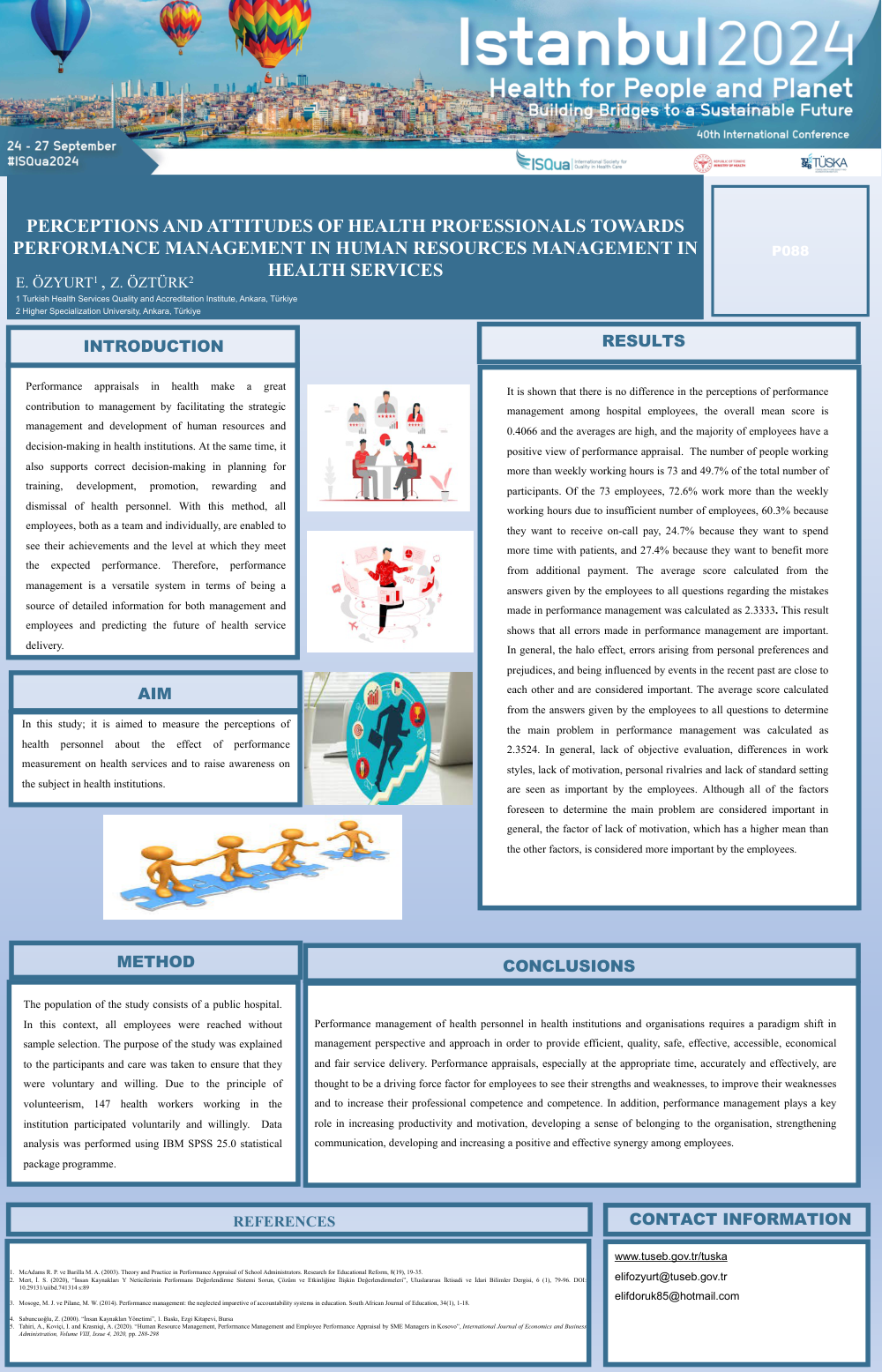
PERCEPTIONS AND ATTITUDES OF HEALTH PROFESSIONALS TOWARDS PERFORMANCE MANAGEMENT IN HUMAN RESOURCES MANAGEMENT IN HEALTH SERVICES
Poster Presenter
Authors
Affiliations
Part of Topic
Patient Safety & Quality Improvement
PERCEPTIONS AND ATTITUDES OF HEALTH PROFESSIONALS TOWARDS PERFORMANCE MANAGEMENT IN HUMAN RESOURCES MANAGEMENT IN HEALTH SERVICES
Elif ÖZYURT1, Zekai ÖZTÜRK2
Abstract
Introduction: Performance appraisals in health make a great contribution to management by facilitating the strategic management and development of human resources and decision-making in health institutions. At the same time, it also supports correct decision-making in planning for training, development, promotion, rewarding and dismissal of health personnel. With this method, all employees, both as a team and individually, are enabled to see their achievements and the level at which they meet the expected performance. Therefore, performance management is a versatile system in terms of being a source of detailed information for both management and employees and predicting the future of health service delivery. In this study; it is aimed to measure the perceptions of health personnel about the effect of performance measurement on health services and to raise awareness on the subject in health institutions.
Method: The population of the study consists of a public hospital. In this context, all employees were reached without sample selection. The purpose of the study was explained to the participants and care was taken to ensure that they were voluntary and willing. Due to the principle of volunteerism, 147 health workers working in the institution participated voluntarily and willingly. Data analysis was performed using IBM SPSS 25.0 statistical package programme.
Results: It is shown that there is no difference in the perceptions of performance management among hospital employees, the overall mean score is 0.4066 and the averages are high, and the majority of employees have a positive view of performance appraisal. The number of people working more than weekly working hours is 73 and 49.7% of the total number of participants. Of the 73 employees, 72.6% work more than the weekly working hours due to insufficient number of employees, 60.3% because they want to receive on-call pay, 24.7% because they want to spend more time with patients, and 27.4% because they want to benefit more from additional payment. The average score calculated from the answers given by the employees to all questions regarding the mistakes made in performance management was calculated as 2.3333. This result shows that all errors made in performance management are important. In general, the halo effect, errors arising from personal preferences and prejudices, and being influenced by events in the recent past are close to each other and are considered important. The average score calculated from the answers given by the employees to all questions to determine the main problem in performance management was calculated as 2.3524. In general, lack of objective evaluation, differences in work styles, lack of motivation, personal rivalries and lack of standard setting are seen as important by the employees. Although all of the factors foreseen to determine the main problem are considered important in general, the factor of lack of motivation, which has a higher mean than the other factors, is considered more important by the employees.
Conclusion: Performance management of health personnel in health institutions and organisations requires a paradigm shift in management perspective and approach in order to provide efficient, quality, safe, effective, accessible, economical and fair service delivery. Performance appraisals, especially at the appropriate time, accurately and effectively, are thought to be a driving force factor for employees to see their strengths and weaknesses, to improve their weaknesses and to increase their professional competence and competence. In addition, performance management plays a key role in increasing productivity and motivation, developing a sense of belonging to the organisation, strengthening communication, developing and increasing a positive and effective synergy among employees.
Keywords: Performance Management, Human Resources Management, Professional Development and Competence