586 posters, 8 topics, 23 sessions, 1,077 authors, 622 institutions
ePostersLive by SciGen Technologies S.A. All rights reserved.
ISQua's 40th International Conference 2024
24th - 27th September 2024 | Istanbul, Türkiye

P095
COMPARISON OF ANTI-HCV LEVELS IN HCV RNA POSITIVE SERUM SAMPLES WITH DIFFERENT ELISA METHODS
Poster Presenter
Authors
Affiliations
Part of Topic
Patient Safety & Quality Improvement
isqua2024.3410202
Comparison of Anti-HCV levels in HCV-RNA positive serum samples with different ELISA methods
ERDOGAN YAYLA¹, ALPARSLAN TOYRAN²
¹: KARACABEY STATE HOSPITAL, CENTRAL LABORATORY
KARACABEY, BURSA,TÜRKİYE
²: ANKARA BILKENT CITY HOSPITAL, MEDICAL MICROBIOLOGY LABORATORY, ANKARA, TÜRKİYE
INTRODUCTION: Hepatitis C is an inflammation of the liver caused by the hepatitis C virus (HCV). This virus; It may cause acute or chronic hepatitis, and may cause liver cirrhosis and cancer in advanced ages in a spectrum ranging from acute disease to chronic disease. (1) Early diagnosis, treatment and follow-up of HCV infections are important because of the serious complications they cause in the future. (2) Generally, two-stage screening and confirmation test algorithm is applied in the diagnosis. First; Antibody screening and confirmation tests (anti-HCV/RIBA), and the second is molecular (HCV-RNA) tests. (3) In the diagnosis of HCV infections, according to the algorithm of the CDC; It was stated that the support (confirmation) test can be applied according to the S/CO (Sample/Cut-off) ratios of the samples with positive antibody screening test results. However, before these recommendations are implemented, each laboratory should determine the ratio of S/CO with a positive result with a support test of ≥95 in the populations they screen test and evaluate the relationship between the results with a positive screening test. With the implementation of these recommendations by the laboratories, the number of samples with positive screening test that will require the application of a support test will decrease and the cost burden will decrease. In addition, more reliable results will be provided to patients and doctors (4).
AIM: In this study; It was aimed to compare the performance of existing ELISA systems by retrospectively screening antibody (Anti-HCV) levels with three different ELISA kits in serum samples that were previously detected and stored as HCV-RNA positive.
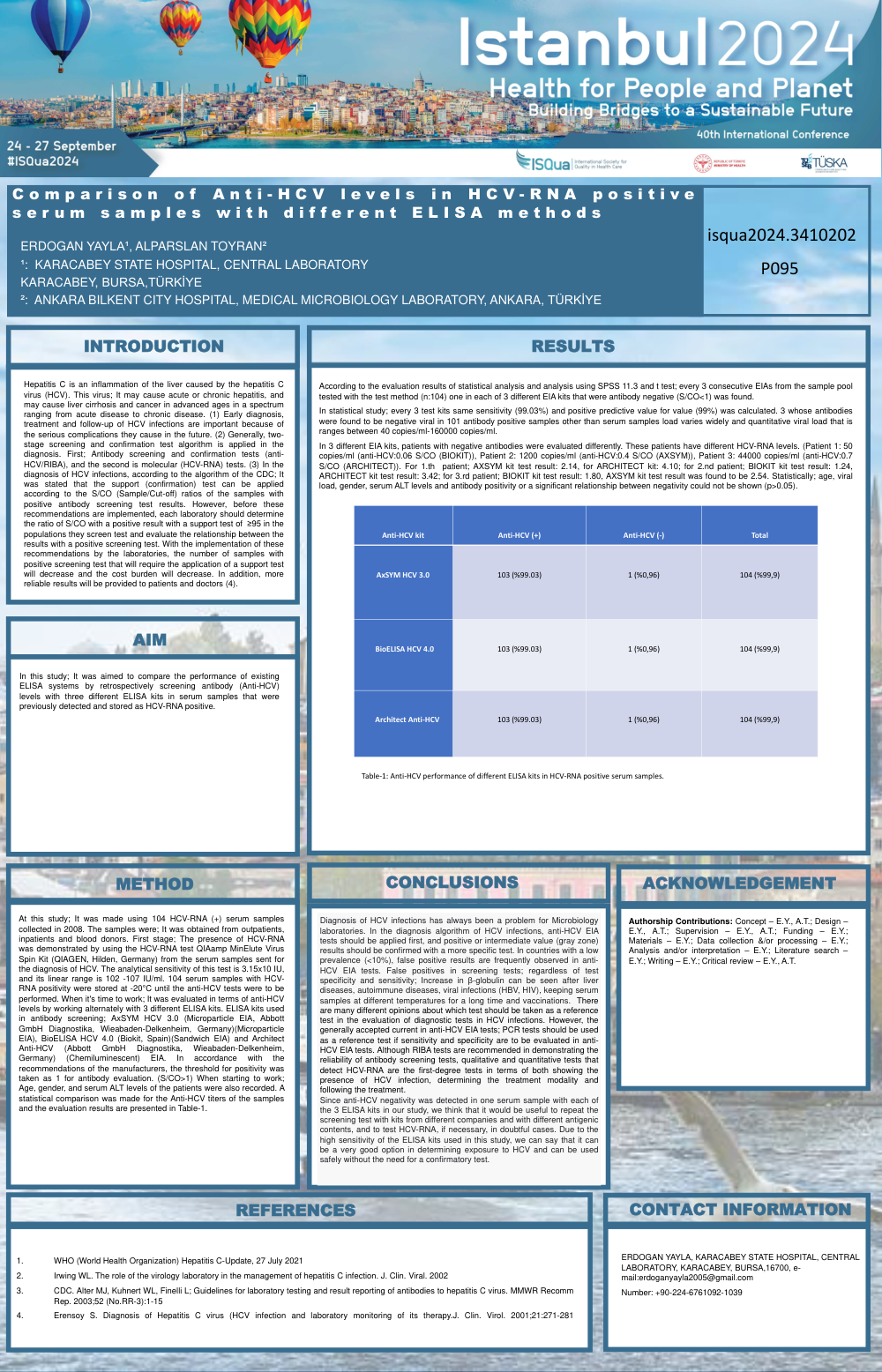
METHOD: At this study; It was made using 104 HCV-RNA (+) serum samples collected in 2008. The samples were; It was obtained from outpatients, inpatients and blood donors. First stage; The presence of HCV-RNA was demonstrated by using the HCV-RNA test QIAamp MinElute Virus Spin Kit (QIAGEN, Hilden, Germany) from the serum samples sent for the diagnosis of HCV. The analytical sensitivity of this test is 3.15x10 IU, and its linear range is 102 -107 IU/ml. 104 serum samples with HCV-RNA positivity were stored at -20°C until the anti-HCV tests were to be performed. When it's time to work; It was evaluated in terms of anti-HCV levels by working alternately with 3 different ELISA kits. ELISA kits used in antibody screening; AxSYM HCV 3.0 (Microparticle EIA, Abbott GmbH Diagnostika, Wieabaden-Delkenheim, Germany)(Microparticle EIA), BioELISA HCV 4.0 (Biokit, Spain)(Sandwich EIA) and Architect Anti-HCV (Abbott GmbH Diagnostika, Wieabaden-Delkenheim, Germany) (Chemiluminescent) EIA. In accordance with the recommendations of the manufacturers, the threshold for positivity was taken as 1 for antibody evaluation. (S/CO>1) When starting to work; Age, gender, and serum ALT levels of the patients were also recorded. A statistical comparison was made for the Anti-HCV titers of the samples and the evaluation results are presented in Table-1.
RESULTS: According to the evaluation results of statistical analysis and analysis using SPSS 11.3 and t test; every 3 consecutive EIAs from the sample pool tested with the test method (n:104) one in each of 3 different EIA kits that were antibody negative (S/CO<1) was found.
In statistical study; every 3 test kits same sensitivity (99.03%) and positive predictive value for value (99%) was calculated. 3 whose antibodies were found to be negative viral in 101 antibody positive samples other than serum samples load varies widely and quantitative viral load that is ranges between 40 copies/ml-160000 copies/ml.
In 3 different EIA kits, patients with negative antibodies were evaluated differently. These patients have different HCV-RNA levels. (Patient 1: 50 copies/ml (anti-HCV:0.06 S/CO (BIOKIT)), Patient 2: 1200 copies/ml (anti-HCV:0.4 S/CO (AXSYM)), Patient 3: 44000 copies/ml (anti-HCV:0.7 S/CO (ARCHITECT)). For 1.th patient; AXSYM kit test result: 2.14, for ARCHITECT kit: 4.10; for 2.nd patient; BIOKIT kit test result: 1.24, ARCHITECT kit test result: 3.42; for 3.rd patient; BIOKIT kit test result: 1.80, AXSYM kit test result was found to be 2.54. Statistically; age, viral load, gender, serum ALT levels and antibody positivity or a significant relationship between negativity could not be shown (p>0.05).
CONCLUSIONS: Diagnosis of HCV infections has always been a problem for Microbiology laboratories. In the diagnosis algorithm of HCV infections, anti-HCV EIA tests should be applied first, and positive or intermediate value (gray zone) results should be confirmed with a more specific test. In countries with a low prevalence (<10%), false positive results are frequently observed in anti-HCV EIA tests. False positives in screening tests; regardless of test specificity and sensitivity; Increase in β-globulin can be seen after liver diseases, autoimmune diseases, viral infections (HBV, HIV), keeping serum samples at different temperatures for a long time and vaccinations. There are many different opinions about which test should be taken as a reference test in the evaluation of diagnostic tests in HCV infections. However, the generally accepted current in anti-HCV EIA tests; PCR tests should be used as a reference test if sensitivity and specificity are to be evaluated in anti-HCV EIA tests. Although RIBA tests are recommended in demonstrating the reliability of antibody screening tests, qualitative and quantitative tests that detect HCV-RNA are the first-degree tests in terms of both showing the presence of HCV infection, determining the treatment modality and following the treatment.
Since anti-HCV negativity was detected in one serum sample with each of the 3 ELISA kits in our study, we think that it would be useful to repeat the screening test with kits from different companies and with different antigenic contents, and to test HCV-RNA, if necessary, in doubtful cases. Due to the high sensitivity of the ELISA kits used in this study, we can say that it can be a very good option in determining exposure to HCV and can be used safely without the need for a confirmatory test.
ACKNOWLEDGEMENT: Authorship Contributions: Concept – E.Y., A.T.; Design – E.Y., A.T.; Supervision – E.Y., A.T.; Funding – E.Y.; Materials – E.Y.; Data collection &/or processing – E.Y.; Analysis and/or interpretation – E.Y.; Literature search – E.Y.; Writing – E.Y.; Critical review – E.Y., A.T.
REFERENCES:
1.WHO(WorldHealthOrganization)HepatitisC-Update,27July2021
2.IrwingWL.TheroleofthevirologylaboratoryinthemanagementofhepatitisCinfection.J.Clin.Viral.2002
3.CDC.AlterMJ,KuhnertWL,FinelliL;GuidelinesforlaboratorytestingandresultreportingofantibodiestohepatitisCvirus.MMWRRecommRep.2003;52(No.RR-3):1-15
4.ErensoyS.DiagnosisofHepatitisCvirus(HCVinfectionandlaboratorymonitoringofitstherapy.J.Clin.Virol.2001;21:271-281
CONTACT INFORMATION:
ERDOGAN YAYLA, KARACABEY STATE HOSPITAL, CENTRAL LABORATORY, KARACABEY, BURSA,16700, e-mail:erdoganyayla2005@gmail.com
Number: +90-224-6761092-1039