586 posters, 8 topics, 23 sessions, 1,077 authors, 622 institutions
ePostersLive by SciGen Technologies S.A. All rights reserved.
ISQua's 40th International Conference 2024
24th - 27th September 2024 | Istanbul, Türkiye

P516
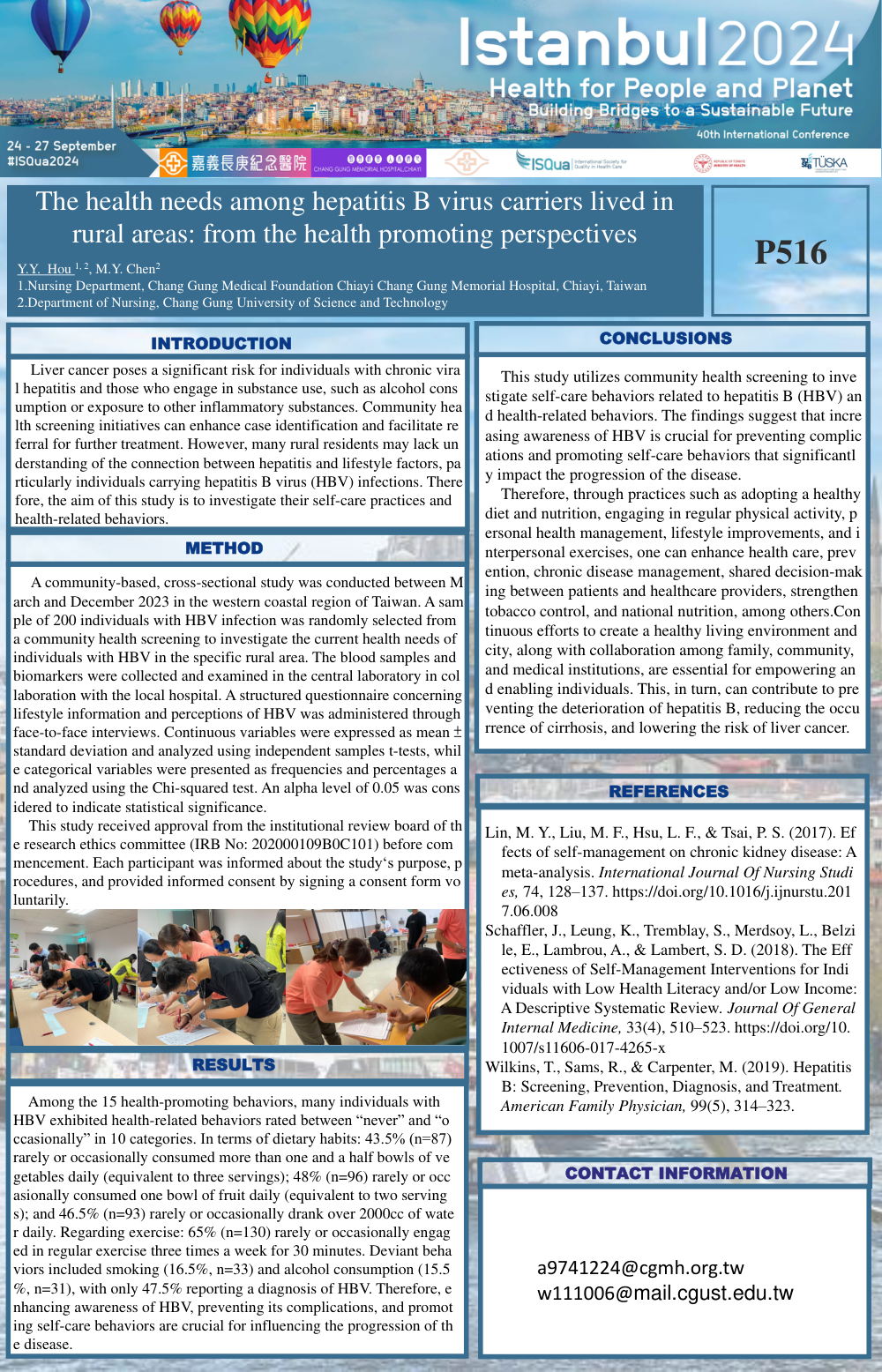
The health needs among hepatitis B virus carriers lived in rural areas: from the health promoting perspectives
Poster Presenter
Authors
Affiliations
Part of Topic
Integrated Care Communities
ISQUA2024-ABS-3181
The health needs among hepatitis B virus carriers lived in rural areas: from the health promoting perspectives
Ya-Yu Hou* 1, 2, Mei-Yen Chen1
1Department of Nursing, Chang Gung University of Science and Technology, 2Nursing Department, Chang Gung Medical
Foundation Chiayi Chang Gung Memorial Hospital, Chiayi, Taiwan
Preferred presentation method: Poster Display
Have you presented this abstract at an ISQua Conference before?: No
I confirm that the submission has been approved by all authors: Yes
Introduction: Liver cancer poses a significant risk for individuals with chronic viral hepatitis and those who engage in
substance use, such as alcohol consumption or exposure to other inflammatory substances. Community health screening
initiatives can enhance case identification and facilitate referral for further treatment. However, many rural residents may
lack understanding of the connection between hepatitis and lifestyle factors, particularly individuals carrying hepatitis B
virus (HBV) infections. Therefore, the aim of this study is to investigate their self-care practices and health-related
behaviors.
Methods: A community-based, cross-sectional study was conducted between March and December 2023 in the western
coastal region of Taiwan. A sample of 200 individuals with HBV infection was randomly selected from a community health
screening to investigate the current health needs of individuals with HBV in the specific rural area. The blood samples
and biomarkers were collected and examined in the central laboratory in collaboration with the local hospital. A structured
questionnaire concerning lifestyle information and perceptions of HBV was administered through face-to-face interviews.
Continuous variables were expressed as mean ± standard deviation and analyzed using independent samples t-tests,
while categorical variables were presented as frequencies and percentages and analyzed using the Chi-squared test. An
alpha level of 0.05 was considered to indicate statistical significance. This study received approval from the institutional
review board of the research ethics committee (IRB No: 202000109B0C101) before commencement. Each participant
was informed about the study's purpose, procedures, and provided informed consent by signing a consent form
voluntarily.
Results: Among the 15 health-promoting behaviors, many individuals with HBV exhibited health-related behaviors rated
between "never" and "occasionally" in 10 categories. In terms of dietary habits: 43.5% (n=87) rarely or occasionally
consumed more than one and a half bowls of vegetables daily (equivalent to three servings); 48% (n=96) rarely or
occasionally consumed one bowl of fruit daily (equivalent to two servings); and 46.5% (n=93) rarely or occasionally drank
over 2000cc of water daily. Regarding exercise: 65% (n=130) rarely or occasionally engaged in regular exercise three
times a week for 30 minutes. Deviant behaviors included smoking (16.5%, n=33) and alcohol consumption (15.5%,
n=31), with only 47.5% reporting a diagnosis of HBV. Therefore, enhancing awareness of HBV, preventing its
complications, and promoting self-care behaviors are crucial for influencing the progression of the disease.
Conclusion: This study utilizes community health screening to investigate self-care behaviors related to hepatitis B (HBV)
and health-related behaviors. The findings suggest that increasing awareness of HBV is crucial for preventing
complications and promoting self-care behaviors that significantly impact the progression of the disease. Therefore,
through practices such as adopting a healthy diet and nutrition, engaging in regular physical activity, personal health
management, lifestyle improvements, and interpersonal exercises, one can enhance health care, prevention, chronic
disease management, shared decision-making between patients and healthcare providers, strengthen tobacco control,
and national nutrition, among others. Continuous efforts to create a healthy living environment and city, along with
collaboration among family, community, and medical institutions, are essential for empowering and enabling individuals.
This, in turn, can contribute to preventing the deterioration of hepatitis B, reducing the occurrence of cirrhosis, and
lowering the risk of liver cancer.
References: Lin, M. Y., Liu, M. F., Hsu, L. F., & Tsai, P. S. (2017). Effeself-management on chronic kidney disease: A
meta-analysis. International Journal Of Nursing Studies, 74, 128–137. https://doi.org/10.1016/j.ijnurstu.2017.06.008
Schaffler, J., Leung, K., Tremblay, S., Merdsoy, L., Belzile, E., Lambrou, A., & Lambert, S. D. (2018). The Effectiveness
of Self-Management Interventions for Individuals with Low Health Literacy and/or Low Income: A Descriptive Systematic
Review. Journal Of General Internal Medicine, 33(4), 510–523. https://doi.org/10.1007/s11606-017-4265-x
Wilkins, T., Sams, R., & Carpenter, M. (2019). Hepatitis B: Screening, Prevention, Diagnosis, and Treatment. American
Family Physician, 99(5), 314–323.
Disclosure of Interest: None Declared
Keywords: Community Health Promotion, Health Behavior, Hepatitis B carrier