586 posters, 8 topics, 23 sessions, 1,077 authors, 622 institutions
ePostersLive by SciGen Technologies S.A. All rights reserved.
ISQua's 40th International Conference 2024
24th - 27th September 2024 | Istanbul, Türkiye

P115
Utilizing the Hopscotch Game Concept for Fall Prevention Screening in Acute Psychiatric Ward
Poster Presenter
Part of Topic
Patient Safety & Quality Improvement
Utilizing the Hopscotch Game Concept for Fall Prevention Screening in Acute Psychiatric Ward
INTRODUCTION
Accidental falls rank second among hospitalized patients in Taiwan, with psychiatric wards exhibiting a higher incidence rate compared to other units, emphasizing the importance of fall prevention screening. In our acute psychiatric ward, two incidents of patient falls occurred on the day of admission in June 2023, leading to nurse frustration. Analysis revealed the use of computerized high-risk factor screening by nurses, but its simplicity often led to subjective assessments, lacking objective measurements and individualization. Additionally, disputes over footwear safety among psychiatric patients highlighted the need for improvement in fall assessment tools upon admission.
AIM
Collaborating with nurses, physical therapists, and occupational therapists, our aim is to improve the current fall risk screening tool by incorporating the "Hopscotch" game concept, with the premise of being clinically easy to implement and effectively identifying high-risk groups.
METHOD
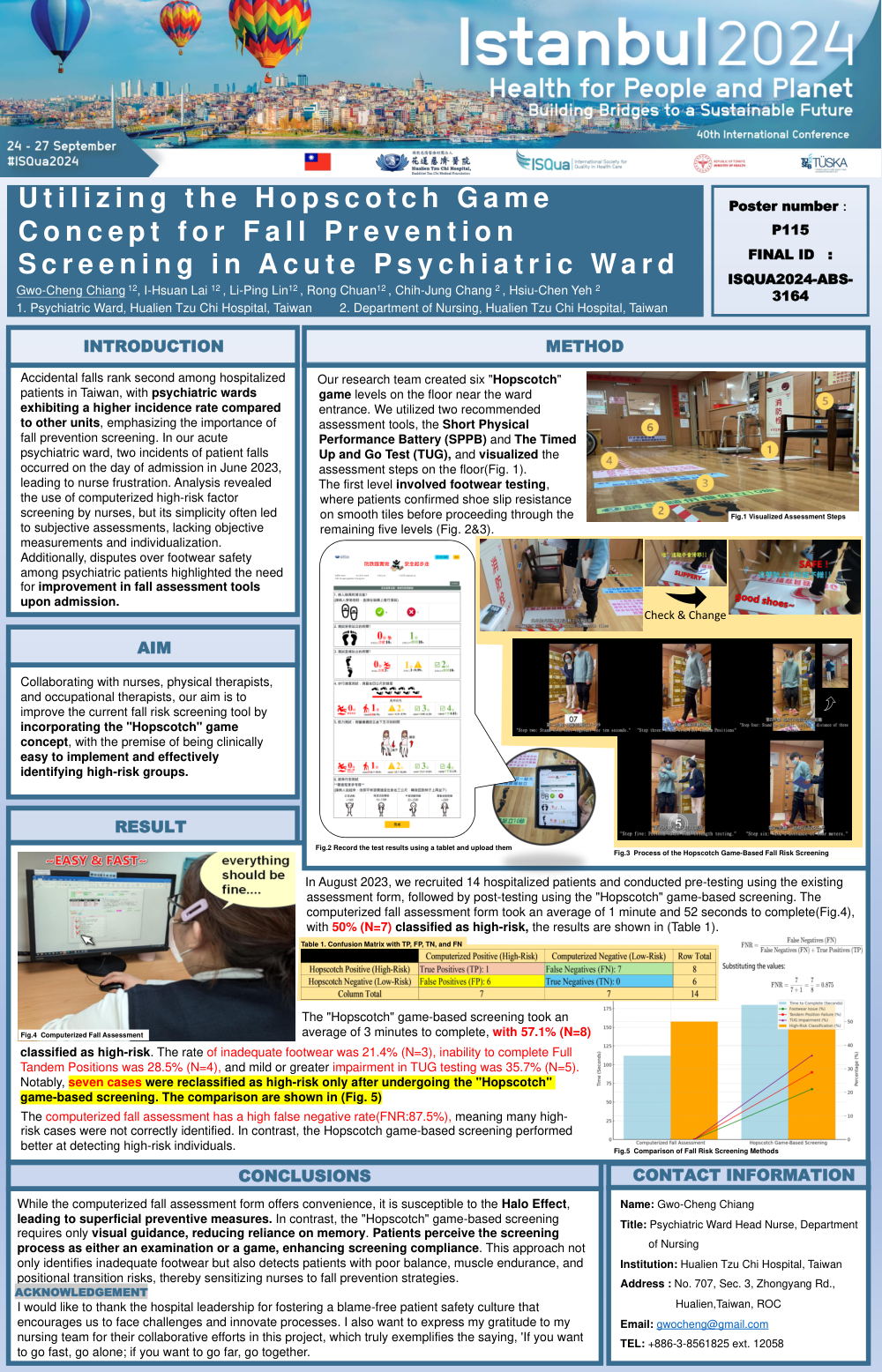
Our research team created six "Hopscotch" game levels on the floor near the ward entrance. We utilized two recommended assessment tools, the Short Physical Performance Battery (SPPB) and The Timed Up and Go Test (TUG), and visualized the assessment steps on the floor. The first level involved footwear testing, where patients confirmed shoe slip resistance on smooth tiles before proceeding through the remaining five levels.
RESULT
In August 2023, we recruited 14 hospitalized patients and conducted pre-testing using the existing assessment form, followed by post-testing using the "Hopscotch" game-based screening. The computerized fall assessment form took an average of 1 minute and 52 seconds to complete, with 50% (N=7) classified as high-risk. The "Hopscotch" game-based screening took an average of 3 minutes to complete, with 57.1% (N=8) classified as high-risk. The rate of inadequate footwear was 21.4% (N=3), inability to complete Full Tandem Positions was 28.5% (N=4), and mild or greater impairment in TUG testing was 35.7% (N=5). Notably, seven cases were reclassified as high-risk only after undergoing the "Hopscotch" game-based screening. The computerized fall assessment has a high false negative rate(FNR:87.5%), meaning many high-risk cases were not correctly identified. In contrast, the Hopscotch game-based screening performed better at detecting high-risk individuals.
CONCLUSIONS
While the computerized fall assessment form offers convenience, it is susceptible to the Halo Effect, leading to superficial preventive measures. In contrast, the "Hopscotch" game-based screening requires only visual guidance, reducing reliance on memory. Patients perceive the screening process as either an examination or a game, enhancing screening compliance. This approach not only identifies inadequate footwear but also detects patients with poor balance, muscle endurance, and positional transition risks, thereby sensitizing nurses to fall prevention strategies