586 posters, 8 topics, 23 sessions, 1,077 authors, 622 institutions
ePostersLive by SciGen Technologies S.A. All rights reserved.
ISQua's 40th International Conference 2024
24th - 27th September 2024 | Istanbul, Türkiye

P311
Nurse-to-patient ratios in South Africa and its impact on nurse and patient outcomes
Poster Presenter
Authors
Siedine K. Coetzee, Joke H Buhrmann, Alwiena J Blignaut, Maria van Zyl-Cillie, Erika Fourie
Affiliations
School of Nursing Science, North-West University, Potchefstroom, South Africa, School of Industrial Engineering, North-West University, Potchefstroom, South Africa, Department of Statistical Consultation, North-West University, Potchefstroom, South Africa
Part of Topic
Patient Safety & Quality Improvement
Introduction
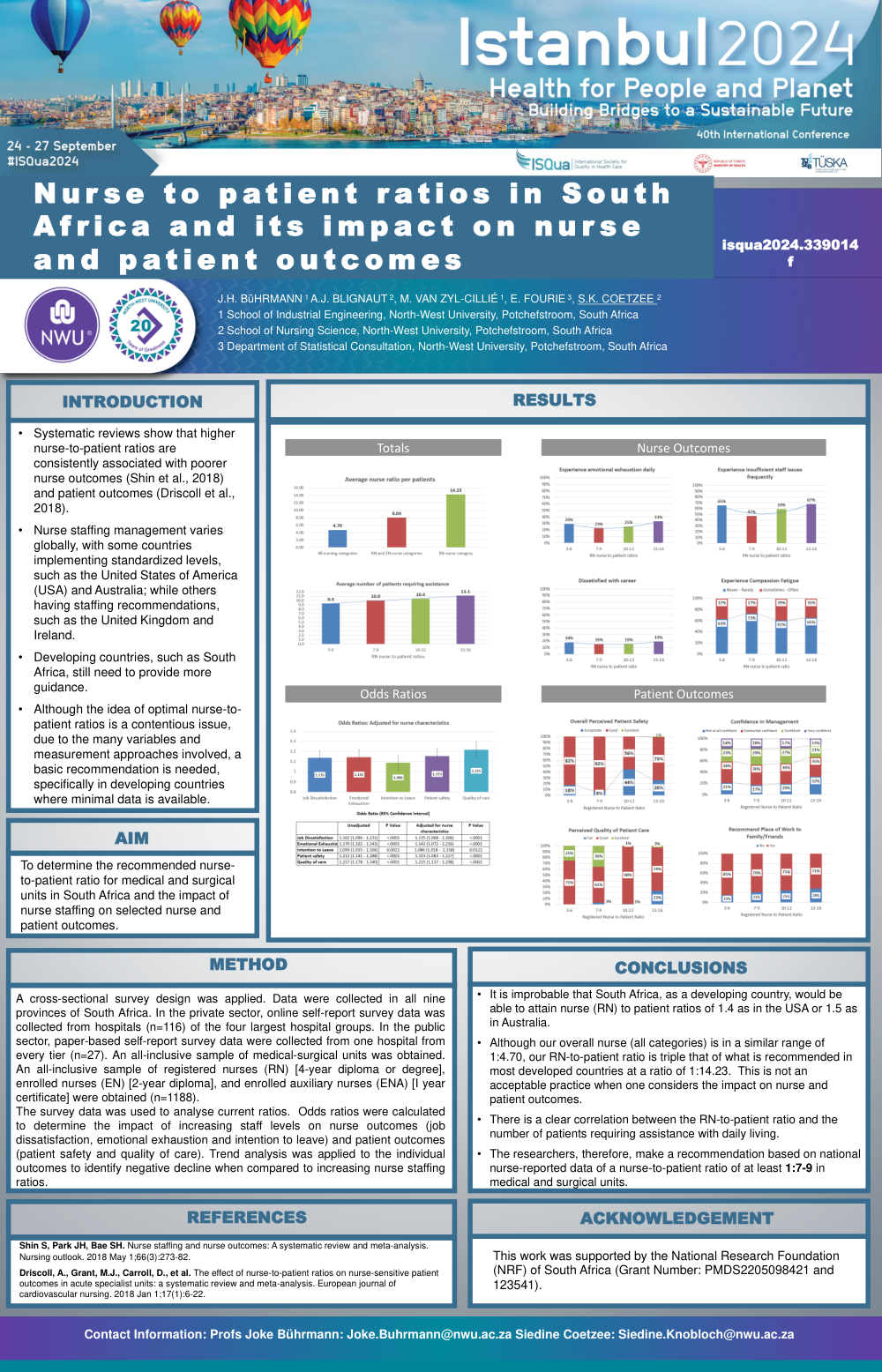
To determine the recommended nurse-to-patient ratio for medical and surgical units in South Africa and the impact of nurse staffing on selected nurse and patient outcomes.
Method
A cross-sectional survey design was applied. Data were collected in all nine provinces of South Africa. In the private sector, online self-report survey data was collected from hospitals (n=116) of the four largest hospital groups. In the public sector, paper-based self-report survey data were collected from one hospital from every tier (n=27). An all-inclusive sample of medical-surgical units was obtained. An all-inclusive sample of registered nurses (RN) [4-year diploma or degree], enrolled nurses (EN) [2-year diploma], and enrolled auxiliary nurses (ENA) [I year certificate] were obtained (n=1188).
The survey data was used to analyse current ratios. Odds ratios were calculated to determine the impact of increasing staff levels on nurse outcomes (job dissatisfaction, emotional exhaustion and intention to leave) and patient outcomes (patient safety and quality of care). Trend analysis was applied to the individual outcomes to identify negative decline when compared to increasing nurse staffing ratios.
Conclusions
Shin S, Park JH, Bae SH. Nurse staffing and nurse outcomes: A systematic review and meta-analysis. Nursing outlook. 2018 May 1;66(3):273-82.
Driscoll, A., Grant, M.J., Carroll, D., et al. The effect of nurse-to-patient ratios on nurse-sensitive patient outcomes in acute specialist units: a systematic review and meta-analysis. European journal of cardiovascular nursing. 2018 Jan 1;17(1):6-22.
Acknowledgements
This work was supported by the National Research Foundation (NRF) of South Africa (Grant Number: PMDS2205098421 and 123541).