586 posters, 8 topics, 23 sessions, 1,077 authors, 622 institutions
ePostersLive by SciGen Technologies S.A. All rights reserved.
ISQua's 40th International Conference 2024
24th - 27th September 2024 | Istanbul, Türkiye

P350
Factors determining the effectiveness of Audit & Feedback on clinical guideline adherence of medical specialists: A systematic review and meta-analysis of randomized controlled trials
Poster Presenter
Part of Topic
Patient Safety & Quality Improvement
Audit & Feedback on clinical guideline adherence: a systematic review and meta-analysis of RCTs
AIM: To examine which design characteristics, cointerventions and contextual factors explain variance in effectiveness of Audit & Feedback (A&F) interventions targeting clinical guideline adherence of hospital-based medical specialists.
INTRODUCTION: Clinical guideline adherence varies, resulting in low value care. A&F can effectively improve guideline adherence, but it is unclear how to design A&F for optimal effectiveness.
METHODS: Systematic Review and meta-analysis of RCTs.
•Screening: 4678 articles ti/ab, 87 full-text, 41 studies were included
•Two reviewers independently screened articles. Data on design characteristics, co-interventions, contextual factors and outcomes were extracted. Risk of Bias was assessed using the ROB2 tools.
•Results were described descriptively and when appropriate a meta-analysis using a random effects model was performed.
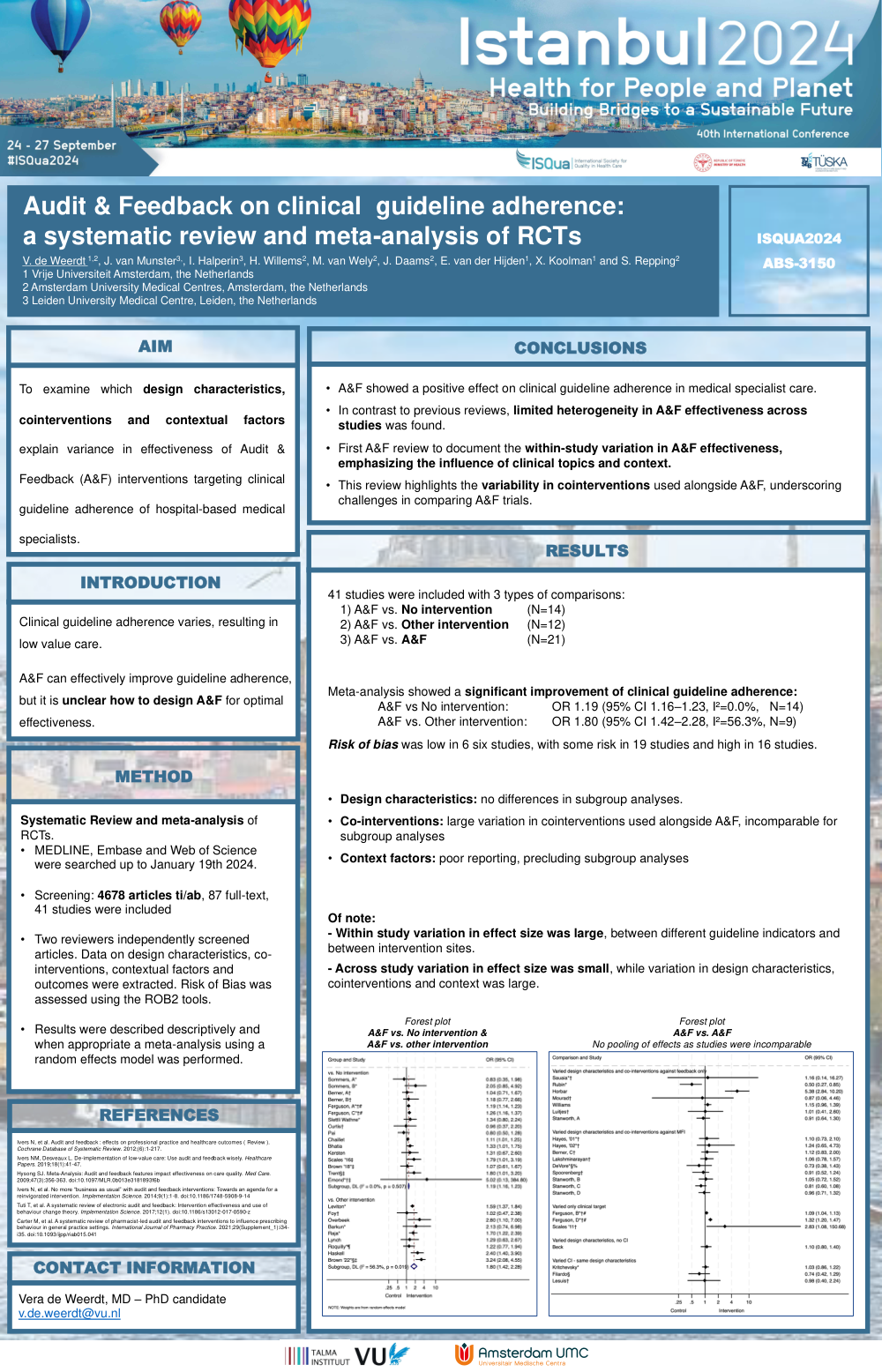
RESULTS: 41 studies were included with 3 types of comparisons:
1) A&F vs. No intervention (N=14)
2) A&F vs. Other intervention (N=12)
3) A&F vs. A&F (N=21)
Meta-analysis showed a significant improvement of clinical guideline adherence:
A&F vs No intervention: OR 1.19 (95% CI 1.16–1.23, I²=0.0%, N=14)
A&F vs. Other intervention: OR 1.80 (95% CI 1.42–2.28, I²=56.3%, N=9)
Risk of bias was low in 6 six studies, with some risk in 19 studies and high in 16 studies.
Of note:
- Within study variation in effect size was large, between different guideline indicators and between intervention sites.
- Across study variation in effect size was small, while variation in design characteristics, cointerventions and context was large.
CONCLUSION: