586 posters, 8 topics, 23 sessions, 1,077 authors, 622 institutions
ePostersLive by SciGen Technologies S.A. All rights reserved.
ISQua's 40th International Conference 2024
24th - 27th September 2024 | Istanbul, Türkiye

P087
EVALUATION OF THE LEVEL OF CLINICAL LEADERSHIP APPROACH OF ACCREDITATION SURVEYORS IN HEALTH
Poster Presenter
Authors
Affiliations
Part of Topic
Patient Safety & Quality Improvement
EVALUATION OF THE LEVEL OF CLINICAL LEADERSHIP APPROACH OF ACCREDITATION SURVEYORS IN HEALTH
Elif ÖZYURT1, Keziban AVCI2, Şenol DEMİRCİ3, Figen ÇİZMECİ ŞENEL4
Özet
Introduction: Ensuring a safe, high quality and standardised service in health accreditation surveys requires the participation and cooperation of surveyors with various expertise and characteristics. Trust and co-operation between surveyors is a critical element in the effective, efficient and reliable execution of the survey process planning, execution and evidence-based reporting of the results. Successful implementation and evaluation of survey activities requires a clinical leadership approach based on cooperation, sharing and mutual respect among health accreditation surveyors. This study aimed to evaluate the clinical leadership approach levels of Standards for Accreditation in Health (SAS) surveyors.
Method: The population of the study consisted of SAS surveyors (N: 140) working as surveyors in the Turkish Health Services Quality and Accreditation Institute (TÜSKA). In this context, 140 SAS surveyors working in SAS surveys were reached. The purpose of the study was explained to the participants and care was taken to ensure that they were voluntary and willing. Due to the voluntary basis, 96 SAS surveyors participated voluntarily and willingly. In this descriptive and cross-sectional study, descriptive statistical methods (frequency, percentage, median, interquartile range) and statistical analyses were used to evaluate the study data.
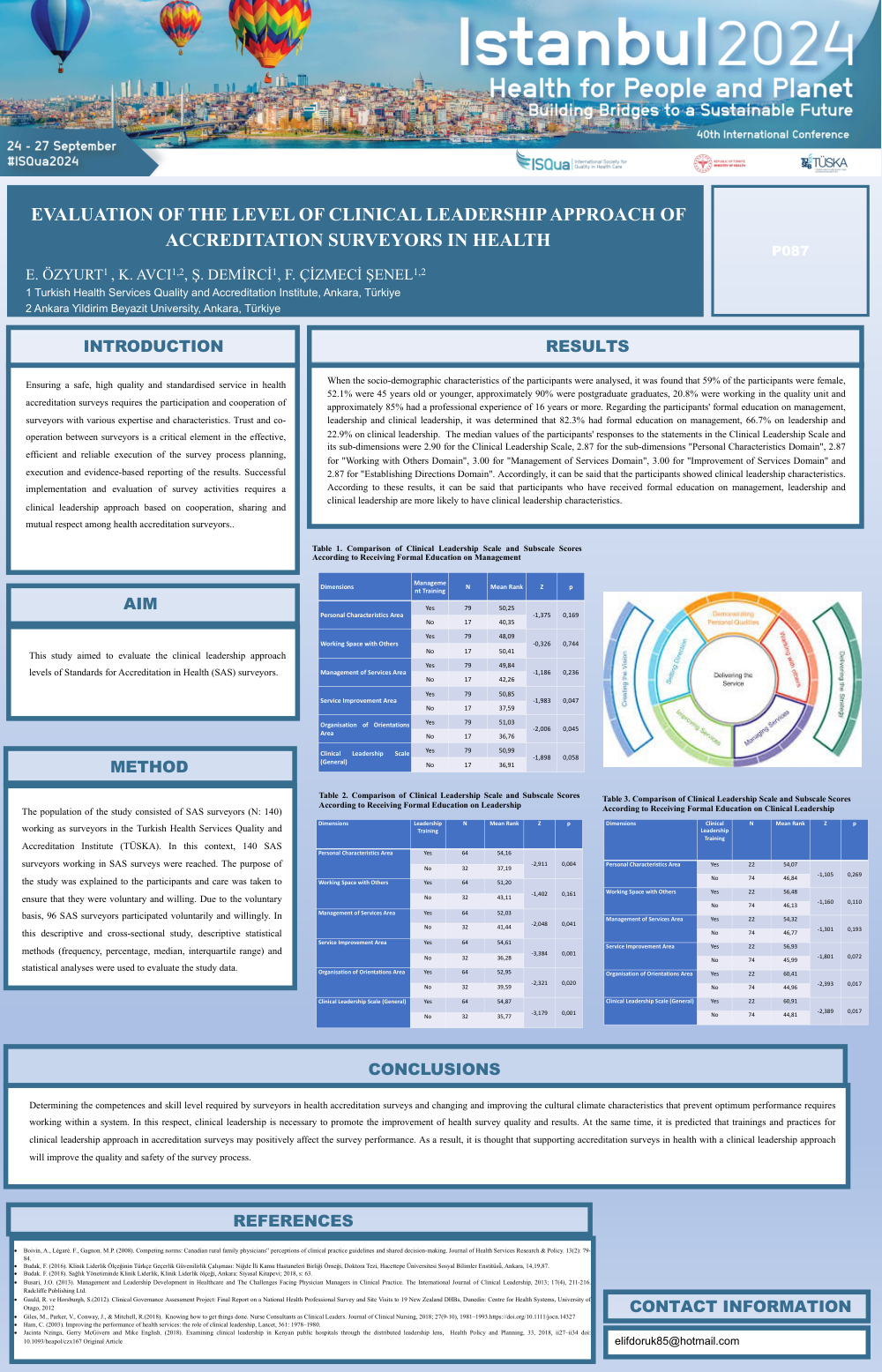
Results: When the socio-demographic characteristics of the participants were analysed, it was found that 59% of the participants were female, 52.1% were 45 years old or younger, approximately 90% were postgraduate graduates, 20.8% were working in the quality unit and approximately 85% had a professional experience of 16 years or more. Regarding the participants' formal education on management, leadership and clinical leadership, it was determined that 82.3% had formal education on management, 66.7% on leadership and 22.9% on clinical leadership. The median values of the participants' responses to the statements in the Clinical Leadership Scale and its sub-dimensions were 2.90 for the Clinical Leadership Scale, 2.87 for the sub-dimensions "Personal Characteristics Domain", 2.87 for "Working with Others Domain", 3.00 for "Management of Services Domain", 3.00 for "Improvement of Services Domain" and 2.87 for "Establishing Directions Domain". Accordingly, it can be said that the participants showed clinical leadership characteristics. According to these results, it can be said that participants who have received formal education on management, leadership and clinical leadership are more likely to have clinical leadership characteristics.
Conclusion: Determining the competences and skill level required by surveyors in health accreditation surveys and changing and improving the cultural climate characteristics that prevent optimum performance requires working within a system. In this respect, clinical leadership is necessary to promote the improvement of health survey quality and results. At the same time, it is predicted that trainings and practices for clinical leadership approach in accreditation surveys may positively affect the survey performance. As a result, it is thought that supporting accreditation surveys in health with a clinical leadership approach will improve the quality and safety of the survey process.
Keywords: Clinical Leadership, Quality and Accreditation, Accreditation Surveyor, Survey, Survey Quality