586 posters, 8 topics, 23 sessions, 1,077 authors, 622 institutions
ePostersLive by SciGen Technologies S.A. All rights reserved.
ISQua's 40th International Conference 2024
24th - 27th September 2024 | Istanbul, Türkiye

P160
Bridging the Gap: A Versatile Evidence-Based Provider Experience Survey for International Performance Comparisons and Quality Improvement
Poster Presenter
Authors
Affiliations
Part of Topic
Patient Safety & Quality Improvement
Bridging the Gap: A Versatile Evidence-Based Provider Experience Survey for International Performance Comparisons and Quality Improvement
Introduction
Clinicians' experiences in care delivery, including decision-making, safety, and relationships with colleagues, are associated with improved wellbeing and better patient outcomes12. These experiences are vital for assessing care outcomes in value-based healthcare3. However, the absence of a standardised tool to measure clinician experience across diverse healthcare settings impedes global performance comparisons. Developing such a tool is crucial for ensuring high-quality, standardised care, benchmarking best practices, addressing systemic challenges, and guiding quality improvement initiatives. To address this gap, we developed an evidence-based Provider Experience Survey.
Aim
The Provider Experience Survey tool aims to:
1.Assess clinician experience,
2.Enable international performance comparisons,
3.Identify healthcare system variations,
Method
The Provider Experience Survey was developed using quantitative methodology.
The survey comprised four (4) questions covering
These domains encompassed key aspects of the clinician experience4. A comment section allowed participant elaboration and identification of improvement areas.
The survey was conducted across projects spanning three continents, demonstrating its success in capturing clinician experiences in diverse global contexts. Qualitative analysis of survey feedback from project managers was used to verify its effectiveness in achieving the survey objectives.
Results
Sustainable healthcare workforces are crucial for ensuring the delivery of high-quality care over the long term. By understanding and addressing clinician experiences, healthcare organisations can improve staff satisfaction and wellbeing, reduce turnover rates, attract talented professionals, and enhance overall workforce retention2. This not only leads to better patient outcomes but also contributes to the stability and effectiveness of healthcare systems3.
The survey was implemented across diverse healthcare settings, encompassing varying levels of care (e.g., primary and tertiary), multicultural environments, different service modalities (e.g., virtual and face-to-face), and complex settings (e.g., remote and challenging). Challenges in coordinating survey rollout across diverse projects were addressed through a phased approach and educational sessions. Involving all levels of management was crucial for embedding the survey into existing reporting requirements and ensuring its long-term sustainability.
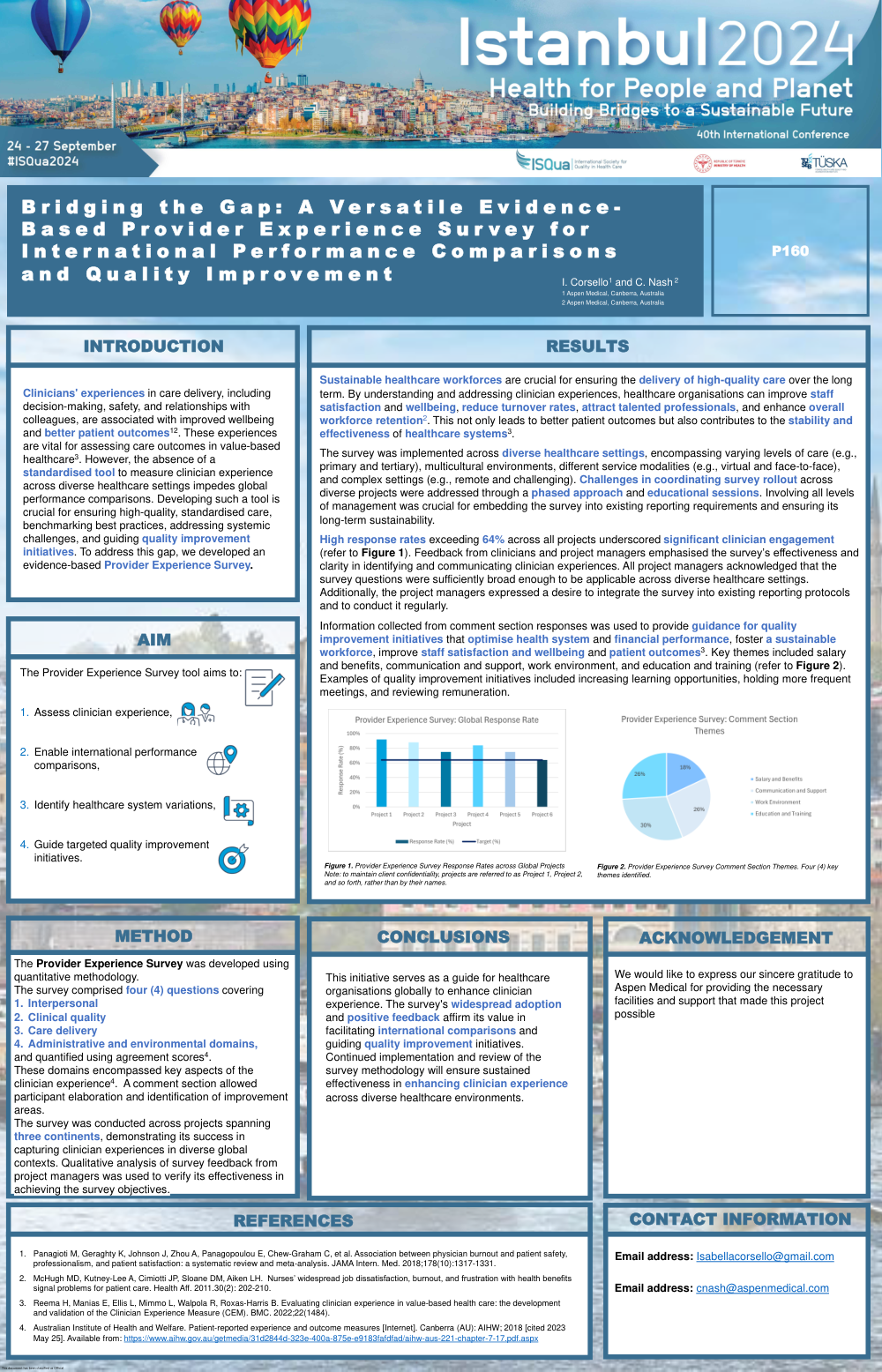
High response rates exceeding 64% across all projects underscored significant clinician engagement (refer to Figure 1). Feedback from clinicians and project managers emphasised the survey’s effectiveness and clarity in identifying and communicating clinician experiences. All project managers acknowledged that the survey questions were sufficiently broad enough to be applicable across diverse healthcare settings. Additionally, the project managers expressed a desire to integrate the survey into existing reporting protocols and to conduct it regularly.
Information collected from comment section responses were used to provide guidance for quality improvement initiatives that optimise health system and financial performance, foster a sustainable workforce, improve staff satisfaction and wellbeing and patient outcomes3. Key themes included salary and benefits, communication and support, work environment, and education and training. Examples of quality improvement initiatives included increasing learning opportunities, holding more frequent meetings, and reviewing remuneration.
Conclusion
This initiative serves as a guide for healthcare organisations globally to enhance clinician experience. The survey's widespread adoption and positive feedback affirm its value in facilitating international comparisons and guiding quality improvement initiatives. Continued implementation and review of the survey methodology will ensure sustained effectiveness in enhancing clinician experience across diverse healthcare environments.