586 posters, 8 topics, 23 sessions, 1,077 authors, 622 institutions
ePostersLive by SciGen Technologies S.A. All rights reserved.
ISQua's 40th International Conference 2024
24th - 27th September 2024 | Istanbul, Türkiye

P003
PAIN MANAGEMENT INDICATORS: THE POWER OF A MONTHELY SHORT MEETING FEEDBACK OVER 6 YEARS IN A MULTISITE TERCERY HOSPITAL (University hospitals of Geneva, Switzerland)
Part of Topic
Patient Safety & Quality Improvement
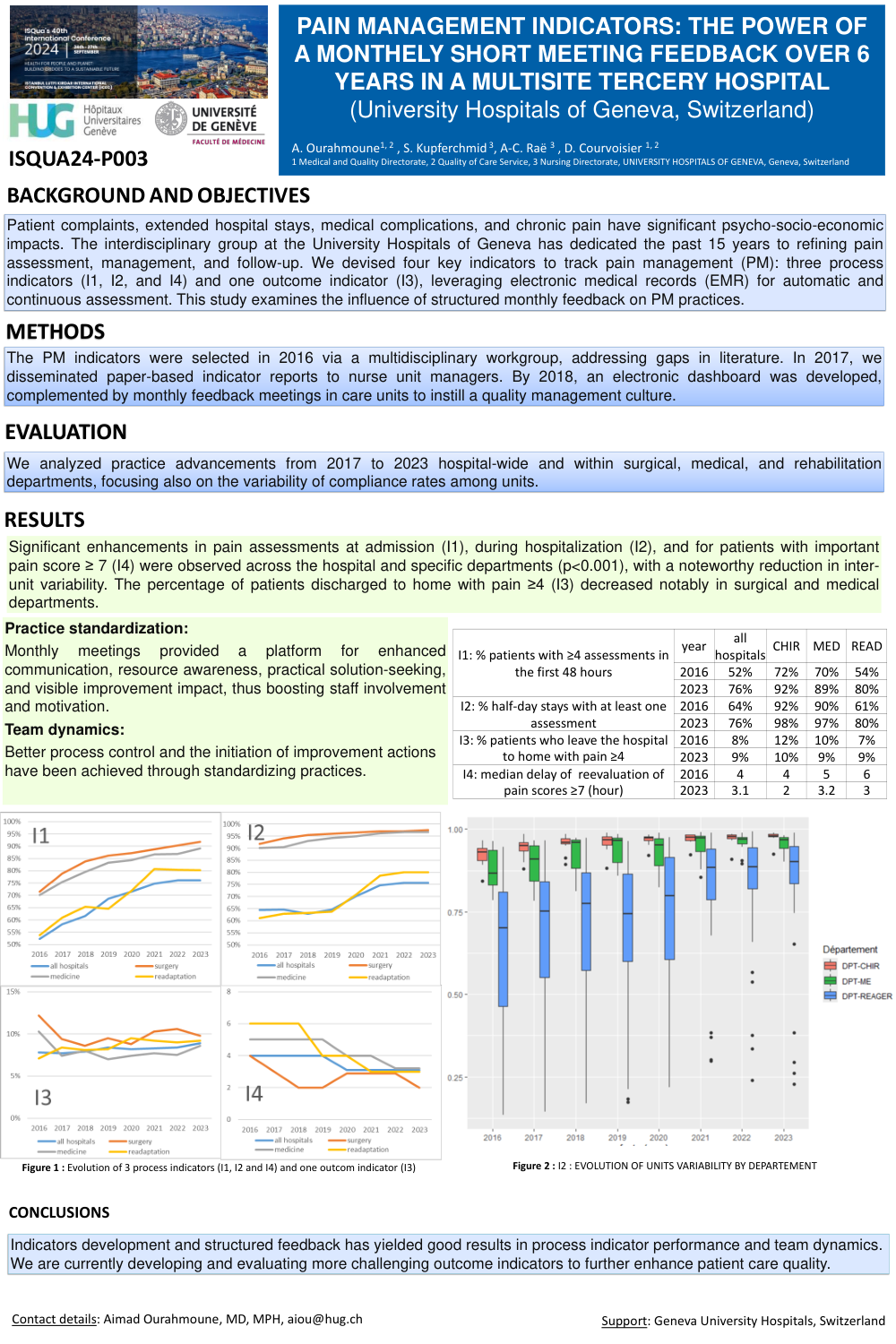
Introduction: Patient complaints, extended hospital stays, medical complications, and chronic pain have significant psycho-socio-economic impacts. The interdisciplinary group at the University Hospitals of Geneva has dedicated the past 15 years to refining pain assessment, management, and follow-up. We devised four key indicators to track pain management (PM): three process indicators (I1, I2, and I4) and one outcome indicator (I3), leveraging electronic medical records (EMR) for automatic and continuous assessment. This study examines the influence of structured monthly feedback on PM practices.
Methods: The PM indicators were selected in 2016 via a multidisciplinary workgroup, addressing gaps in literature. In 2017, we disseminated paper-based indicator reports to nurse unit managers. By 2018, an electronic dashboard was developed, complemented by monthly feedback meetings in care units to instill a quality management culture.
Evaluation: We analyzed practice advancements from 2017 to 2023 hospital-wide and within surgical, medical, and rehabilitation departments, focusing also on the variability of compliance rates among units.
Results: Significant enhancements in pain assessments at admission (I1), during hospitalization (I2), and for patients with important pain score ≥ 7 (I4) were observed across the hospital and specific departments (p<0.001), with a noteworthy reduction in inter-unit variability. The percentage of patients discharged to home with pain ≥4 (I3) decreased notably in surgical and medical departments.
Practice Standardization: Monthly meetings provided a platform for enhanced communication, resource awareness, practical solution-seeking, and visible improvement impact, thus boosting staff involvement and motivation.
Team Dynamics: Better process control and the initiation of improvement actions have been achieved through standardizing practices.
Conclusion:
Indicators development and structured feedback has yielded good results in process indicator performance and team dynamics. We are currently developing and evaluating more challenging outcome indicators to further enhance patient care quality.