586 posters, 8 topics, 23 sessions, 1,077 authors, 622 institutions
ePostersLive by SciGen Technologies S.A. All rights reserved.
ISQua's 40th International Conference 2024
24th - 27th September 2024 | Istanbul, Türkiye

P379
Analysis of Medication Errors over a 10 year period in a Tertiary Paediatric Anaesthesia Department
Poster Presenter
Authors
Affiliations
Part of Topic
Patient Safety & Quality Improvement
Title:
Analysis of Medication Errors over a 10 year period in a Tertiary Paediatric Anaesthesia Department
Yew Nam Siow1, Teddy Fabila1
1 Department of Paediatric Anaesthesia , KK Women's and Children’s Hospital, Singapore
Introduction:
KK Women's and Children's Hospital is a tertiary facility that administers approximately 8,000 pediatric anesthetics annually. Medication errors pose a significant risk to patient safety in anesthesia, with particular importance in pediatric anesthesia due to the greater variation in drug dosages across age and weight ranges. This study aimed to analyze medication errors reported in a anesthetic department. The primary objective is to understand the types of medications and administration contexts at highest risk, in order to formulate effective preventative strategies.
Methodology
Data for this study was sourced from the Department's Voluntary Incident Reporting System, covering the period from 2014 to 2023.
The analysis focused on several key parameters.
Firstly, we examined the types of drugs involved, including their frequency and percentage incidence.
Secondly, we classified human errors based on Reason's psychological theory.
Thirdly, we assessed the severity of errors using the National Coordinating Council for Medication Error Reporting and Prevention (NCC MERP) classification system.
Lastly, the anesthetic team evaluated root causes and contextual risk factors contributing to these errors, to generate ideas for preventing such errors.
Results:
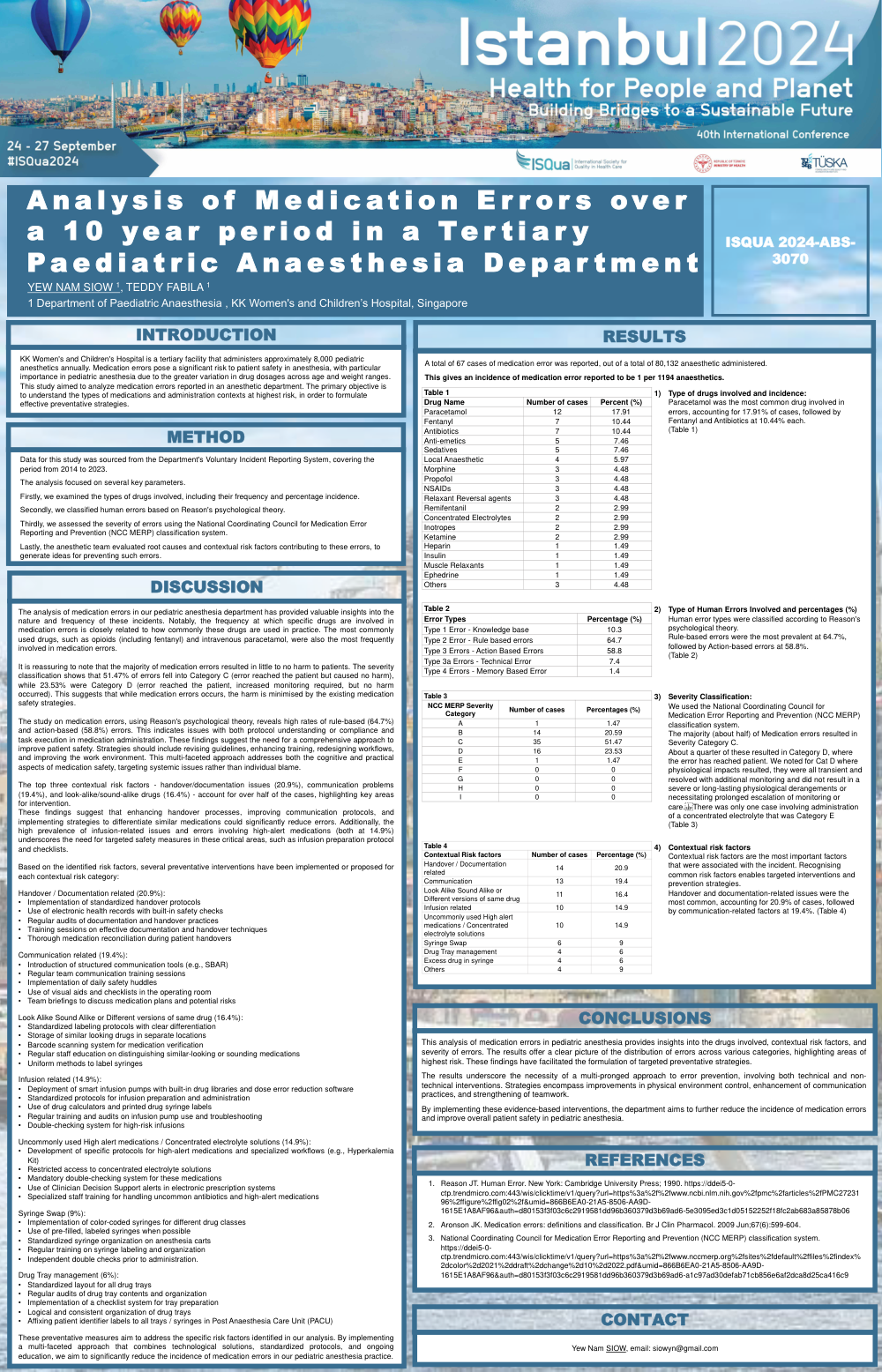
A total of 67 cases of medication error was reported, out of a total of 80,132 anaesthetic administered.
This gives an incidence of medication error reported to be 1 per 1194 anaesthetics.
1)Type of drugs involved and incidence:
Paracetamol was the most common drug involved in errors, accounting for 17.91% of cases, followed by Fentanyl and Antibiotics at 10.44% each. (Table 1)
2)Type of Human Errors Involved and percentages (%)
Human error types were classified according to Reason's psychological theory.
Rule-based errors were the most prevalent at 64.7%, followed by Action-based errors at 58.8%. (Table 2)
3) Severity Classification:
We used the National Coordinating Council for Medication Error Reporting and Prevention (NCC MERP) classification system
The majority (about half) of Medication errors resulted in Severity Category C
About a quarter of these resulted in Category D, where the error has reached patient. We noted for Cat D where physiological impacts resulted, they were all transient and resolved with additional monitoring and did not result in a severe or long lasting physiological derangements or necessitating prolonged escalation of monitoring or care.
There was only one case involving administration of a concentrated electrolyte that was Category E (Table 3)
4)Contextual risk factors
Contextual risk factors are the most important factors that were associated with the incident. Recognising common risk factors enables targeted interventions and prevention strategies.
Handover and documentation-related issues were the most common, accounting for 20.9% of cases, followed by communication-related factors at 19.4%. (Table 4)
Discussion:
The analysis of medication errors in our pediatric anesthesia department has provided valuable insights into the nature and frequency of these incidents. Notably, the frequency at which specific drugs are involved in medication errors is closely related to how commonly these drugs are used in practice. The most commonly used drugs, such as opioids (including fentanyl) and intravenous paracetamol, were also the most frequently involved in medication errors.
It is reassuring to note that the majority of medication errors resulted in little to no harm to patients. The severity classification shows that 51.47% of errors fell into Category C (error reached the patient but caused no harm), while 23.53% were Category D (error reached the patient, increased monitoring required, but no harm occurred). This suggests that while medication errors occurs, the harm is minimised by the existing medication safety strategies.
The study on medication errors, using Reason's psychological theory, reveals high rates of rule-based (64.7%) and action-based (58.8%) errors. This indicates issues with both protocol understanding or compliance and task execution in medication administration. These findings suggest the need for a comprehensive approach to improve patient safety. Strategies should include revising guidelines, enhancing training, redesigning workflows, and improving the work environment. This multi-faceted approach addresses both the cognitive and practical aspects of medication safety, targeting systemic issues rather than individual blame.
The top three contextual risk factors - handover/documentation issues (20.9%), communication problems (19.4%), and look-alike/sound-alike drugs (16.4%) - account for over half of the cases, highlighting key areas for intervention.
These findings suggest that enhancing handover processes, improving communication protocols, and implementing strategies to differentiate similar medications could significantly reduce errors. Additionally, the high prevalence of infusion-related issues and errors involving high-alert medications (both at 14.9%) underscores the need for targeted safety measures in these critical areas, such as infusion preparation protocol and checklists.
Based on the identified risk factors, several preventative interventions have been implemented or proposed for each contextual risk category:
Handover / Documentation related (20.9%):
Implementation of standardized handover protocols
Use of electronic health records with built-in safety checks
Regular audits of documentation and handover practices
Training sessions on effective documentation and handover techniques
Thorough medication reconciliation during patient handovers
Communication related (19.4%):
Introduction of structured communication tools (e.g., SBAR)
Regular team communication training sessions
Implementation of daily safety huddles
Use of visual aids and checklists in the operating room
Team briefings to discuss medication plans and potential risks
Look Alike Sound Alike or Different versions of same drug (16.4%):
Standardized labeling protocols with clear differentiation
Storage of similar looking drugs in separate locations
Barcode scanning system for medication verification
Regular staff education on distinguishing similar-looking or sounding medications
Uniform methods to label syringes
Infusion related (14.9%):
Deployment of smart infusion pumps with built-in drug libraries and dose error reduction software
Standardized protocols for infusion preparation and administration
Use of drug calculators and printed drug syringe labels
Regular training and audits on infusion pump use and troubleshooting
Double-checking system for high-risk infusions
Uncommonly used High alert medications / Concentrated electrolyte solutions (14.9%):
Development of specific protocols for high-alert medications and specialized workflows (e.g., Hyperkalemia Kit)
Restricted access to concentrated electrolyte solutions
Mandatory double-checking system for these medications
Use of Clinician Decision Support alerts in electronic prescription systems
Specialized staff training for handling uncommon antibiotics and high-alert medications
Syringe Swap (9%):
Implementation of color-coded syringes for different drug classes
Use of pre-filled, labeled syringes when possible
Standardized syringe organization on anesthesia carts
Regular training on syringe labeling and organization
Independent double checks prior to administration.
Drug Tray management (6%):
Standardized layout for all drug trays
Regular audits of drug tray contents and organization
Implementation of a checklist system for tray preparation
Logical and consistent organization of drug trays
Affixing patient identifier labels to all trays / syringes in Post Anaesthesia Care Unit (PACU)
These preventative measures aim to address the specific risk factors identified in our analysis. By implementing a multi-faceted approach that combines technological solutions, standardized protocols, and ongoing education, we aim to significantly reduce the incidence of medication errors in our pediatric anesthesia practice.
Conclusion:
This analysis of medication errors in pediatric anesthesia provides insights into the drugs involved, contextual risk factors, and severity of errors. The results offer a clear picture of the distribution of errors across various categories, highlighting areas of highest risk. These findings have facilitated the formulation of targeted preventative strategies.
The results underscore the necessity of a multi-pronged approach to error prevention, involving both technical and non-technical interventions. Strategies encompass improvements in physical environment control, enhancement of communication practices, and strengthening of teamwork.
By implementing these evidence-based interventions, the department aims to further reduce the incidence of medication errors and improve overall patient safety in pediatric anesthesia.
Reference:
1. Reason JT. Human Error. New York: Cambridge University Press; 1990. https://www.ncbi.nlm.nih.gov/pmc/articles/PMC2723196/figure/fig02/
2. Aronson JK. Medication errors: definitions and classification. Br J Clin Pharmacol. 2009 Jun;67(6):599-604.
3. National Coordinating Council for Medication Error Reporting and Prevention (NCC MERP) classification system. https://www.nccmerp.org/sites/default/files/index-color-2021-draft-change-10-2022.pdf