586 posters, 8 topics, 23 sessions, 1,077 authors, 622 institutions
ePostersLive by SciGen Technologies S.A. All rights reserved.
ISQua's 40th International Conference 2024
24th - 27th September 2024 | Istanbul, Türkiye

ISQUA2024-ABS-2154
The effect of Joint Commission International accreditation on patient safety culture and outcomes
Poster Presenter
Part of Topic
Patient Safety & Quality Improvement
THE EFFECT OF THE JCI ACCREDITATION ON PATIENT SAFETY CULTURE AND OUTCOMES
S. KAYA1, B. METE2, Z. ASILKAN3, A.H. METE3, S. AKTURAN4, N. TUNCER ALP5, F. YUKSELIR ALASIRT6 and O. TOKA1
1Hacettepe University, Ankara 2Sakarya University of Applied Sciences, Sakarya 3Istanbul University-Cerrahpasa, Istanbul 4Yıldırım Beyazıt University Yenimahalle Training and Research Hospital, Ankara 5Hitit University, Corum 6Kırklareli University, Kırklareli, Türkiye.
INTRODUCTION
Accreditation is believed to have a positive impact on quality and safety in healthcare. The foundation of any sustainable effort to improve patient safety is patient safety culture. However, there is limited literature about the effect of accreditation on patient safety culture and outcomes in Türkiye.
AIM
The aims of this study are to determine the effects of Joint Commission International (JCI) accreditation on patient safety culture and four outcomes (making errors, witnessing errors, incident reporting, and patient safety grade).
METHOD
The data were collected using the Turkish version of the Safety Attitudes Questionnaire (SAQ)1,2 which consists of 6 dimensions. Of 1679 personnel working in 3 accredited and 3 non-accredited hospitals in Ankara, 860 were randomly selected (response rate: 62.7%). The participants answered the survey items on a 5-point Likert-type scale ranging from 1=disagree strongly to 5=agree strongly. Median scores for the overall SAQ, its 6 dimensions, and 4 outcome variables were calculated. The Mann-Whitney U test was employed to compare these scores between accredited and non-accredited hospitals. Binary logistic regression analyses were performed to quantify the effect of accreditation on patient safety culture and outcomes. For these analyses the scores were divided into two groups: ≥4 (positive), and <4(others). All regression models were adjusted for characteristics of respondents (position, age, gender, duration of work in hospital and in clinic) and size of the hospital. Odds ratios were calculated and then visualized to illustrate these effects.
RESULTS
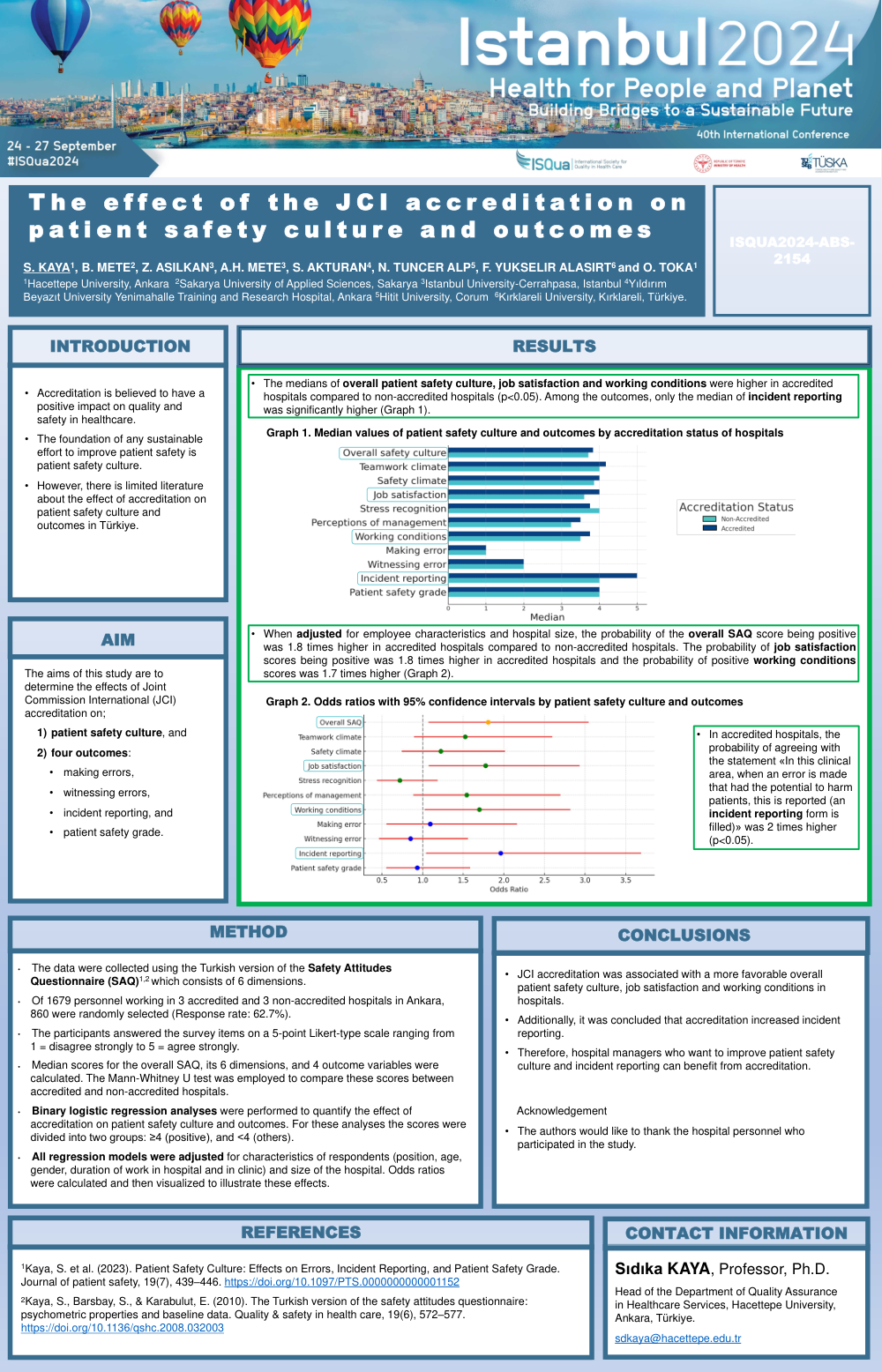
The medians of overall patient safety culture, job satisfaction and working conditions were higher in accredited hospitals compared to non-accredited hospitals (p<0.05). Among the outcomes, only the median of incident reporting was significantly higher. When adjusted for employee characteristics and hospital size, the probability of the overall SAQ score being positive was 1.8 times higher in accredited hospitals compared to non-accredited hospitals. The probability of job satisfaction scores being positive was 1.8 times higher in accredited hospitals and the probability of positive working conditions scores was 1.7 times higher. In accredited hospitals, the probability of agreeing with the statement «In this clinical area, when an error is made that had the potential to harm patients, this is reported (an incident reporting form is filled)» was 2 times higher (p<0.05).
CONCLUSIONS
JCI accreditation was associated with a more favorable overall patient safety culture, job satisfaction and working conditions in hospitals. Additionally, it was concluded that accreditation increased incident reporting. Therefore, hospital managers who want to improve patient safety culture and incident reporting can benefit from accreditation.
Acknowledgement
The authors would like to thank the hospital personnel who participated in the study.
REFERENCES
1Kaya, S. et al. (2023). Patient Safety Culture: Effects on Errors, Incident Reporting, and Patient Safety Grade. Journal of patient safety, 19(7), 439–446. https://doi.org/10.1097/PTS.0000000000001152
2Kaya, S., Barsbay, S., & Karabulut, E. (2010). The Turkish version of the safety attitudes questionnaire: psychometric properties and baseline data. Quality & safety in health care, 19(6), 572–577. https://doi.org/10.1136/qshc.2008.032003
CONTACT INFORMATION
Sıdıka KAYA, Professor, Ph.D.
Head of the Department of Quality Assurance in Healthcare Services, Faculty of Economics and Administrative Sciences, Hacettepe University, Ankara, Türkiye.