586 posters, 8 topics, 23 sessions, 1,077 authors, 622 institutions
ePostersLive by SciGen Technologies S.A. All rights reserved.
ISQua's 40th International Conference 2024
24th - 27th September 2024 | Istanbul, Türkiye

P101
Quality assessment of early diagnosis and treatment of dementia in Korea
Poster Presenter
Part of Topic
Patient Safety & Quality Improvement
Quality assessment of early diagnosis and treatment of dementia in Korea
[Introduction]
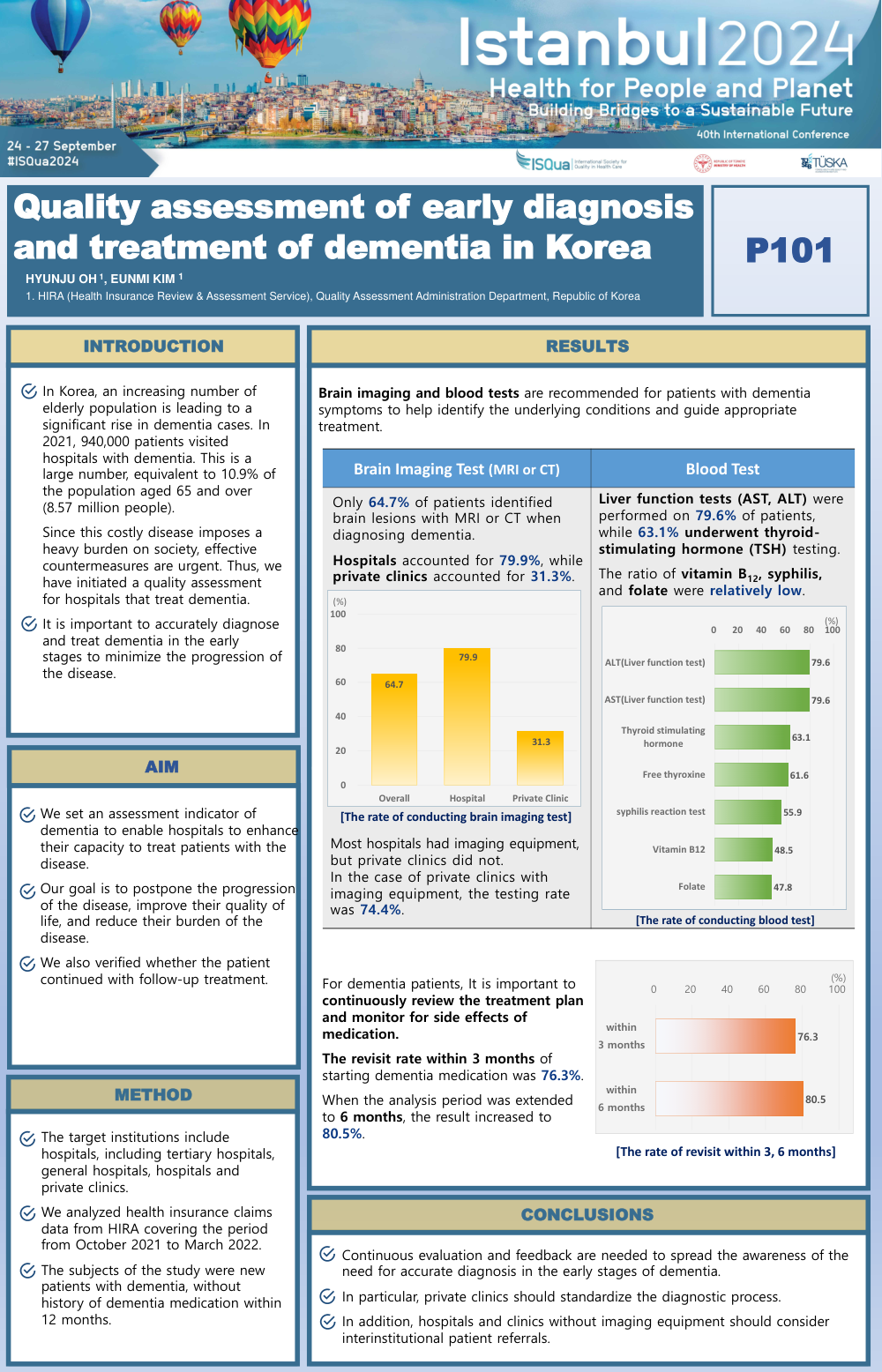
In Korea, an increasing number of elderly population is leading to a significant rise in dementia cases. In 2021, 940,000 patients visited hospitals with dementia. This is a large number, equivalent to 10.9% of the population aged 65 and over (8.57 million people).
Since this costly disease imposes a heavy burden on society, effective countermeasures are urgent. Thus, we have initiated a quality assessment for hospitals that treat dementia.
It is important to accurately diagnose and treat dementia in the early stages to minimize the progression of the disease.
[AIM]
We set an assessment indicator of dementia to enable hospitals to enhance their capacity to treat patients with the disease.
Our goal is to postpone the progression of the disease, improve their quality of life, and reduce their burden of the disease.
We also verified whether the patient continued with follow-up treatment.
[METHOD]
The target institutions include hospitals, including tertiary hospitals, general hospitals, hospitals and private clinics.
We analyzed health insurance claims data from HIRA covering the period from October 2021 to March 2022.
The subjects of the study were new patients with dementia, without history of dementia medication within 12 months.
[RESULT]
Brain imaging and blood tests are recommended for patients with dementia symptoms to help identify the underlying conditions and guide appropriate treatment.
Only 64.7% of patients identified brain lesions with MRI or CT when diagnosing dementia.
Hospitals accounted for 79.9%, while private clinics accounted for 31.3%.
Most hospitals had imaging equipment, but private clinics did not.
In the case of private clinics with imaging equipment, the testing rate was 74.4%.
Liver function tests (AST, ALT) were performed on 79.6% of patients, while 63.1% underwent thyroid-stimulating hormone (TSH) testing.
The ratio of vitamin B12, syphilis, and folate were relatively low.
For dementia patients, It is important to continuously review the treatment plan and monitor for side effects of medication.
The revisit rate within 3 months of starting dementia medication was 76.3%.
When the analysis period was extended to 6 months, the result increased to 80.5%.
[Conclusion]
Continuous evaluation and feedback are needed to spread the awareness of the need for accurate diagnosis in the early stages of dementia.
In particular, private clinics should standardize the diagnostic process.
In addition, hospitals and clinics without imaging equipment should consider interinstitutional patient referrals.