586 posters, 8 topics, 23 sessions, 1,077 authors, 622 institutions
ePostersLive by SciGen Technologies S.A. All rights reserved.
ISQua's 40th International Conference 2024
24th - 27th September 2024 | Istanbul, Türkiye

P272
Post Pandemic Antibiotics Resistance Mapping For Patient Safety at Central Java Hospitals
Poster Presenter
Part of Topic
Patient Safety & Quality Improvement
Post Pandemic Antibiotics Resistance Mapping For Patient Safety at Central Java Hospitals
Ridha Wahyutomo* 1, Rendy Priya Utama2 on behalf of Ridha Wahyutomo and Witjitra Darmana Samsuria, Andreas
Christian Widjaja, Tarcisius Henry, Kristi Noviana Aryadi
1Clinical Microbiology, Mardi Rahayu Hospital, Kudus, 2Pharmacy, Telogorejo hospital, Semarang, Indonesia
Introduction: The pandemic has had a widespread impact on various sectors of life, especially the health sector that
related to antibiotic use during pandemic. Uncertain therapeutic guidance triggers the use of antibiotics for COVID-19
patients who have the potential for resistance. Overall, the purpose of this study is to obtain an overview of the antibiotic
mapping in each hospital from January 2020 until December 2023. Antibiotic resistance mapping plays a role in the
preparation of therapeutic strategies, policies and prevention of infection transmission, particularly in tertiary hospitals.
Methods: This study is an observational descriptive study. The study samples were antibiotic resistance mapping at
some tertiary care hospitals, namely Mardi Rahayu hospital Kudus and Telogorejo hospital Semarang. The data
observed in the study from 1237 antibiotic sensitivity test’s results that are collected and analysed using WHO-Net.
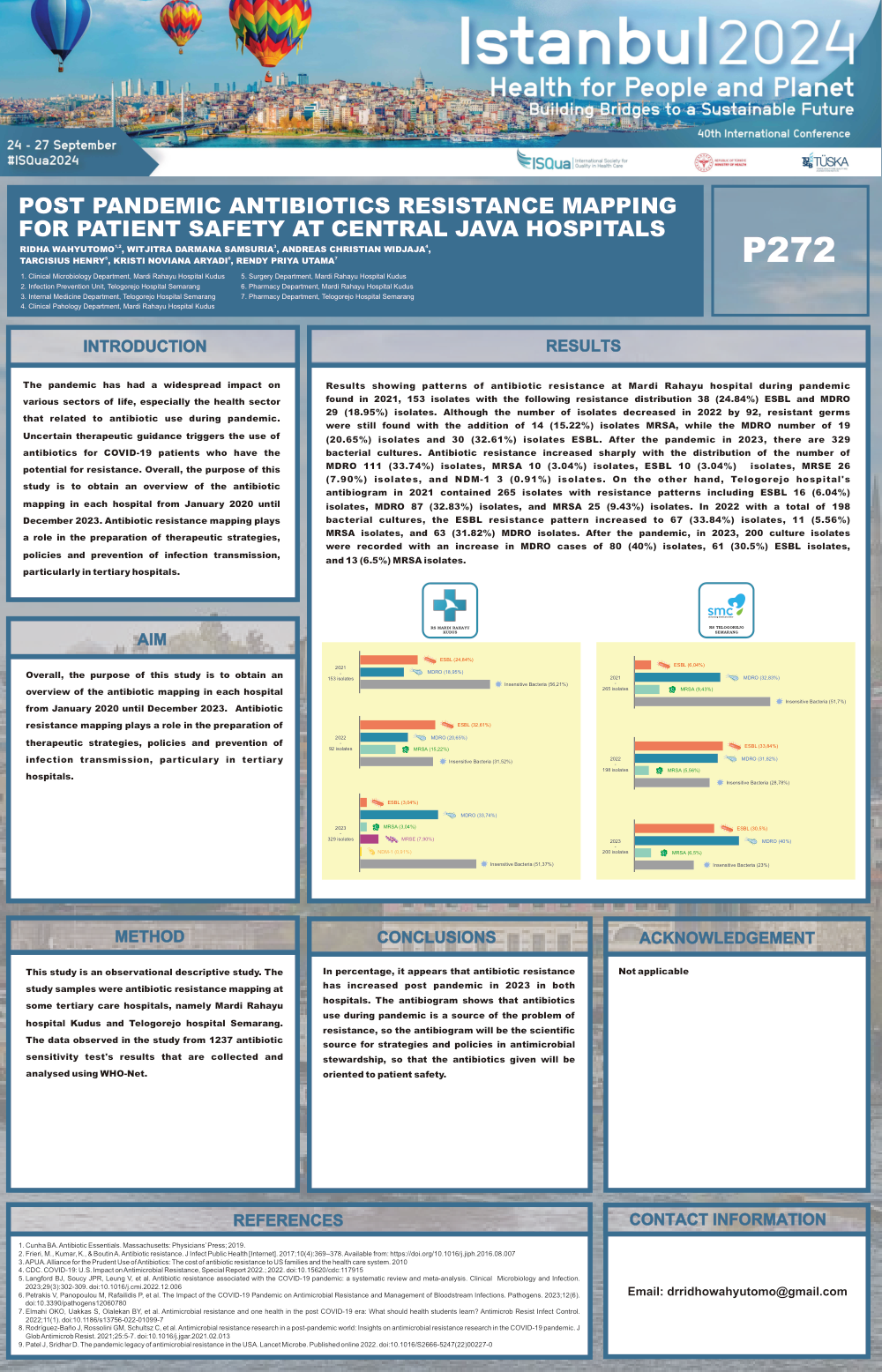
Results: Results showing patterns of antibiotic resistance at Mardi Rahayu hospital during pandemic found in 2021, 153
isolates with the following resistance distribution 38 (24.84%) ESBL and MDRO 29 (18.95%) isolates. Although the
number of isolates decreased in 2022 by 92, resistant germs were still found with the addition of 14 (15.22%) isolates
MRSA, while the MDRO number of 19 (20.65%) isolates and 30 (32.61%) isolates ESBL. After the pandemic in 2023,
there are 329 bacterial cultures. Antibiotic resistance increased sharply with the distribution of the number of MDRO 111
(33.74%) isolates, MRSA 10 (3.04%) isolates, ESBL 10 (3.04%) isolates, MRSE 26 (7.90%) isolates, and NDM-1 3
(0.91%) isolates. On the other hand, Telogorejo hospital’s antibiogram in 2021 contained 265 isolates with resistance
patterns including ESBL 16 (6.04%) isolates, MDRO 87 (32.83%) isolates, and MRSA 25 (9.43%) isolates. In 2022 with a
total of 198 bacterial cultures, the ESBL resistance pattern increased to 67 (33.84%) isolates, 11 (5.56%) MRSA isolates,
and 63 (31.82%) MDRO isolates. After the pandemic, in 2023, 200 culture isolates were recorded with an increase in
MDRO cases of 80 (40%) isolates, 61 (30.5%) ESBL isolates, and 13 (6.5%) MRSA isolates.
Conclusion: In percentage, the antibiogram shows that antibiotics use during pandemic is a source of resistance
problem, so the antibiogram will be the scientific source for strategies and policies in antimicrobial stewardship, so that
the antibiotics given will be oriented to patient safety.
Keywords: Antibiotics, post pandemic, resistance mapping.
References:
1. Cunha BA. Antibiotic Essentials. Massachusetts: Physicians’ Press; 2019.
2. Frieri, M., Kumar, K., & Boutin A. Antibiotic resistance. J Infect Public Health [Internet]. 2017;10(4):369–378. Available from:https://doi.org/10.1016/j.jiph.2016.08.007
3. APUA. Alliance for the Prudent Use of Antibiotics: The cost of antibiotic resistance to US families and the health care system. 2010
4. CDC. COVID-19: U.S. Impact on Antimicrobial Resistance, Special Report 2022.; 2022. doi:10.15620/cdc:117915
5. Langford BJ, Soucy JPR, Leung V, et al. Antibiotic resistance associated with the COVID-19 pandemic: a systematic review and meta-analysis. Clinical Microbiology and Infection. 2023;29(3):302-309. doi:10.1016/j.cmi.2022.12.006
6. Petrakis V, Panopoulou M, Rafailidis P, et al. The Impact of the COVID-19 Pandemic on Antimicrobial Resistance and Management of Bloodstream Infections. Pathogens. 2023;12(6). doi:10.3390/pathogens12060780
7. Elmahi OKO, Uakkas S, Olalekan BY, et al. Antimicrobial resistance and one health in the post COVID-19 era: What should health students learn? Antimicrob Resist Infect Control. 2022;11(1). doi:10.1186/s13756-022-01099-7
8. Rodríguez-Baño J, Rossolini GM, Schultsz C, et al. Antimicrobial resistance research in a post-pandemic world: Insights on antimicrobial resistance research in the COVID-19 pandemic. J Glob Antimicrob Resist. 2021;25:5-7. doi:10.1016/j.jgar.2021.02.013
9. Patel J, Sridhar D. The pandemic legacy of antimicrobial resistance in the USA. Lancet Microbe. Published online
2022. doi:10.1016/S2666-5247(22)00227-0