586 posters, 8 topics, 23 sessions, 1,077 authors, 622 institutions
ePostersLive by SciGen Technologies S.A. All rights reserved.
ISQua's 40th International Conference 2024
24th - 27th September 2024 | Istanbul, Türkiye

P250
Using Context Specific Solutions to Strengthen Access to Emergency Obstetric Care in a Low Resource Setting.
Poster Presenter
Authors
Affiliations
Part of Topic
Patient Safety & Quality Improvement
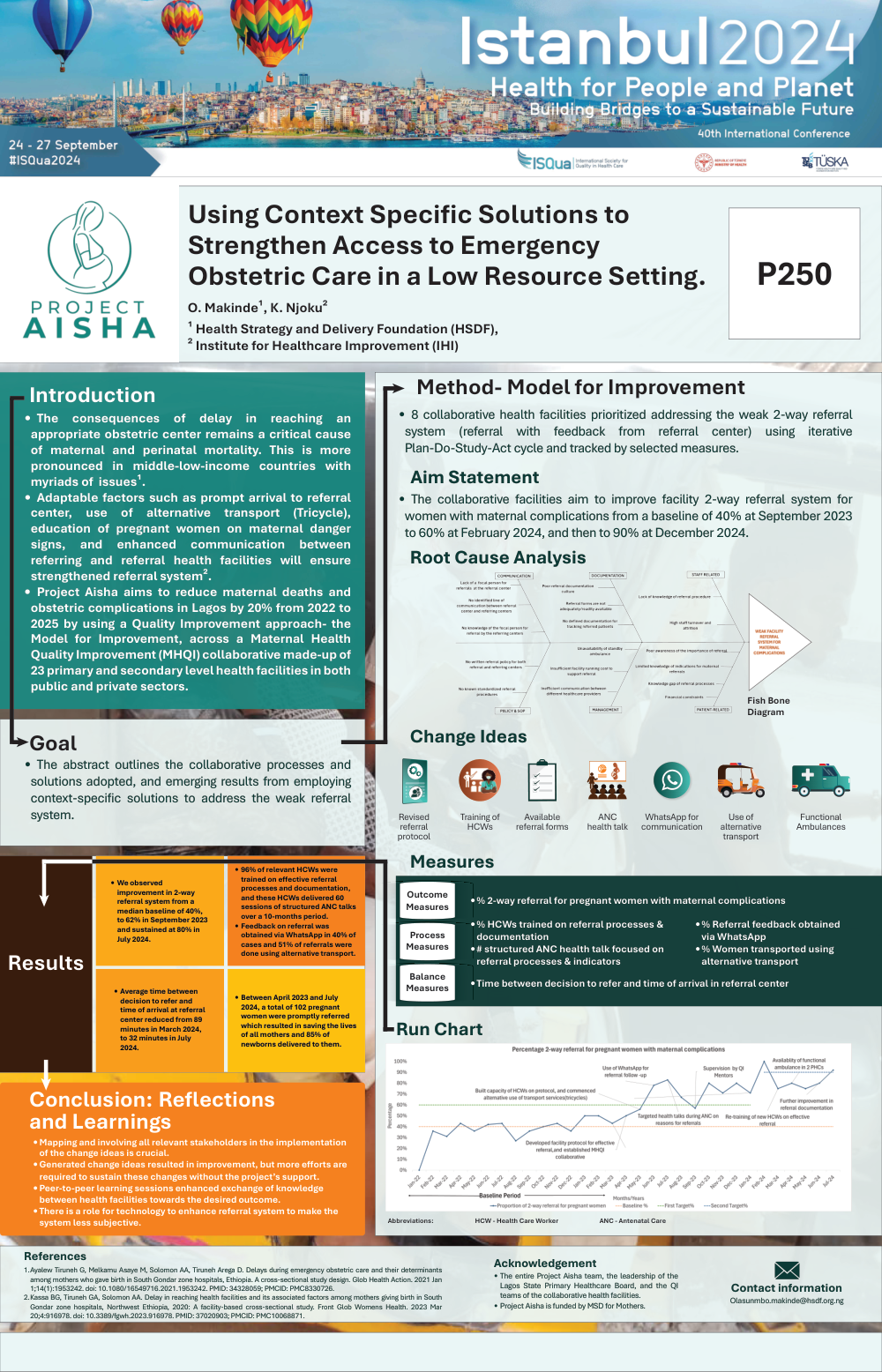
Using Context-Specific Solutions to Strengthen Access to Emergency Obstetric Care in a Low Resource Setting.
O. Makinde¹, K. Njoku²
¹ Health Strategy and Delivery Foundation (HSDF), ² Institute for Healthcare Improvement (IHI)
Introduction
- The consequences of delay in reaching an appropriate obstetric center remain a critical cause of maternal and perinatal mortality. This is more pronounced in middle-low-income countries with myriads of issues¹.
- Adaptable factors such as prompt arrival to the referral center, use of alternative transport, education of pregnant women on maternal danger signs, and enhanced communication between referring and referral health facilities will ensure a strengthened referral system².
- Project Aisha aims to reduce maternal deaths and obstetric complications in Lagos by 20% from 2022 to 2025 by using a Quality Improvement approach- the Model for Improvement, across a Maternal Health Quality Improvement (MHQI) collaborative made-up of 23 primary and secondary level health facilities in both public and private sectors.
Goal
- The abstract outlines the collaborative processes and solutions adopted, and emerging results from employing context-specific solutions to address the weak referral system.
Method- Model for Improvement
- 8 collaborative health facilities prioritized addressing the weak 2-way referral system (referral with feedback from referral center) using an iterative Plan-Do-Study-Act cycle and tracked by selected measures.
Aim Statement
- The collaborative facilities aim to improve facility 2-way referral system for women with maternal complications from a baseline of 40% at September 2023 to 60% at February 2024, and then to 90% at December 2024.
Change Ideas
- Revised referral protocol
- Training of HCWs
- Available referral forms
- ANC health talk
- WhatsApp for communication
- Use of alternative transport
- Functional Ambulances
Measures
|
Outcome Measures |
% 2-way referral for pregnant women with maternal complications |
|
Process Measures |
% HCWs trained on referral processes & documentation % Referral feedback obtained via WhatsApp # Structured ANC health talk focused on referral processes & indicators % Women transported using alternative transport |
|
Balance Measures |
Time between decision to refer and time of arrival in referral center |
Result Interpretation
- We observed improvement in 2-way referral system from a median baseline of 40%, to 62% in September 2023 and sustained at 80% in July 2024.
- 96% of relevant HCWs were trained on effective referral processes and documentation, and these HCWs delivered 60 sessions of structured ANC talks over a 10-months period. Feedback on referral was obtained via WhatsApp in 40% of cases and 51% of referred women were done using alternative transport.
- Average time between decision to refer and time of arrival at referral center reduced from 89 minutes in March 2024 to 32 minutes in July 2024.
- Between April 2023 and July 2024, a total of 102 pregnant women were promptly referred which resulted in saving the lives of all mothers and 85% of newborns delivered to them.
Conclusion: Reflections and Learnings
- Mapping and involving all relevant stakeholders in the implementation of the change ideas is crucial.
- Generated change ideas resulted in improvement, but more efforts are required to sustain these changes without the project’s support.
- Peer-to-peer learning sessions enhanced exchange of knowledge between health facilities towards the desired outcome.
- There is a role for technology to enhance the referral system to make the system less subjective.
References
- Ayalew Tiruneh G, Melkamu Asaye M, Solomon AA, Tiruneh Arega D. Delays during emergency obstetric care and their determinants among mothers who gave birth in South Gondar zone hospitals, Ethiopia. A cross-sectional study design. Glob Health Action. 2021 Jan 1;14(1):1953242. doi: 10.1080/16549716.2021.1953242. PMID: 34328059; PMCID: PMC8330726.
- Kassa BG, Tiruneh GA, Solomon AA. Delay in reaching health facilities and its associated factors among mothers giving birth in South Gondar zone hospitals, Northwest Ethiopia, 2020: A facility-based cross-sectional study. Front Glob Womens Health. 2023 Mar 20;4:916978. doi: 10.3389/fgwh.2023.916978. PMID: 37020903; PMCID: PMC10068871.
Acknowledgment
- The entire Project Aisha team, the leadership of the Lagos State Primary Healthcare Board, and the QI teams of the collaborative health facilities.
- Project Aishe is funded by MSD for Mothers.
Contact information