586 posters, 8 topics, 23 sessions, 1,077 authors, 622 institutions
ePostersLive by SciGen Technologies S.A. All rights reserved.
ISQua's 40th International Conference 2024
24th - 27th September 2024 | Istanbul, Türkiye

P055
A Comprehensive Solution for Better Patient Safety: TMUH Surgical Complication Classification Template and Automated Surgical Complication Dashboard
Poster Presenter
Part of Topic
Patient Safety & Quality Improvement
A Comprehensive Solution for Better Patient Safety: TMUH Surgical Complication Classification Template and
Automated Surgical Complication Dashboard
Introduction:
This research aims to establish a TMUH Surgical Complication Classification Template and an Automated Surgical Complication Dashboard that are suitable for our hospitals and can be referred to by clinical departments at any time. This will improve the completeness and consistency of surgical complication reporting and further enable the evaluation of the categorical distribution of inpatient surgical complications.
Methods:
1. The TMUH Surgical Complication Classification integrates the NSQIP post-operation occurrence classification and TMUH's 5-year complication classification, and is divided into 15 categories with a total of 56 items. It was established and tested by two medical quality consultant physicians, and suggestions were collected from clinicians of various disciplines through Walk Around. Starting in January 2022, it will be combined with the monthly report form of the cloud
clinical department for reporting surgical complications.
2. The Automated Surgical Complication Dashboard can perform cross-year analysis, department distribution tables, TMUH surgical complication classification distribution, and case details based on the daily real-time updates of the report form in the cloud. It can also screen the department and operation time for case discussion by clinical departments, improving the completeness and consistency of complication reporting, with the aim of enhancing the quality of surgery
and patient safety.
Results:
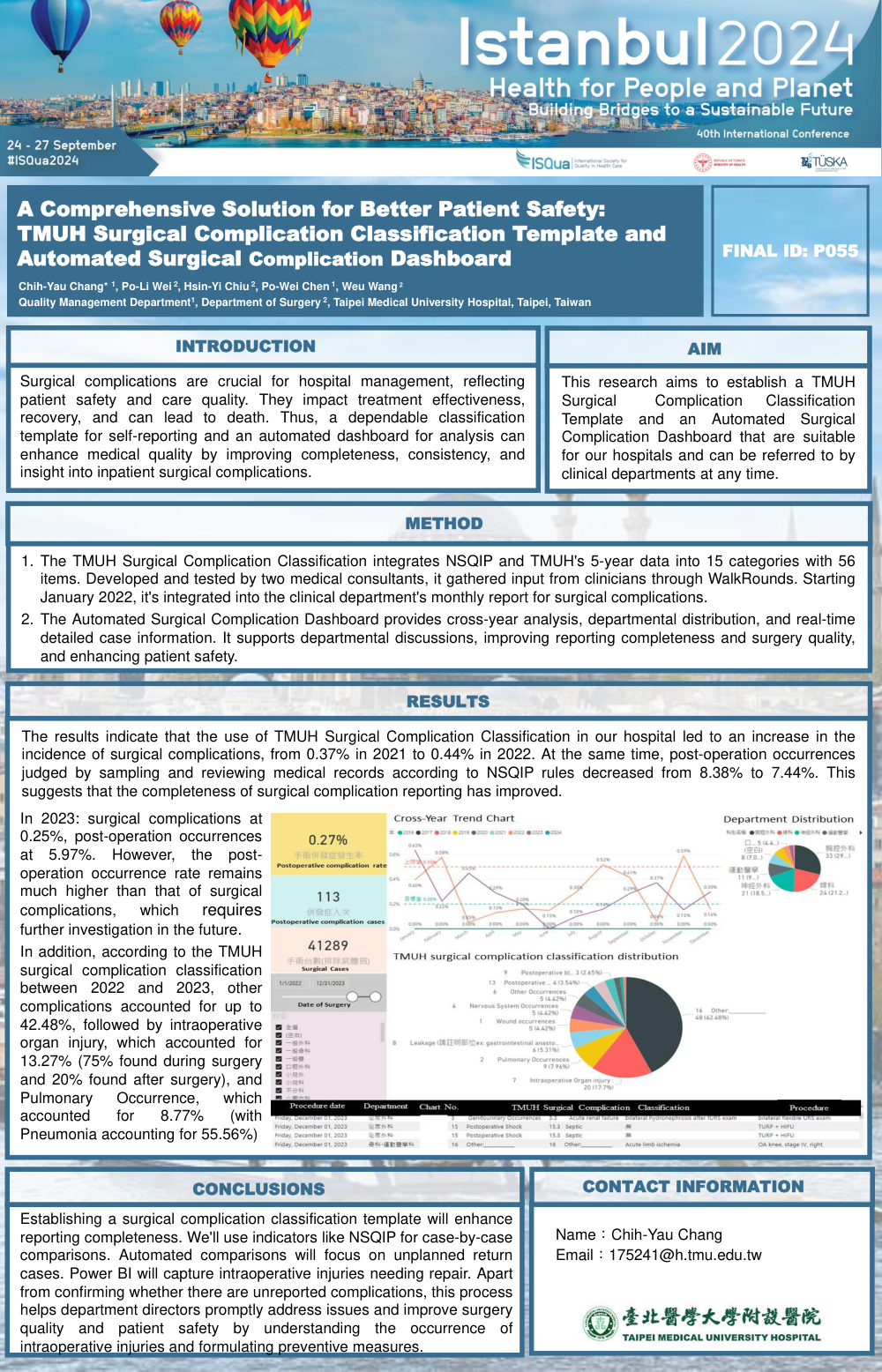
The results indicate that the use of TMUH Surgical Complication Classification in our hospital led to an increase in the incidence of surgical complications, from 0.37% in 2021 to 0.44% in 2022. At the same time, post-operation occurrences judged by sampling and reviewing medical records according to NSQIP rules decreased from 8.38% to 7.44%. This suggests that the completeness of surgical complication reporting has improved. In 2023: surgical complications at
0.25%, post-operation occurrences at 5.97%. However, the post-operation occurrence rate remains much higher than that of surgical complications, which requires further investigation in the future. In addition, according to the TMUH surgical complication classification between 2022 and 2023, other complications
accounted for up to 42.48%, followed by intraoperative organ injury, which accounted for 13.27% (75% found during surgery and 20% found after surgery), and Pulmonary Occurrence, which accounted for 8.77% (with Pneumonia accounting for 55.56%)
Conclusion:
Establishing a surgical complication classification template will help improve the completeness of reporting of surgical complications. Afterwards, we plan to use other indicators to verify whether the reporting of surgical complications is complete, such as the NSQIP post-operation occurrence implemented by our hospital for case-by-case comparison. Furthermore, automatic comparisons can be performed for specific categories of unplanned return cases of inpatient surgery. In addition, the study found that other complications and organ damage are common types of inpatient surgical complications. We can use Power Business Intelligence (BI) to automatically capture the cases of intraoperative injuries that need to be repaired based on the surgical records. Apart from confirming whether there are unreported complications, the department director can immediately understand the occurrence of intraoperative injuries in the department and formulate corresponding preventive measures to improve the quality of surgery and patient safety.