586 posters, 8 topics, 23 sessions, 1,077 authors, 622 institutions
ePostersLive by SciGen Technologies S.A. All rights reserved.
ISQua's 40th International Conference 2024
24th - 27th September 2024 | Istanbul, Türkiye

P508
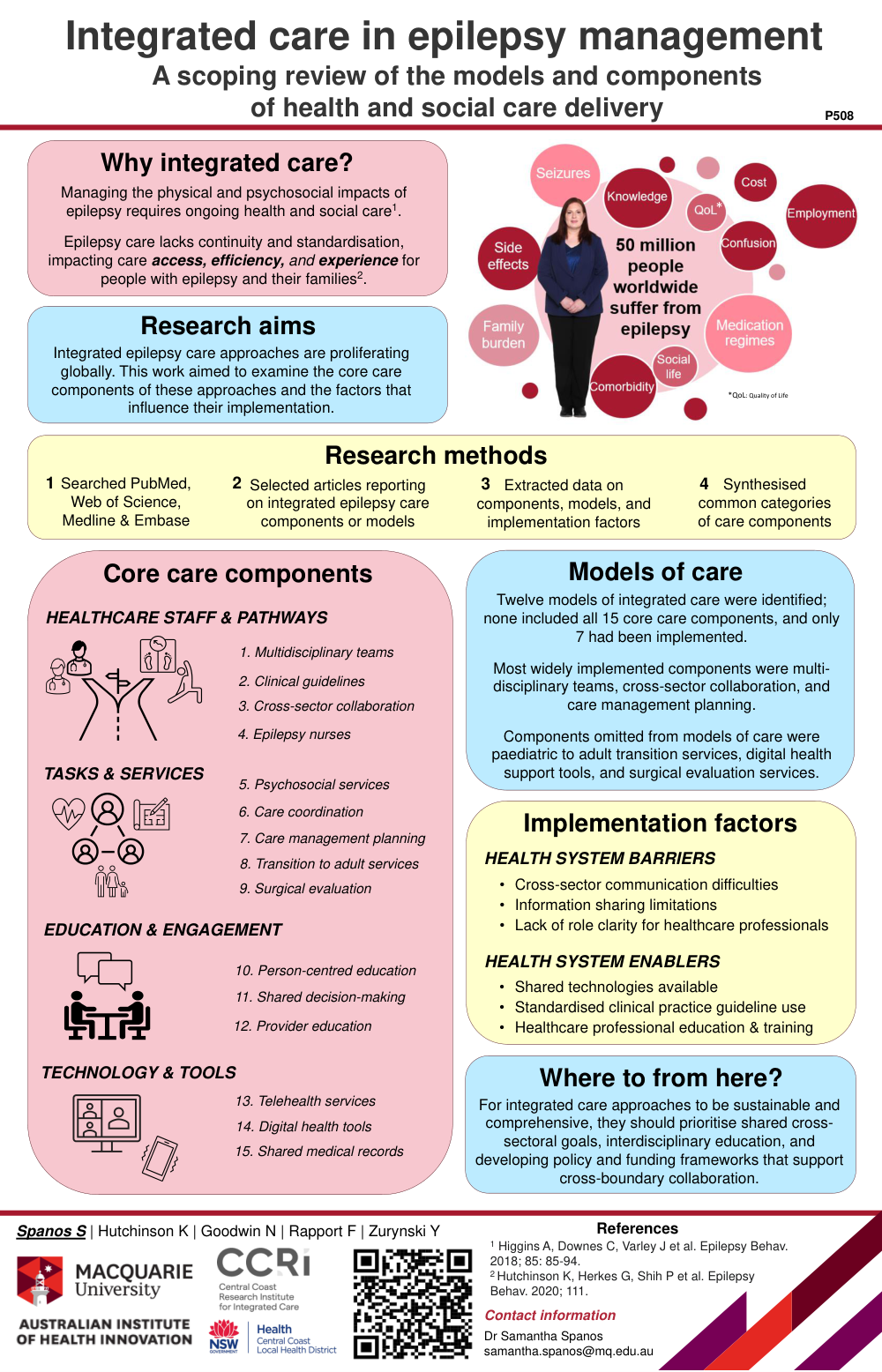
Integrated care in epilepsy management: A scoping review of the models and components of health and social care delivery
Poster Presenter
Authors
Samantha Spanos, Karen Hutchinson, Nicholas Goodwin, Frances Rapport, Yvonne Zurynski
Affiliations
Australian Institute of Health Innovation, 1. Australian Institute of Health Innovation, Macquarie University, Sydney, 1. Australian Institute of Health Innovation, Macquarie University, Sydney; 2. Central Coast Local Health District, 2. Central Coast Local Health District; 3. Central Coast Research Institute for Integrated Care, University of Newcastle, Gosford, 1. Australian Institute of Health Innovation, Macquarie University, Sydney; 4. NHMRC Partnership Centre for Health System Sustainability, Macquarie University, Sydney, Australia
Part of Topic
Integrated Care Communities
Integrated care in epilepsy management: A scoping review of the models and components of health and social care delivery
Why integrated care?
Managing the physical and psychosocial impacts of epilepsy requires ongoing health and social care1. Epilepsy care lacks continuity and standardisation, impacting care access, efficiency, and experience for people with epilepsy and their families2.
Research aims
Integrated epilepsy care approaches are proliferating globally. This work aimed to examine the core care components of these approaches and the factors that
influence their implementation.
Research methods
1. Searched PubMed, Web of Science, Medline & Embase
2. Selected articles reporting on integrated epilepsy care components or models
3. Extracted data on components, models, and implementation factors
4. Synthesised common categories of care components
Core care components
HEALTHCARE STAFF & PATHWAYS
1. Multidisciplinary teams
4. Epilepsy nurses
3. Cross-sector collaboration
2. Clinical guidelines
TASKS & SERVICES
5. Psychosocial services
7. Care management planning
8. Transition to adult services
9. Surgical evaluation
6. Care coordination
EDUCATION & ENGAGEMENT
10. Person-centred education
11. Shared decision-making
12. Provider education
TECHNOLOGY & TOOLS
13. Telehealth services
14. Digital health tools
15. Shared medical records
Models of care
- Twelve models of integrated care were identified;none included all 15 core care components, and only 7 had been implemented.
- Most widely implemented components were multidisciplinary teams, cross-sector collaboration, and care management planning.
- Components omitted from models of care were paediatric to adult transition services, digital health support tools, and surgical evaluation services.
Implementation factors
HEALTH SYSTEM BARRIERS
• Cross-sector communication difficulties
• Information sharing limitations
• Lack of role clarity for healthcare professionals
HEALTH SYSTEM ENABLERS
• Shared technologies available
• Standardised clinical practice guideline use
• Healthcare professional education & training
Where to from here?
For integrated care approaches to be sustainable and comprehensive, they should prioritise shared crosssectoral goals, interdisciplinary education, and
developing policy and funding frameworks that support cross-boundary collaboration.
Spanos S | Hutchinson K | Goodwin N | Rapport F | Zurynski Y
References
1 Higgins A, Downes C, Varley J et al. Epilepsy Behav.
2018; 85: 85-94.
2 Hutchinson K, Herkes G, Shih P et al. Epilepsy
Behav. 2020; 111.
Contact information
Dr Samantha Spanos
samantha.spanos@mq.edu.au