586 posters, 8 topics, 23 sessions, 1,077 authors, 622 institutions
ePostersLive by SciGen Technologies S.A. All rights reserved.
ISQua's 40th International Conference 2024
24th - 27th September 2024 | Istanbul, Türkiye

P014
Key progress regarding continuous quality improvement in antenatal care (ANC) services in urban slums of Bangladesh.
Poster Presenter
Authors
Anjuman Begum, A.T.M. Rezaul Karim, Farzana Islam, Nicole Carbone
Affiliations
Part of Topic
Patient Safety & Quality Improvement
Introduction
Across Bangladesh, the 2022 Demographic & Health Survey found that 88% of pregnant women attended at least one antenatal care (ANC) visit with a medically trained provider, and 21% of those received standard quality ANC services [1].
Among women attending at least one ANC visit, 81% and 80% received urine (albumin) and blood (hemoglobin) tests, respectively[1].
Aim
Healthy Women, Healthy Families (HWHF) Project Objective:
To improve access to quality maternal and newborn health and family planning services for young first-time parents in the urban slums of Tongi, Dhaka
Study Objective: To evaluate the quality of albumin and hemoglobin (Hb) testing for ANC services at the facility level
Partners: Management Sciences for Health (MSH), Bangladesh Rural Advancement Committee (BRAC) Maternity Centers, Population Council, SCOPE
The HWHF project utilizes the two-part “Model for Improvement” framework. First, participants define their intended achievement, contribute ideas that might make a difference, and define measures to understand if improvement occurred. Second, implement “Plan, Do, Study, Act” (PDSA) cycles to see if updated approach leads to the intended results.
Beginning in September 2022, service providers collected data on pregnant women receiving ANC services, including albumin and hemoglobin (Hb) testing. Data was managed using an online platform. Targets were agreed upon at the start of the project; data were collected by the service providers and the results were tracked at each facility. Work Improvement Team (WIT) met weekly to review the PDSA cycle.
Results
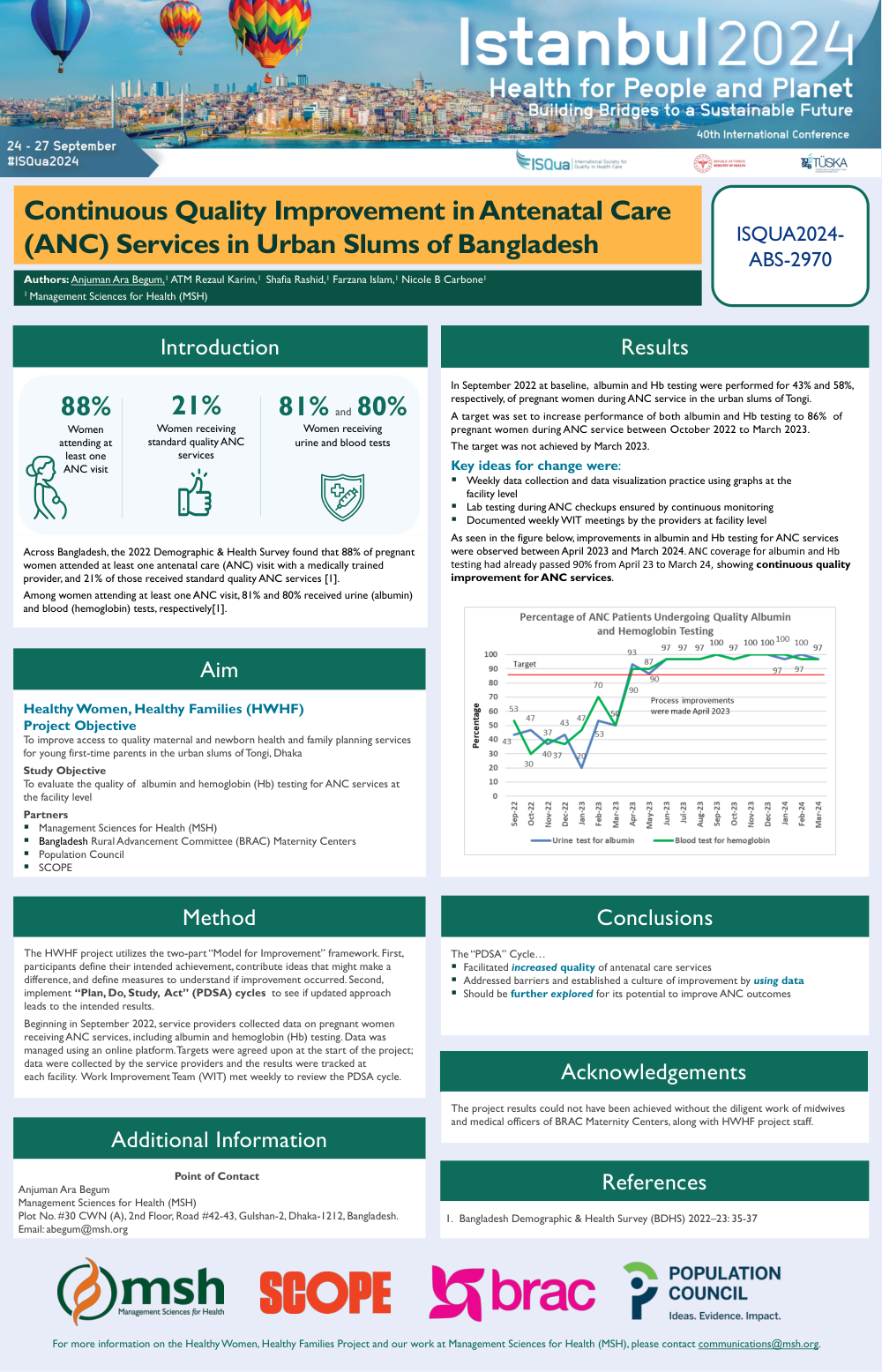
In September 2022 at baseline, albumin and Hb testing were performed for 43% and 58%, respectively, of pregnant women during ANC service in the urban slums of Tongi. A target was set to increase performance of both albumin and Hb testing to 86% of pregnant women during ANC service between October 2022 to March 2023. The target was not achieved by March 2023.
Key ideas for change were:
facility level
As seen in the figure below, improvements in albumin and Hb testing for ANC services were observed between April 2023 and March 2024. ANC coverage for albumin and Hb testing had already passed 90% from April 23 to March 24, showing continuous quality improvement for ANC services.
Conclusions
The “PDSA” Cycle…
The project results could not have been achieved without the diligent work of midwives and medical officers of BRAC Maternity Centers, along with HWHF project staff.
Additional Information
Anjuman Ara Begum
Management Sciences for Health (MSH)
Plot No. #30 CWN (A), 2nd Floor, Road #42-43, Gulshan-2, Dhaka-1212, Bangladesh.
Email: abegum@msh.org
References