586 posters, 8 topics, 23 sessions, 1,077 authors, 622 institutions
ePostersLive by SciGen Technologies S.A. All rights reserved.
ISQua's 40th International Conference 2024
24th - 27th September 2024 | Istanbul, Türkiye

ISQUA2024-ABS-2126
Implementation of patient blood management program in transfusion practice of orthotopic liver transplantation
Poster Presenter
Authors
Affiliations
Tri-Service General Hospital, National Defense Medical Center
Part of Topic
Patient Safety & Quality Improvement
Implementation of patient blood management program in transfusion practice of orthotopic liver transplantation
Chueng-He Lu1, Teng-Wei Chen2
1 Department of Anesthesiology, 2 Division of General Surgery, Tri-Service General Hospital, Taipei, Taiwan
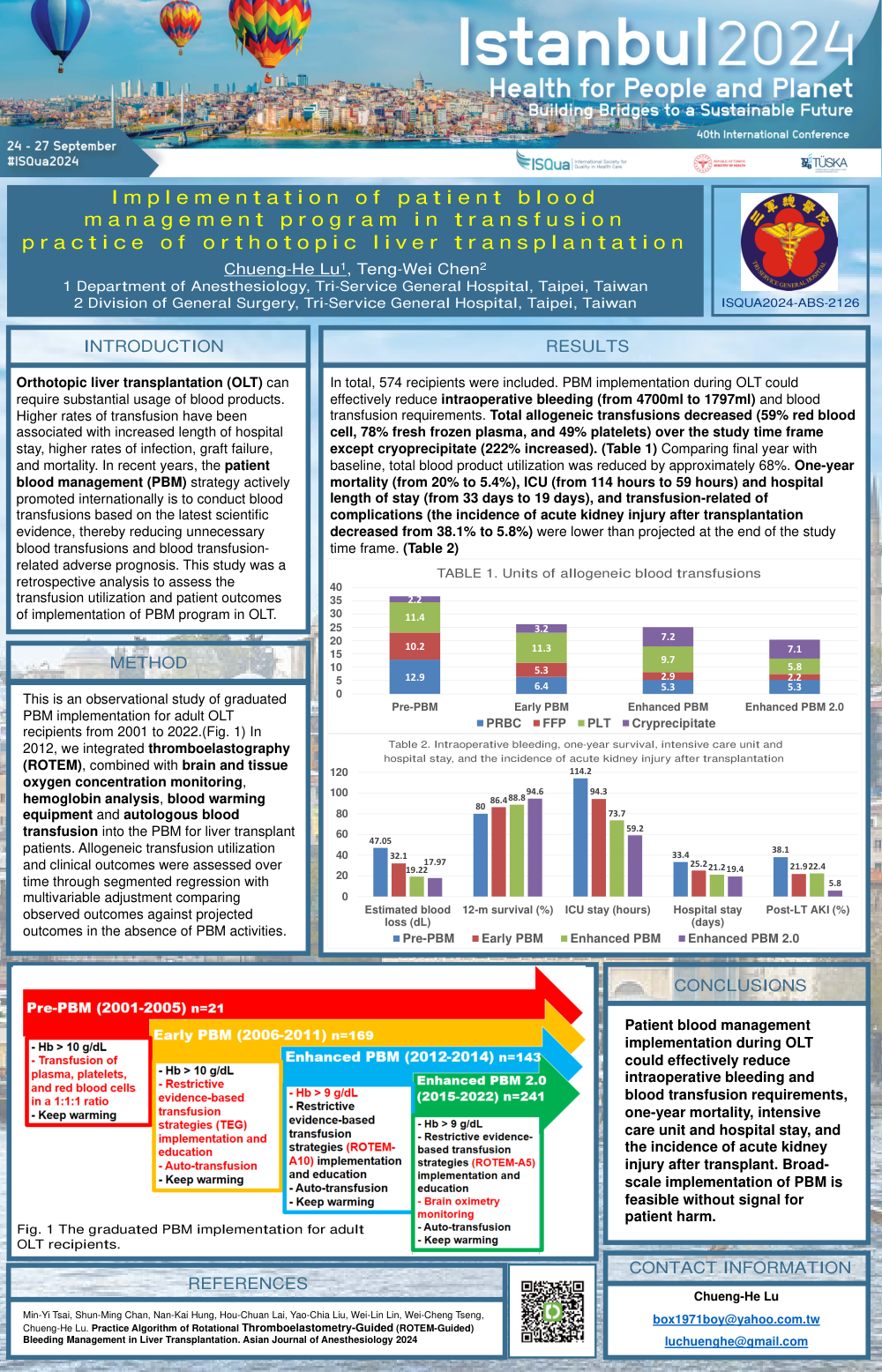
Introduction: Orthotopicliver transplantation (OLT) can require substantial usage of blood products. Higher rates of transfusion have been associated with increased length of hospital stay, higher rates of infection, graft failure, and mortality. In recent years, the patient blood management (PBM) strategy actively promoted internationally is to conduct blood transfusions based on the latest scientific evidence, thereby reducing unnecessary blood transfusions and blood transfusion-related adverse prognosis. This study was a retrospective analysis to assess the transfusion utilization and patient outcomes of implementation of PBM program in OLT.
Methods: This is an observational study of graduated PBM implementation for adult OLT recipients from 2001 to 2022.(Fig. 1) In 2012, we integrated thromboelastography (ROTEM), combined with brain and tissue oxygen concentration monitoring, hemoglobin analysis, blood warming equipment and autologous blood transfusion into the PBM for liver transplant patients. Allogeneic transfusion utilization and clinical outcomes were assessed over time through segmented regression with multivariable adjustment comparing observed outcomes against projected outcomes in the absence of PBM activities.
Results: In total, 574 recipients were included. PBM implementation during OLT could effectively reduce intraoperative bleeding (from 4700ml to 1797ml) and blood transfusion requirements. Total allogeneic transfusions decreased (59% red blood cell, 78% fresh frozen plasma, and 49% platelets) over the study time frame except cryoprecipitate (222% increased). Comparing final year with baseline, total blood product utilization was reduced by approximately 68%. One-year mortality (from 20% to 5.4%), ICU (from 114 hours to 59 hours) and hospital length of stay (from 33 days to 19 days), and transfusion-related of complications (the incidence of acute kidney injury after transplantation decreased from 38.1% to 5.8%) were lower than projected at the end of the study time frame.
Conclusion: Patient blood management implementation during OLT could effectively reduce intraoperative bleeding and blood transfusion requirements, one-year mortality, intensive care unit and hospital stay, and the incidence of acute kidney injury after transplant. Broad-scale implementation of PBM is feasible without signal for patient harm.
Keywords: Orthotopic liver transplantion, Patient blood management, Transfusion