586 posters, 8 topics, 23 sessions, 1,077 authors, 622 institutions
ePostersLive by SciGen Technologies S.A. All rights reserved.
ISQua's 40th International Conference 2024
24th - 27th September 2024 | Istanbul, Türkiye

P275
Identifying predictive features for staff and patient safety using routinely collected data. A secondary analysis of the NuRS Study
Poster Presenter
Authors
Affiliations
Part of Topic
Patient Safety & Quality Improvement
Introduction
Quality care is safe care1. When patients are admitted to hospital the aim is to deliver care which “first does no harm” but as medical interventions become more complex and resources are stretched, patient safety can be compromised2.
Since the publication of ‘To Err Is Human’3; the British NHS have strived to treat safety incidents not as acute incidents arising from individuals but as a sign of a wider systemic failing. If we wish to deliver safe care – we must strive to deliver a system which is built to learn and grow to respond to the very real risks of a changing system.
Aim
This study aimed to utilize routinely collected operational data from three NHS Trusts (two Acute and one Mental Health) to identify patterns indicative of harmful adverse event reporting. Via the combination and analysis of staffing levels, methods of staffing fulfilment, and demand the worked aimed to identify scenarios in which a Ward was most likely to experience harmful incidents.
Method
Routinely collected data sets were exported from three NHS Trusts (two Acute and one Mental Health) comprising their staffing levels, use of ‘substantive’ vs ‘bank’ vs ‘agency’ staff, admissions/ discharges and adverse event reporting. These disparate data sets were aligned by Ward/ Day and aggregated to the Ward-Month level before analysing the level of ‘Harmful’ incidents reported where the incident impacted a) Staff and b) Patients.
The data set constructed was first analysed via count statistic models, initially using a binary decision tree to learn hypothetical step changes for each variable followed by Lasso poisson regression (10-fold cross validation), including the learned steps as features. The model space included a shared effect term for each Trust and Trust specific corrections for each parameter.
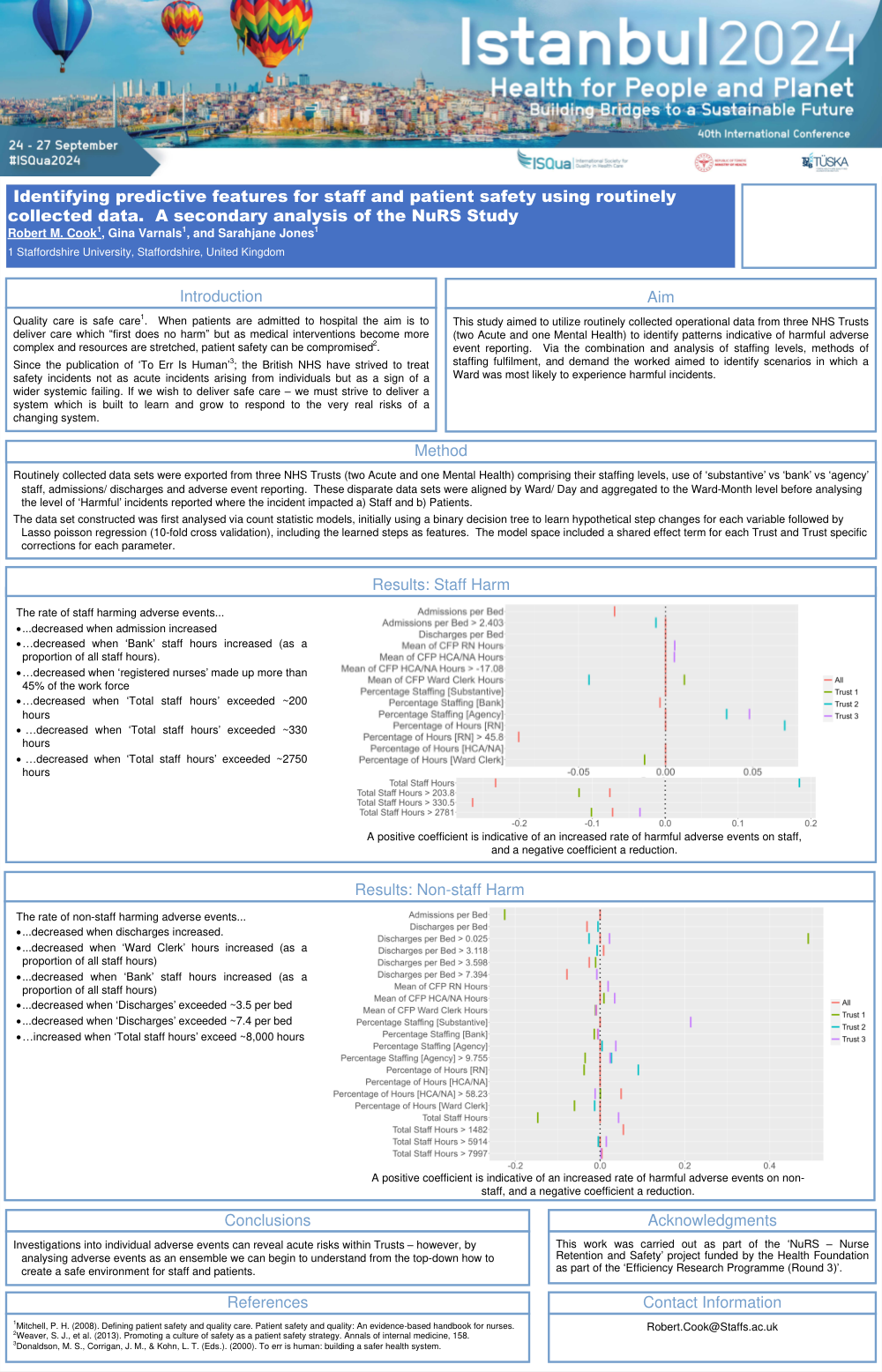
Results: Staff Harm
The rate of staff harming adverse events...
- ...decreased when admission increased
- …decreased when ‘Bank’ staff hours increased (as a proportion of all staff hours).
- …decreased when ‘registered nurses’ made up more than 45% of the work force
- …decreased when ‘Total staff hours’ exceeded ~200 hours
- …decreased when ‘Total staff hours’ exceeded ~330 hours
- …decreased when ‘Total staff hours’ exceeded ~2750 hours
Results: Non-staff Harm
The rate of non-staff harming adverse events...
- ...decreased when discharges increased.
- ...decreased when ‘Ward Clerk’ hours increased (as a proportion of all staff hours)
- ...decreased when ‘Bank’ staff hours increased (as a proportion of all staff hours)
- ...decreased when ‘Discharges’ exceeded ~3.5 per bed
- ...decreased when ‘Discharges’ exceeded ~7.4 per bed
- …increased when ‘Total staff hours’ exceed ~8,000 hours
Conclusions
Investigations into individual adverse events can reveal acute risks within Trusts – however, by analysing adverse events as an ensemble we can begin to understand from the top-down how to create a safe environment for staff and patients.
Acknowledgments
This work was carried out as part of the ‘NuRS – Nurse Retention and Safety’ project funded by the Health Foundation as part of the ‘Efficiency Research Programme (Round 3)’.
References
1Mitchell, P. H. (2008). Defining patient safety and quality care. Patient safety and quality: An evidence-based handbook for nurses.
2Weaver, S. J., et al. (2013). Promoting a culture of safety as a patient safety strategy. Annals of internal medicine, 158.
3Donaldson, M. S., Corrigan, J. M., & Kohn, L. T. (Eds.). (2000). To err is human: building a safer health system.