586 posters, 8 topics, 23 sessions, 1,077 authors, 622 institutions
ePostersLive by SciGen Technologies S.A. All rights reserved.
ISQua's 40th International Conference 2024
24th - 27th September 2024 | Istanbul, Türkiye

P097
Learning from Incidents : An Insight into the Experience and Wellbeing of Healthcare staff involved in Patient Safety Incidents
Poster Presenter
Part of Topic
Patient Safety & Quality Improvement
Learning From Incidents: An Insight into the Experience and Wellbeing of Healthcare Staff Involved in Patient Safety Incidents
Erika Carroll 1, Adele Grazi 1 & Samuel Cromie 1
1 Centre for Innovative Human Systems, Trinity College Dublin, Ireland
Introduction
With over 480,000 patient safety incidents reported within the Irish National Incident Management System since 20181, it is predicted that every clinician will be involved in an incident at some point of their career2. Research proposes three pathways for clinicians following their involvement in an incident; Survive, Thrive or Drop-Out3. Approximately one third of staff involved in a patient safety incident meet the definition of a Second Victim4 due to the significant negative personal and professional implications they experience in the incident aftermath5. Factors that may affect coping and Second Victim likelihood include experience with the incident review process, gender, age, experience and role.
Aims
An explanatory sequential mixed-methods design was employed, conducted in two phases.126 participants who have previously been involved in a patient safety incident (56 Anaesthesiologists and 70 General Healthcare staff) completed an online survey containing the validated Second Victim Experience and Support Questionnaire (SVEST)7. 14 semi-structured interviews were conducted to extract more meaning from the quantitative data, identifying 4 key themes and 14 subthemes.
Quantitative Results
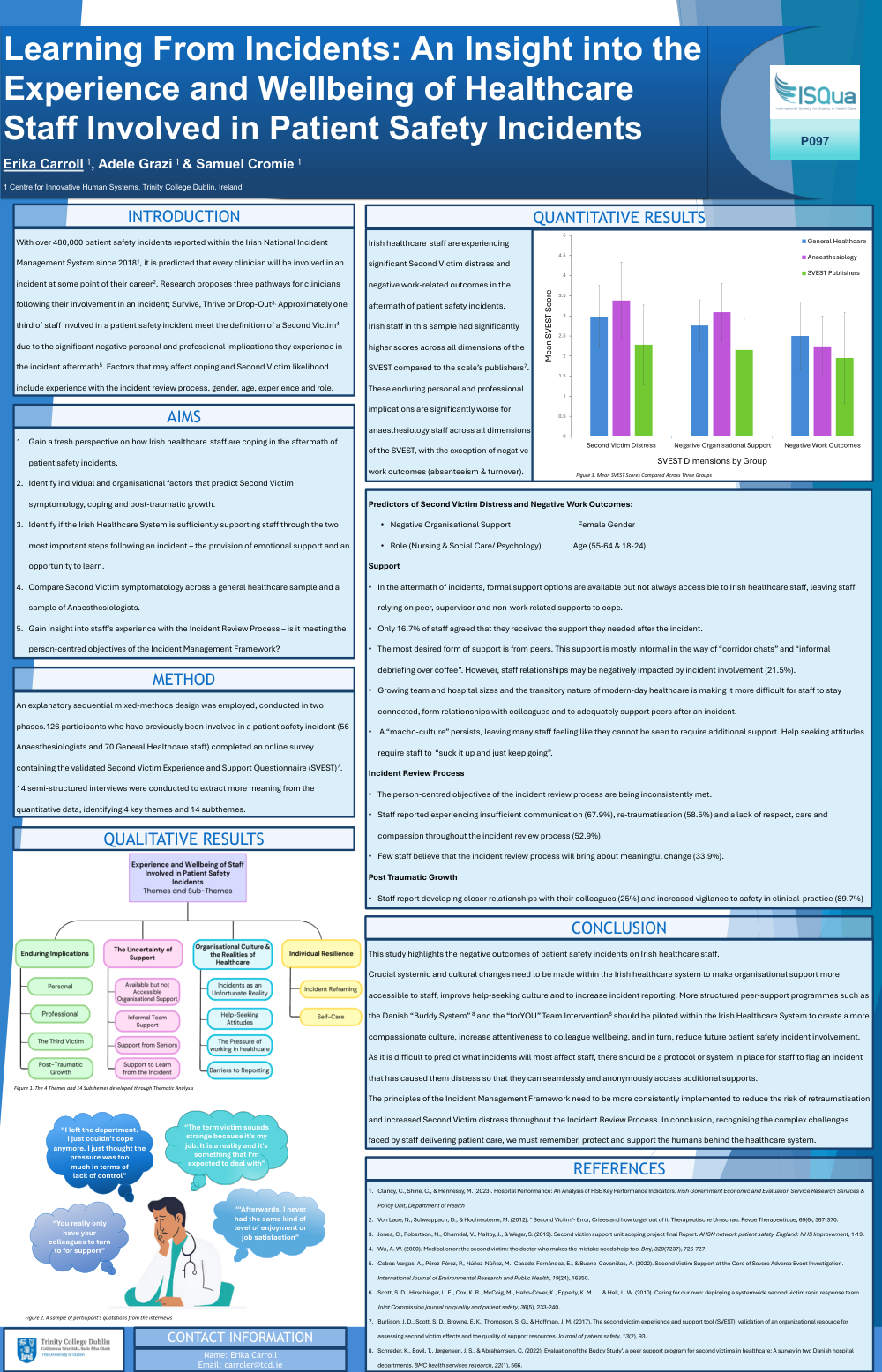
Irish healthcare-staff are experiencing significant Second Victim distress and negative work-related outcomes in the aftermath of patient safety incidents. Irish staff in this sample had significantly higher scores across all dimensions of the SVEST compared to the scale’s publishers7. These enduring personal and professional implications are significantly worse for anaesthesiology staff across all dimensions of the SVEST, with the exception of negative work outcomes (absenteeism & turnover).
Predictors of Second Victim Distress and Negative Work Outcomes:
Support
Incident Review Process
Post Traumatic Growth
This study highlights the negative outcomes of patient safety incidents on Irish healthcare staff.
Crucial systemic and cultural changes need to be made within the Irish healthcare system to make organisational support more accessible to staff, improve help-seeking culture and to increase incident reporting. More structured peer-support programmes such as the Danish “Buddy System” 8 and the “forYOU” Team Intervention6 should be piloted within the Irish Healthcare System to create a more compassionate culture, increase attentiveness to colleague wellbeing, and in turn, reduce future patient safety incident involvement.
As it is difficult to predict what incidents will most affect staff, there should be a protocol or system in place for staff to flag an incident that has caused them distress so that they can seamlessly and anonymously access additional supports.
The principles of the Incident Management Framework need to be more consistently implemented to reduce the risk of retraumatisation and increased Second Victim distress throughout the Incident Review Process. In conclusion, recognising the complex challenges faced by staff delivering patient care, we must remember, protect and support the humans behind the healthcare system.
References